

Patent Secured For Data Centers Built To Operate In Orbit
Caltech Deepens Research Pact With Startup as 2027 In-Space Demonstration Remains the Target

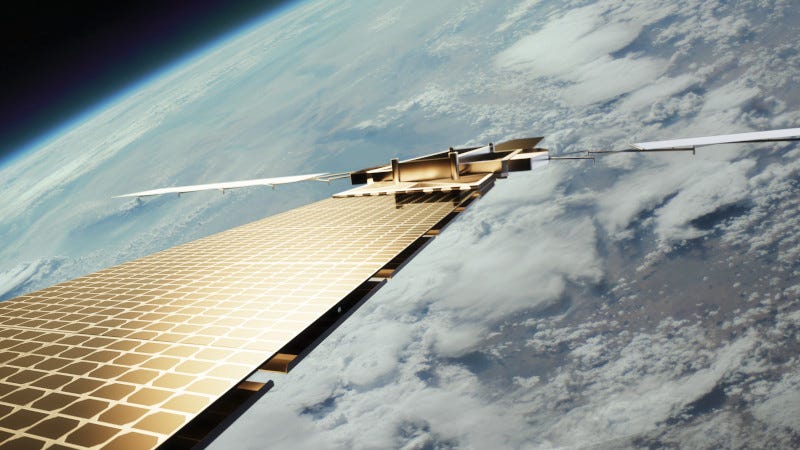
The U.S. Patent and Trademark Office has issued a patent covering the design of computer data centers built to run in Earth orbit, jointly owned by Sophia Space Inc. and the California Institute of Technology.
“The only way to cool the data center in space is by radiating waste heat into deep space.”
Dr. Leon Alkalai, Sophia Space
Sophia Space, a Pasadena, California-based orbital computing company backed by Mandala Space Ventures, announced the patent’s issuance Wednesday. Patent No. 12,679,564, titled “Space-Based Data Centers,” was filed in October 2024 and issued July 14, 2026, according to the company.
The invention traces to internal research and development work inside NASA’s Jet Propulsion Laboratory, which Caltech manages. That work, the company said, was aimed at high-risk, high-reward concepts outside JPL’s active mission portfolio. Seven inventors are named on the patent, drawing from JPL, Caltech and Sophia Space: Dr. John R. Brophy, Dr. Leon Alkalai, Prof. Sergio Pellegrino, Dr. Jonathan Sauder, Timothy P. McElrath, Dr. Douglas J. Sheldon and Don J. Hunter.
The architecture draws power from sunlight to run onboard computers and data storage built for the space environment, then sheds waste heat by radiating it into deep space rather than relying on a mechanical cooling system.
Dr. Alkalai, a former JPL Fellow who founded Sophia Space in June 2023 to commercialize the invention, said the design required rethinking how a data center handles heat. “Cooling in space is not simple,” he said. “The only way to cool the data center in space is by radiating waste heat into deep space.” He said the resulting design, called TILE — Thermal Integrated LEO Edge — is a modular, passively cooled compute and storage unit meant to be assembled into a larger orbital data center that stays continuously powered by the sun.
Alkalai said the work builds on Caltech’s Space Solar Power Project, which was funded by a donation from the Donald and Brigitte Bren Foundation starting in 2013 and which demonstrated wireless transmission of power from space to Earth in 2023 for the first time, according to Caltech. “Instead of beaming down energy to Earth from orbit, we decided to consider putting computing in space and beam down data,” Alkalai said.
Dr. Brophy, a JPL researcher and one of the patent’s named inventors, framed the patent as a case study in moving federally funded research into commercial use. “This is an illustration of how JPL, Caltech and private industry can work together to rapidly develop solutions to difficult technical problems for the benefit of the nation,” he said.
Alongside the patent, Sophia Space said it has signed a new sponsored research agreement with Caltech under which Pellegrino’s team will develop lightweight, large-scale deployable structures and thermal management techniques for future Sophia Space orbital data centers.
Sophia Space has raised $22 million in total funding, according to the company, and is targeting a 2027 in-space demonstration of its TILE technology aboard an Apex Nova satellite bus.