

Part 100 Rule Approved by FCC
Creates a “Licensing Assembly Line” for Satellite Approvals

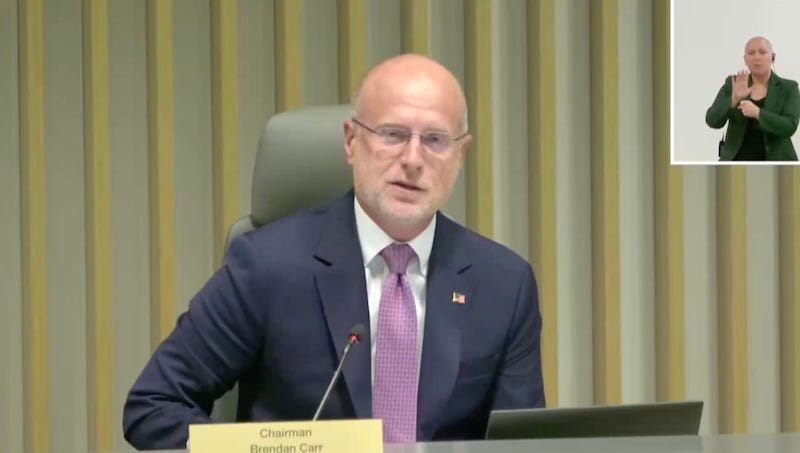
The Federal Communications Commission approved a new Part 100 to unify satellite spectrum sharing rules and move away from case‑by‑case coordination under Part 25 at their July monthly meeting on Wednesday.
“We’re scrapping our old rules in their entirety and replacing them with better new ones. This kind of ambition shouldn’t be taken for granted.”
Brendan Carr, FCC
In International Bureau Docket 25‑306, the agency outlines a power spectral flux density formula that would cap how much signal any non‑geostationary system can direct toward Earth or the geostationary arc in shared bands.
The change is meant to scale a framework that was built for a handful of constellations into one that will accomodate dozens of broadband, direct‑to‑device, and servicing systems all competing for Ku‑, Ka‑, and V‑band access.
During the commission’s July monthly meeting, FCC Space Bureau Acting Associate Division Chief of the Satellite Programs and Policy Division Brandon Padgett, outlined the provisions of the new Part 100.
“This report in order would replace Part 25 of the Commission’s rules with Part 100. In doing so, it would delete unnecessary and outdated rules and organize the new rules in a manner that’s easier to understand. Additionally, it would create an application processing framework based on bright-line criteria presumed to be in the public interest, modify processing round procedures, and remove bond requirement for certain space stations,” Padgett said. “It would also create a new variable trajectory space station license category, extend license terms for most space and earth stations to 20 years, allow for a nationwide blanket licensing approach for earth stations, and require space station operators to share space situational awareness data. In addition, the item includes a further notice of proposed rulemaking that would seek comment on additional proposals and reforms intended to build upon the new Part 100.”
There was no objection to the change on the three-member commission. Prior to the vote, Chairman Brendan Carr said the commission was making an unprecedented move.
“We’re scrapping our old rules in their entirety and replacing them with better new ones. This kind of ambition shouldn’t be taken for granted. Regulators tend to tinker around the edges. They don’t throw away the rule book and rewrite it from scratch. They take years and decades to reform, not 18 months. The Space Bureau landed the rare trifecta on that, all while pushing through other game-changing reforms on spectrum sharing and spectrum abundance. There’s so much to like in the new Part 100 rules for one speed and predictability is built into the DNA,” Carr said. “The new rules establish bright lines and eliminate fuzzy standards. They keep licensing focused on the FCC’s core statutory responsibilities, spectrum management, harmful interference, national security, and orbital debris. They eliminate guessing games and hidden requirements. While most applications will breeze through a fast lane, the new rules outline the limited situations when more targeted review is needed. And if an application falls within the four corners of our new Part 100, it’s presumed to serve the public interest. That’s just not making promises. The rules say this with clarity.” 9:57
Newer entrants generally see a clear formula as a way to prevent incumbents from stretching out negotiations, while established non‑geostationary and geostationary operators worry about retroactive constraints and aggregate interference.
Part 100 would also create a separate lane for in‑space servicing, assembly, and manufacturing missions with added debris‑mitigation bonding, so proximity‑operations programs will need to align designs and timelines with that category.
The Part-100 rule was approved unanimously.