

Parsing the Orbital Data Center Supply Chain
No Supplier Has Solved the Starship-Class Power and Cooling Gap

What This Means
Muon Space’s Condor-Ultra announcement on June 3, 2026 is the moment the orbital data center market stopped being a concept and became a procurement problem. A named platform, a confirmed 100 kW power architecture, an NVIDIA AI inference module, and a 2028 pathfinder delivery date now exist, but the sub-tier supply chain those specs require does not. The three suppliers who matter most in this window are not the primes: they are whoever qualifies a complete active thermal control system for a 100 kW orbital payload, whoever secures a committed production slot for triple-junction solar cells before Golden Dome contractors consume available capacity, and NVIDIA, whose Space-1 Vera Rubin Module must now demonstrate a radiation tolerance specification it has not yet publicly disclosed.
The first Starship-class orbital data center platform has a name, a 2028 pathfinder delivery date, and a 100 kW power architecture. The sub-tier supply chain it requires does not yet exist at that scale.
Muon Space unveiled Condor-Ultra on June 3, 2026, a Starship-class spacecraft platform designed for data-center-class compute, with a scalable power architecture ranging from 20 kW to 100 kW future variants. Sub-tier manufacturers serving terrestrial hyperscalers are not qualified for the radiation environment, vacuum thermal cycling, or power-density constraints that Condor-Ultra demands. The gap between terrestrial data center specs and orbital data center requirements is a sourcing problem with no current solution on the shelf.
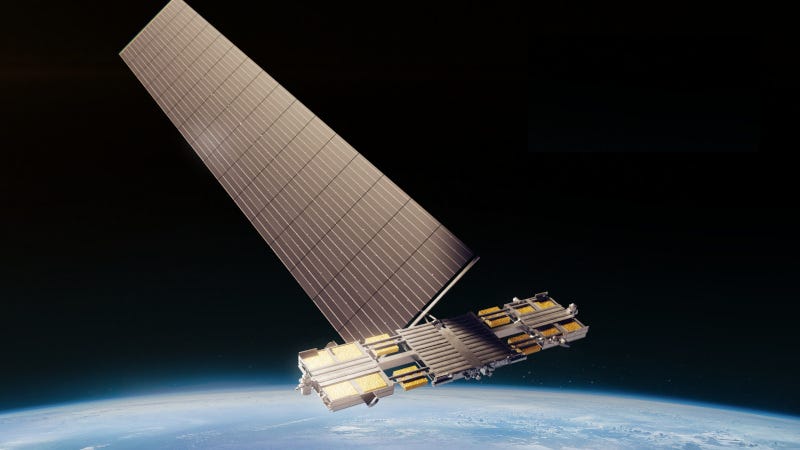
Muon Space unveiled Condor-Ultra on June 3, 2026, at its Mountain View, California headquarters. The platform is a Starship-class spacecraft designed for high-power, networked constellations and optimized for stackable mass-deployment from SpaceX’s Starship. Condor-Ultra features a 20 kW initial power architecture with variants scaling to 100 kW, over 18 square meters of nadir payload area, 100 Gbps intersatellite optical mesh networking, and integration with the NVIDIA Space-1 Vera Rubin Module, a purpose-built AI inference platform for orbital workloads that Muon Space states delivers up to 25 times the compute performance of an H100 GPU for space applications. The first pathfinder mission is slated for delivery in 2028.
The FAA granted test flight approval to SpaceX’s Starfall in-orbit manufacturing vehicle in June 2026. Starfall is designed to operate in the Starship payload bay, a pressurized volume larger than any previously flown commercial spacecraft, and its approval opens a near-term qualification window for orbital manufacturing and computing infrastructure that did not exist twelve months ago.
Condor-Ultra’s power, thermal, and networking architecture is designed, in Muon Space’s own description, to meet the unique demands of orbital data centers: scalable power generation, high-density compute workloads, and autonomous mission, network, and data operations at constellation scale. Those three requirements define a sub-tier supply chain problem that no hyperscale data center supplier is currently positioned to fill without significant redesign.
The Signal
The FAA’s test flight approval for Starfall is the regulatory triggering event. It establishes that a large-format Starship-class payload with manufacturing or computing functions can progress through regulatory review, and sets a precedent that orbital industrial platforms, not just launch vehicles, can receive FAA authorization as test articles. Combined with Muon Space’s June 3 Condor-Ultra announcement, the argument for an orbital computing platform has moved from speculative to commercially staged within a defined 24-to-36-month development window.
Condor-Ultra is not the only orbital computing architecture under development. Amazon Web Services (AWS) has maintained a quiet interest in orbital edge computing through its relationship with Amazon Leo. Microsoft Azure has invested in Azure Space, which includes orbital processing capabilities. Neither company has disclosed a Starship-class platform design as of June 2026. Muon Space, by virtue of the Condor-Ultra announcement, its published architecture work, and its documented feasibility work with hyperscalers on large-scale AI infrastructure in orbit, represents the most concrete Starship-class orbital data center program currently visible to the market.
The sub-tier procurement question is not hypothetical. Condor-Ultra at its full 100 kW variant, confirmed in Muon Space’s June 3 press release, requires solar array output, vacuum thermal rejection, and radiation-tolerant AI inferencing hardware at scales that no currently catalogued commercial supplier is qualified to fill. Supply chain managers at companies serving this market need to begin qualification planning now, before the program reaches a procurement readiness review ahead of its 2028 pathfinder delivery date.
