

Haven-1's Three Revenue Streams Are Not Equal — and the Difference Matters
The Economics of Haven-1, the World’s First Commercial Space Station

WHAT THIS MEANS
Vast has committed more than $1 billion to Haven-1 before a single commercial crew seat has been sold, a national pathfinder MOU has converted to a funded mission contract, or NASA has issued a CLD Phase II award — which is now officially on hold. For investors and corporate R&D buyers, the question is not whether Haven-1 is real. It is whether the economics of a four-mission, 45-cubic-meter station can generate enough commercial revenue to justify the capital already deployed and reduce the risk on the much larger Haven-2 bet that follows. This article maps the revenue architecture, the cost structure claims, and the supply chain dependencies that will determine the answer.
A Race No Longer Theoretical
Before any investor writes a check for Haven-2, Haven-1 has to answer one question: can a commercial space station generate enough revenue from research berths, national missions, and NASA contracts to justify the more than $1 billion already committed — before a single paying crew has docked?
That question is no longer hypothetical. In January 2026, Vast moved Haven-1 from structural qualification into final systems integration, targeting a Q1 2027 launch aboard a SpaceX Falcon 9. One month later, on February 24, competitor Starlab completed its Critical Design Review with NASA, validating its own business plan and confirming that the race to replace the ISS is now a capital allocation contest, not a technology demonstration. The window for first-mover advantage in commercial LEO is closing. The question is whether Haven-1’s economics are strong enough to matter when it does.
Haven-1 is simultaneously three things: a commercial product, a NASA CLD bid instrument, and a team-building exercise. Vast has been unusually candid in its official communications about all three. That candor is either confidence or necessity — and which one it is will be visible in the revenue numbers.
The Deliberate Minimum Viable Station
Here is what Haven-1 actually is: approximately 45 cubic meters of pressurized volume, roughly the interior of a large RV. Peak power around 13.2 kilowatts. Open-loop life support derived from Space Shuttle heritage hardware. Four planned crewed missions of ten days each, over a projected three-year orbital lifespan. That sounds modest, and it is. But modest was the point.
Vast’s official communications have been unusually candid about the program’s three strategic rationales: build the team, bid on NASA’s Commercial LEO Destinations Phase II contract, and demonstrate the economics of private station operations while ISS continuity remains a near-term concern. Haven-1 is not trying to compete with the ISS. It is trying to prove that a commercial successor to the ISS can be built and operated at a cost structure that does not require perpetual government subsidy.
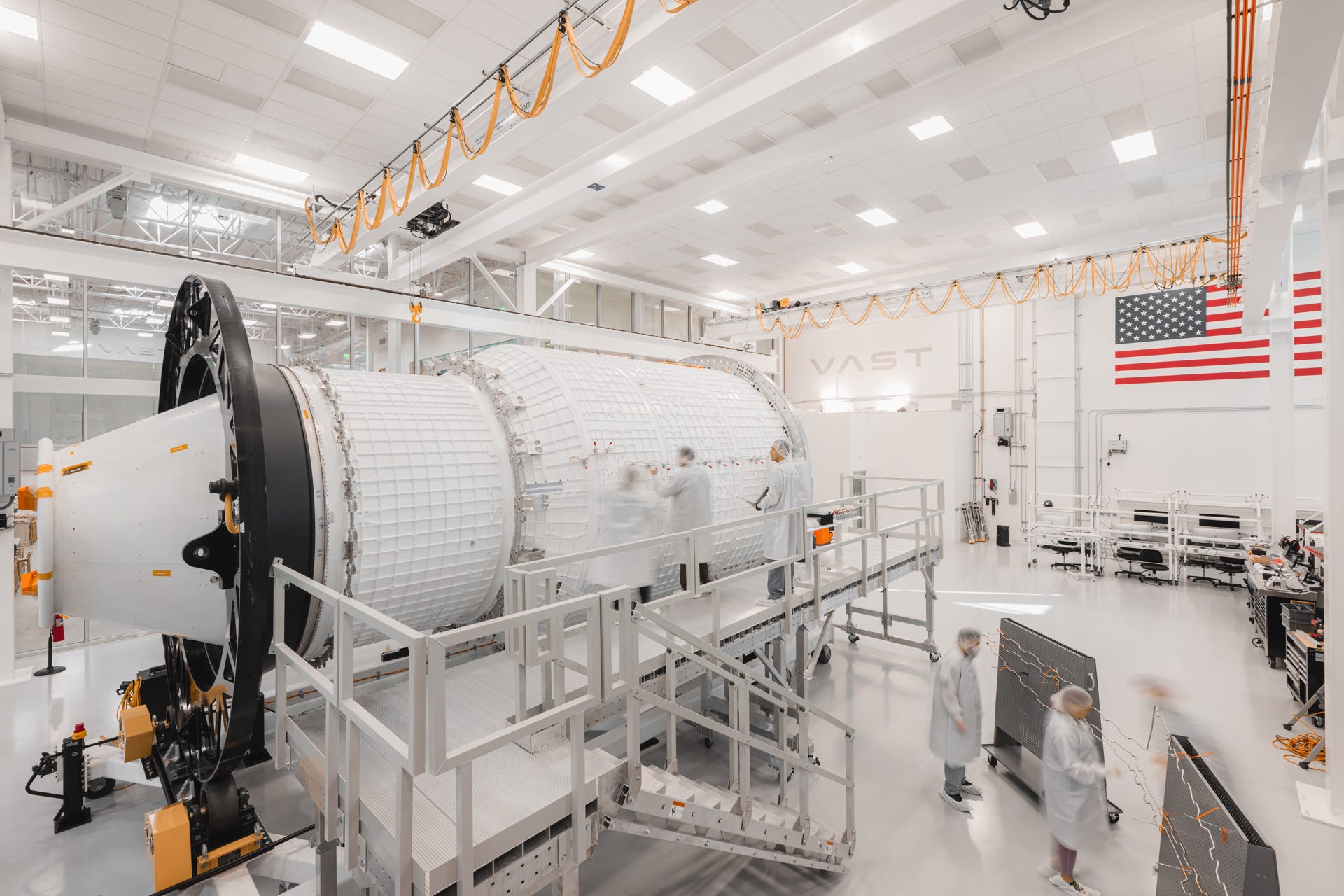
The manufacturing record so far is genuinely interesting. After running parallel design studies on stainless steel versus aluminum in November 2023, Vast selected aluminum, completed a trade study by March 2024, and delivered a proof-tested primary structure in roughly 15 months. The company claims this represents a tenfold reduction in primary structure manufacturing costs compared to traditional space station programs. That claim is self-reported, and no independent third-party audit has validated it — it should be read as a company assertion, not a verified benchmark. But the timeline itself is hard to dismiss: 15 months from blank-sheet to proof-tested hardware is fast for any pressurized spacecraft, let alone one with human rating requirements.
Three Revenue Streams, Three Different Risk Profiles
