

Oklahoma Spaceplane Challenge Opens Competition for Research Payload Flights to Edge of Space
State Competition Offers Up to 25 Suborbital Flights Valued at $5 Million Aboard Dawn Aerospace’s Aurora Spaceplane

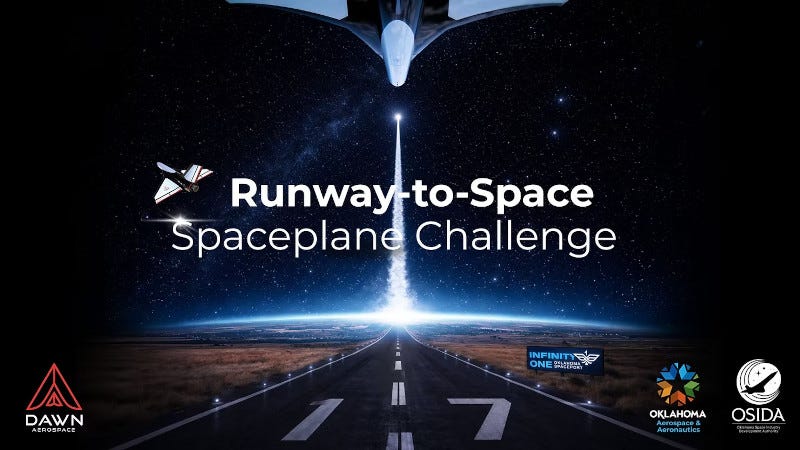
Applications opened April 16 for a first-of-its-kind U.S. competition that will send research payloads to the edge of space aboard an uncrewed reusable spaceplane operating out of a landlocked Oklahoma spaceport. The Oklahoma Space Industry Development Authority (OSIDA), in partnership with Dawn Aerospace, launched the Runway-to-Space Spaceplane Challenge, inviting U.S.-based research institutions to fly experiments aboard Dawn’s Aurora suborbital spaceplane from the Infinity One Oklahoma Spaceport in Burns Flat. The program will allocate up to 25 flights with a combined value of $5 million.
“Meaningful access to microgravity typically means going to orbit, which is expensive, slow, and often out of reach for early-stage ideas. Aurora changes that.”
Stefan Powell, Dawn Aerospace
Unlike traditional suborbital missions that are typically single-use and separated by months, the Aurora is designed for rapid, runway-based operations with turnaround times measured in hours — bringing spaceflight closer to an aviation-like model.
“This partnership underscores Oklahoma’s commitment to being a leader in the aerospace industry,” said Grayson Ardies, CEO of OSIDA. “By utilizing the unique capabilities of the Aurora Spaceplane, we are providing our universities and research centers with a rapid-response platform to accelerate American innovation in space.”
The Aurora, which has completed more than 60 operational missions, can carry payloads of up to 15 kg (≈33 lbs) to altitudes approaching 100 km (≈62 miles) — roughly the internationally recognized boundary of space — at speeds exceeding Mach 3.5, providing up to 127 seconds of microgravity per flight.
Stefan Powell, CEO of Dawn Aerospace, said the program addresses a gap in access to space-based research environments. “Meaningful access to microgravity typically means going to orbit, which is expensive, slow, and often out of reach for early-stage ideas,” Powell said. “Aurora changes that by giving teams a fast, lower-cost way to access microgravity and iterate within months. It’s not a substitute for long-duration missions, but it enables experiments that would otherwise never leave the ground, turning ideas that might never have flown into viable missions that can ultimately progress to orbit.”
“This competition is about capturing the imagination of scientists, engineers, and researchers, while also enabling a new way of working, where research can move faster, iterate more frequently, and strengthen U.S. leadership in space-enabled science and industry,” said Jim Bridenstine, managing partner of The Artemis Group and former NASA administrator.
Eligible applicants must be led by an Oklahoma-based university or research institution. Out-of-state universities and research institutions may participate as partners alongside an Oklahoma lead. Selected winners can fly payloads on up to five flights per submission, with Dawn Aerospace providing mission planning, trajectory design, payload integration interfaces, and a media kit.
The competition is open in three research areas: microgravity and life sciences, technology development and demonstration, and Earth observation and atmospheric sciences.
Key Dates:
Submission deadline: Sept. 25, 2026, at 5 p.m. CDT
Finalists announced: Oct. 23, 2026
Winners announced: Nov. 13, 2026
Payload flight-ready deadline: Sept. 6, 2027
Flights scheduled to begin: Mid- to late 2027
The competition coincides with more than $30 million in upgrades and renovations underway at the Infinity One Oklahoma Spaceport, one of only 14 FAA-licensed spaceports in the United States. The facility features one of the longest runways in North America at 13,503 feet and was the first FAA-approved spaceport in a landlocked state.
OSIDA has also invested in the 2025 deployment of an automated detect-and-avoid system for Advanced Air Mobility and will begin construction on a dedicated space operations complex for the Aurora spaceplane scheduled to arrive in 2027.