

Observable Space Raised $90 Million
Now It Needs a Laser Hardware Supply Chain That Barely Exists

What This Means:
Observable Space’s $90 million Series A is not a story about a startup closing a round. It is a stress test arriving in real time for one of the most constrained hardware supply chains in commercial space. Free-space optical (FSO) communications and laser ranging hardware depend on a sub-tier supplier base so concentrated that a single qualified vendor controls meaningful share of several critical component categories. Investors with exposure to Observable Space, Mynaric, or any constellation program that has bet on optical links should map that sub-tier exposure now, specifically laser sources, optical modulators, and radiation-hardened (rad-hard) signal processing electronics, before the next production ramp reveals the bottleneck. Supply-chain leaders serving the space sector have a narrow window to qualify into this pipeline before demand locks in incumbents.
The Signal: What the Round Actually Tells You
In late May 2026, Observable Space closed a $90 million Series A to boost production of laser and optical hardware. B Capital led the round, with Shield Capital and Cerberus Ventures co-leading. The company builds free-space optical terminals for satellite-to-satellite and satellite-to-ground communications, as well as laser-based ranging and proximity sensors for space domain awareness applications.
The headline number is attention-grabbing. The strategic signal behind it is more important.
Observable Space is not the only company that just received a large capital injection to scale optical hardware. Rocket Lab Corporation, in closing its Mynaric acquisition in May 2026, absorbed a company whose entire value proposition rests on the same optical intersatellite link (OISL) supply chain. The Aerospace Industries Association (AIA) and PricewaterhouseCoopers (PwC) co-authored a supply chain study in 2025 that named optical intersatellite links as one of nine highly specialized components facing a serious lack of production capacity, with only three or fewer qualified domestic suppliers in some of the most critical sub-categories.
So here is the structural situation: multiple well-funded companies are now simultaneously trying to ramp production of hardware that draws on the same sparse supplier base. Observable Space’s $90 million Series A is one input into a demand surge that the supply chain currently cannot fully absorb.
The Supply Chain Map: What Observable Space Actually Needs
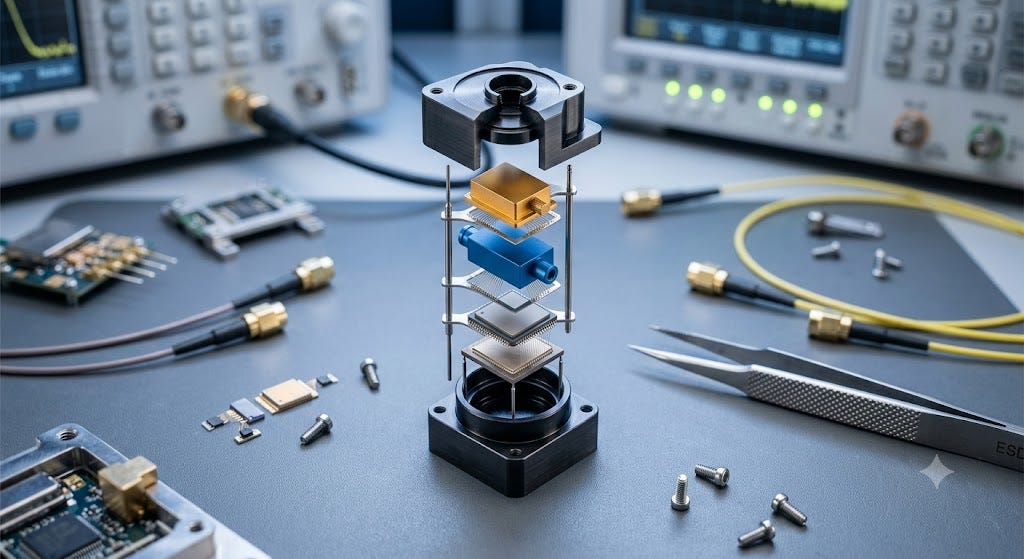
To understand the supply chain risk, start with the bill of materials inside a free-space optical terminal. The terminal is not one product. It is a stack of precision-engineered sub-assemblies, each with its own sourcing profile.
Laser sources. Laser sources are the highest-concentration supply risk in Observable Space’s bill of materials. The qualified vendor list for space-grade versions of this component is a small subset of the commercial telecom market. At the core of any optical communications terminal is the laser source itself. For space applications, the dominant technology is fiber-coupled laser diodes operating in the 1,550-nanometer (nm) wavelength band, a choice driven by eye-safety standards, atmospheric transmission windows, and compatibility with commercial telecommunications components originally developed for fiber optic networks. The civilian telecom industry built a deep supply chain for 1,550 nm components, and that heritage is one of the reasons optical intersatellite links became commercially viable.
The problem is that space-grade laser sources require radiation tolerance, thermal cycling qualification, and outgassing compliance that commercial telecom variants do not. The suppliers capable of delivering qualified space-grade laser sources at production volumes are a subset of the telecom laser market, and a small one. II-VI Incorporated (now Coherent Corp. following its 2022 merger), Lumentum Holdings, and a handful of vertically integrated European suppliers represent the realistic qualified vendor list for this category. That consolidation among volume laser manufacturers creates single-point-of-concentration risk that runs directly through Observable Space’s production plan.
The remaining sub-components in Observable Space's bill of materials, rad-hard electronics with 52-week documented lead times, space-qualified optical modulators with limited domestic production, and the precision mechanism bottleneck that even Rocket Lab decided it could not leave to outside suppliers, reveal the specific categories where a production ramp stalls before it starts. Paid subscribers get the full component-by-component supply chain map, the three-vendor concentration analysis, the investor decision framework, and the five operational action steps for program managers and portfolio holders.
