

No Manual Control, No Rescue Plan, No Margin
The Three HLS Findings That Outlast the Redesign

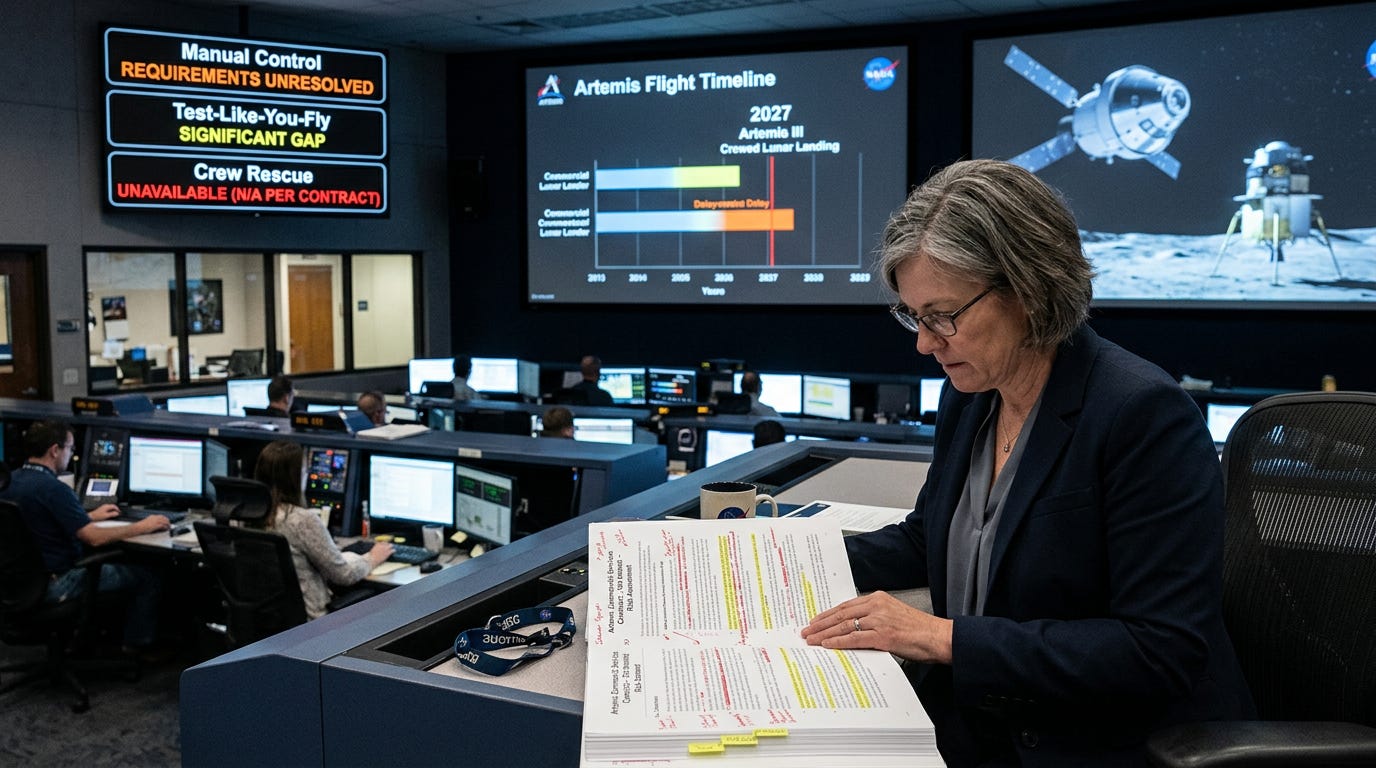
WHAT THIS MEANS
NASA OIG Report IG-26-004 is not a schedule story — it is a documented record of where the commercial service contract model’s cost-control advantages break down at the human-rating boundary. Three specific findings — an unresolved disagreement with SpaceX over manual control certification, a ‘Test Like You Fly’ gap in the planned uncrewed demonstrations, and the absence of crew rescue capability for early crewed missions — will persist regardless of the February 2026 Artemis redesign. Government acquisition professionals managing analogous programs should treat this audit as a structural warning: the Government Task Agreement oversight model provides strong milestone tracking but limited leverage for resolving technical disputes at the human-rating certification boundary.
There is a version of the story in which the NASA Office of Inspector General released its March 10 audit of the Human Landing System program and the findings were so damning that NASA Administrator Jared Isaacman had no choice but to tear up the schedule and start over. That version is tidier than the truth, and acquisition professionals in particular should know the difference, because the actual sequence of events tells you something more useful about how commercial service contracts work under pressure.
The Artemis redesign that Isaacman announced at the agency’s Ignition event on February 27, 2026, came two weeks before the OIG report was published. The independent Aerospace Safety Advisory Panel had already delivered its own sharply-worded warning on February 25, finding that the existing Artemis III plan carried too many firsts to constitute an acceptable risk posture. SpaceX had privately acknowledged to NASA as far back as fall 2025 that the Starship Human Landing System could not make a June 2027 crewed landing. The OIG report, formally designated IG-26-004 and released March 9-10, arrived not as the cause of the redesign but as its formal codification.
That distinction matters. What IG-26-004 provides is not a political trigger. It is a documented oversight record: a Tier 1 government document that names specific technical deficiencies, quantifies residual risk, and flags structural gaps in NASA’s oversight model. For government buyers and acquisition professionals managing analogous commercial programs, that record is the deliverable worth dissecting — because it illuminates the precise stress points at which the commercial service contract model’s considerable cost-control advantages begin to break down.
The Audit in Plain Terms
OIG IG-26-004 examined three things: whether HLS providers are meeting development goals, whether NASA’s oversight model is working, and whether the agency is adequately mitigating risks to astronaut safety. The headline finding is well-known. SpaceX’s Starship HLS will not be ready for a June 2027 lunar landing. The lander has slipped roughly two years from its original schedule. The next critical near-term milestone — a large-scale, vehicle-to-vehicle cryogenic propellant transfer demonstration, an unprecedented in-space operation, was itself delayed a full year to March 2026, involving the same Starship lineage that lost three consecutive vehicles on Flights 7, 8, and 9.
Critical Design Review has been pushed to August 2026. That leaves, in the OIG’s own assessment, roughly four months before an uncrewed demonstration mission and barely six months after that before the original crew landing date, with no margin for anything to go wrong. Even the 12-to-24-day launch pad turnover cadence that SpaceX’s propellant aggregation architecture requires has not been demonstrated.
But the schedule slip, however consequential, is the least structurally interesting finding for acquisition professionals. The more revealing material is in the three technical oversight findings underneath it.
