

Next-Generation Star Tracker Targets Radiation-Hardened Performance for Long-Duration Missions
Rocket Lab ST-HP Builds on Heritage of 185+ Launched Units With Advanced Accuracy and Resilience

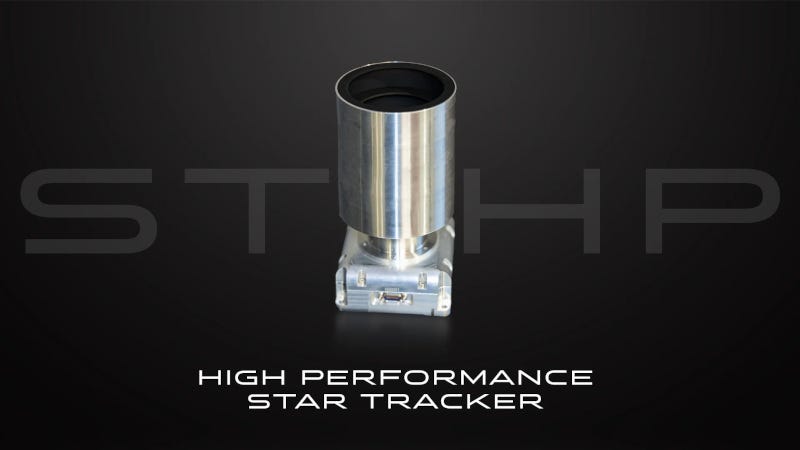
A new star tracker designed for sustained accuracy in high-radiation orbital environments has been unveiled by Rocket Lab, extending the Long Beach, California-based company’s spacecraft component lineup to meet the growing demands of longer-duration missions in low Earth orbit and beyond.
“Rocket Lab continues to evolve our end-to-end offerings by introducing state-of-the-art solutions to meet the changing needs of commercial and government missions.”
Brad Clevenger, Rocket Lab
The High-Performance Star Tracker, designated ST-HP, delivers a targeted pointing accuracy of better than 1 arcsecond — the level of precision required for missions where spacecraft attitude determination directly affects payload performance. Its board-level Total Irradiation Dose tolerance exceeds 50 kRad, a specification designed to maintain orientation accuracy as cumulative radiation exposure builds over the course of extended missions. Together, those two performance parameters define a sensor suited for high-value orbits where both pointing fidelity and long-term hardware resilience are non-negotiable.
“Rocket Lab continues to evolve our end-to-end offerings by introducing state-of-the-art solutions to meet the changing needs of commercial and government missions,” said Brad Clevenger, president of Rocket Lab USA. “By building on decades of experience, we’re delivering a more resilient product that gives customers the high accuracy and performance they need without added cost, lead time, or manufacturing risk.”
The ST-HP is the third star tracker variant in Rocket Lab’s current lineup. The company’s original model, the ST-RT, has accumulated more than 175 units on orbit since 2013, and a second variant, the ST-HV, designed for higher-volume production, has more than 14 units currently operating in orbit. Across all models, Rocket Lab has now launched more than 185 star tracker units in total.
The new model combines advanced radiation hardening with the flight-proven design and manufacturing practices established across those earlier programs. Rocket Lab describes the ST-HP as a low-cost, scalable solution capable of rapid production without sacrificing performance or reliability.
Star trackers determine a spacecraft’s orientation by imaging the surrounding star field and matching the pattern against an internal catalog. Accurate attitude determination is fundamental to mission performance — affecting communications link quality, imaging resolution, scientific instrument targeting, and safe orbital maneuvering. As satellite operators push missions to higher orbits and longer operational lifetimes, radiation tolerance in attitude sensors becomes increasingly critical.
The ST-HP is produced at Rocket Lab’s Toronto facility, which serves as the company’s dedicated center for star tracker development and qualification, equipped with thermal chambers, vibration rigs, X-ray machines, optical inspection and calibration systems, and clean-room environments.
The new star tracker joins a vertically integrated component portfolio that includes reaction wheels, separation systems, radios, flight software, ground software, solar power solutions, and optical payloads — all designed and built in-house across facilities in the United States, Canada, Germany, and New Zealand. Rocket Lab’s spacecraft and satellite components have supported more than 1,700 missions spanning commercial, defense, and national security applications.