

New Initiative Targets Atmospheric Effects of Satellite Reentry
Astroscale, Planet Labs, University of Southampton Form Data-Sharing Collaboration to Address Reentry Research Gap

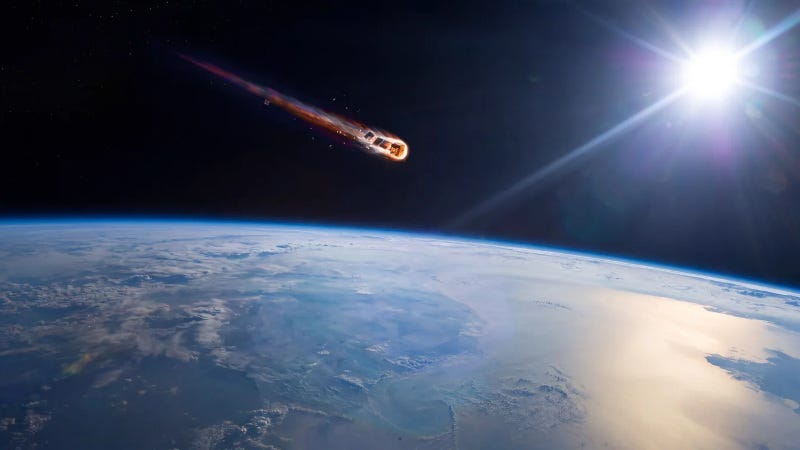
A new industry-academia collaboration aimed at improving scientific understanding of what happens to Earth’s atmosphere when satellites burn up on reentry has launched, with Astroscale Holdings Inc. as convener and Planet Labs PBC and the University of Southampton as founding participants.
“By providing data to the AIRS initiative, we are helping the scientific community move past simulations and toward a factual, data-driven understanding of our industry’s atmospheric footprint.”
Mike Lindsay, Astroscale
The initiative, called Atmospheric Impact of Reentered Spacecraft, or AIRS, was announced June 9. While space sustainability efforts have historically focused on in-orbit operations and debris removal, the atmospheric effects of reentry remain an underexplored area. During reentry, spacecraft are exposed to extreme heating and interaction with atmospheric gases, leading to melting, fragmentation, and vaporization of materials. Those processes release chemical compounds at various layers of the upper atmosphere — altitudes where direct measurement is difficult and modeling has historically depended on incomplete assumptions about spacecraft construction.
As activity in low Earth orbit accelerates, the number of satellites reentering Earth’s atmosphere is expected to rise significantly. Current simulations rely on simplified spacecraft assumptions because actual manufacturing data has not been widely available to researchers. Without access to real-world industry data, the results of advanced academic modeling carry limits on relevance and applicability. AIRS is designed to address that gap.
Under the initiative, space operators and manufacturers will share non-proprietary spacecraft design information with academic researchers to improve atmospheric modeling accuracy while protecting commercially sensitive data. Material composition and approximate mass breakdowns can be shared under confidential bilateral agreements. More detailed data — including component layouts or expected reentry profiles — may be shared at each participant’s discretion.
Astroscale will both coordinate the initiative and contribute its own spacecraft data alongside Planet. Planet brings expertise in Earth observation, satellite manufacturing, and operations. The University of Southampton contributes research capabilities in aerospace engineering and atmospheric science. Together, the three founding participants aim to expand access to actual spacecraft data, reduce uncertainty in atmospheric modeling, and support evidence-based decision-making for the future of low Earth orbit.
“Spacecraft reentry has long been treated as an optimal mission endpoint, but it is increasingly clear that we need a deeper scientific understanding of what happens during this phase,” said Mike Lindsay, Chief Technology Officer at Astroscale. “By enabling industry to contribute real-world data in a trusted way, AIRS removes critical barriers for atmospheric research and ensures space sustainability is guided with the most accurate and up-to-date information.”
Planet’s chief space officer framed the company’s participation around its core mission. “Our mission to make global change visible starts with a deep responsibility for the space environment in which we operate,” said James Mason. “Sustainable space operations must account for a satellite’s entire lifecycle, including its eventual reentry. By providing data to the AIRS initiative, we are helping the scientific community move past simulations and toward a factual, data-driven understanding of our industry’s atmospheric footprint.”
Minkwan Kim, Professor at the University of Southampton, pointed to data scarcity as the problem AIRS is built to solve. “A primary challenge in assessing the effects of re-entry emissions on the upper atmosphere is the scarcity of high-quality data required for robust modeling and evidence-based analysis,” Kim said. “AIRS will address this critical gap, improving our understanding and mitigation of atmospheric re-entry ablation impacts, and ensuring that the benefits of space remain accessible to future generations.”
No additional members beyond the three founding participants have been announced. The initiative’s structure — centered on bilateral confidentiality agreements rather than a single shared data pool — is designed to lower the barrier for future industry participants to contribute spacecraft data on their own terms.