

NASA’s Ignition Framework: Changing Horses Mid-Stream?
Why the New Core Module Architecture Is a Permanent Departure From Full-And-Open LEO Competition

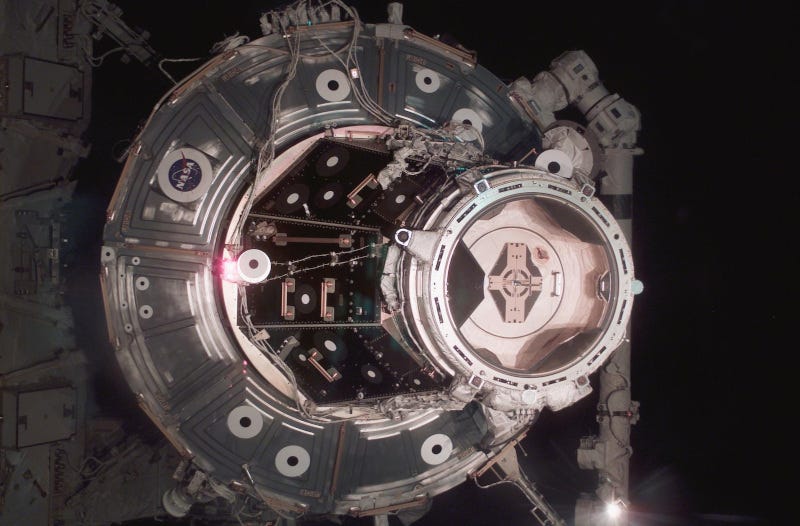
This is a nice article, but it is not valid!
So, no sooner that we get done researching and writing this article - it all changes!
We scheduled this article to publish, as we do, and NASA goes and ruins our hard-won article!
I’m not retracting the article but instead consider this a speculation of what moight have been if NASA had not reversed their stance.
Mike Turner, CEO
What This Means
NASA’s Ignition framework, announced March 24, 2026, marks the end of the full-and-open competition model for commercial Low Earth Orbit (LEO) infrastructure. The agency is pivoting from certifying commercial operators to run full stations to building a government-owned core module with commercial add-ons. That hybrid model concentrates prime-level access in ways the original Commercial LEO Destinations (CLD) Phase 2 framework explicitly avoided. For policy professionals assessing industrial base strategy and for Business Development (BD) teams positioning for the next award cycle, the procurement pattern embedded in Ignition is now the signal that matters most.
What Happened on March 24
NASA unveiled its Ignition framework on March 24, 2026, as part of a broader set of agency initiatives responding directly to President Trump’s December 2025 Executive Order, “Ensuring American Space Superiority.” That order directed NASA to develop a commercial pathway to replace the International Space Station (ISS) by 2030 and spurred private sector innovation and investment by upgrading launch infrastructure and expanding lunar capabilities. The Ignition event was NASA’s public response to that directive across four program areas: Staying in LEO, Going Back to the Moon, Building the Moon Base, and America Underway in Space on Nuclear Power.
The core change on the LEO side: NASA issued a Request for Information (RFI) for a new U.S. Space Station Core Module and associated commercial modules, seeking feedback on operational concepts, architecture, technical trades, supply chain, acquisition approaches, and government-furnished support. The original CLD Phase 2 framework called for NASA to certify fully private, commercial operators to run entire station programs. The Ignition RFI describes a government-owned core module with commercial add-ons. That model is a structural departure, and its procurement consequences have not yet been fully priced into the market.
The Procurement Shift Nobody Has Fully Priced in
Industry coverage of Ignition has focused on the supply chain fallout: which Tier 2 and Tier 3 suppliers are stranded, how much capital is frozen, who bids next. Those are legitimate questions. The more durable story is structural. NASA has signaled a change in how it intends to acquire orbital capability.
The original CLD Phase 2 model was built around full-and-open competition. Multiple commercial operators would bid, NASA would certify qualified competitors, and market forces would drive cost and performance. That is broadly the model that produced the Commercial Crew program’s relative success, with SpaceX and Boeing competing for crewed access to the ISS.
Ignition abandons that logic for the station layer. By anchoring the architecture to a government-owned core module, NASA positions itself as the platform owner. Commercial firms add capability around it rather than owning the platform.
The procurement mechanism that flows from this architecture will most likely take the form of a Funded Space Act Agreement (SAA) or Other Transaction Authority (OTA) structure, drawing on 10 U.S.C. Section 4022, though that has not been confirmed by a formal solicitation. These instruments allow NASA to select partners without a traditional Federal Acquisition Regulation (FAR)-based competitive solicitation. That is not necessarily bad policy. It is a different policy, and BD teams still configured for a FAR-based full-and-open award are positioned for a program that no longer exists.
