

NASA Signs Deal To Test New Glenn Engines At Historic Stennis Stand
Agreement Adds Test Capacity As Blue Origin Works Toward Return To Flight

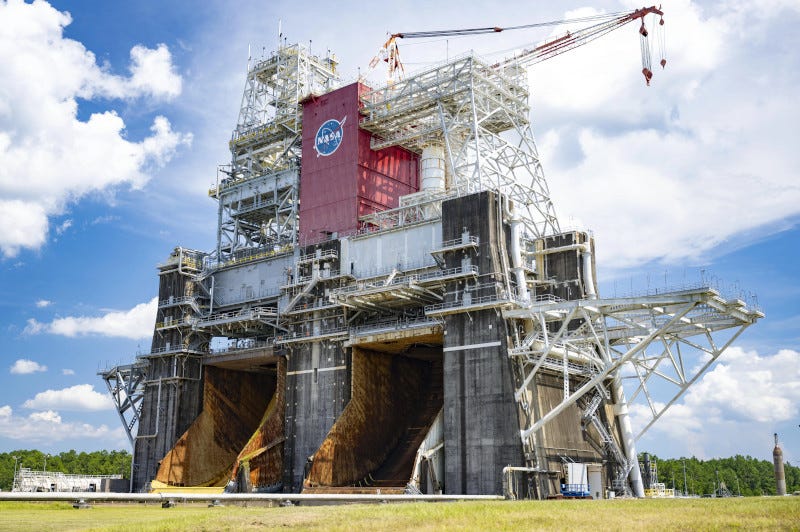
NASA and Blue Origin have signed an agreement to conduct hot fire testing of the New Glenn rocket’s second stage at Stennis Space Center in Mississippi, the agency and the company announced Friday.
“Stennis helped take Americans to the Moon, and through this partnership, it will help take us back.”
Dave Limp, Blue Origin
The deal is an annex to a reimbursable Space Act Agreement signed earlier this month. It sets up testing on the B-2 stand near Bay St. Louis, a dual-position facility built in the 1960s to test Saturn V rocket stages during the Apollo program. The adjacent B-1 position handles single-engine tests; B-2 is built for full rocket stages.
The new site adds test capacity as Blue Origin works to separate its test schedule from launch operations at Launch Complex 36, according to the company’s announcement. Blue Origin has not set a date for New Glenn’s return to flight following a hot fire test anomaly on May 28, after which the company said it was rebuilding hardware and targeting a return to flight later this year.
“Winning the new space race means moving faster and working alongside a strong commercial industry,” said NASA Administrator Jared Isaacman. “Supporting Blue Origin at NASA’s Stennis Space Center puts world-class American infrastructure to work advancing the capabilities needed to return astronauts to the Moon, establish a sustained lunar presence, and prepare for Mars.”
“We are proud to partner with NASA and build on our shared commitment to returning America to the Moon and our broader mission to build a road to space for the benefit of Earth,” said Blue Origin CEO Dave Limp. “Stennis helped take Americans to the Moon, and through this partnership, it will help take us back.”
“Stennis continues to be a hub for the commercial space industry,” said Sen. Roger Wicker, R-Miss. “Mississippi warmly welcomes Blue Origin’s return to the coast and to our legendary rocket testing facilities.”
Sen. Cindy Hyde-Smith, R-Miss., framed the deal as a starting point rather than a settled arrangement. “I hope its use of B-2 test stand becomes a long-term arrangement that broadens our state’s contribution to space exploration,” she said. “I will certainly do what I can to make that a reality.”
Testing is targeted to begin this fall. NASA said it will provide engineers, equipment and building services to prepare B-2 for the New Glenn second stage, along with dedicated workspace and technical expertise from past propulsion testing at the stand — including the Green Run test series NASA ran on the SLS core stage ahead of the Artemis I flight.
The rocket’s second stage is powered by two BE-3 engines burning liquid oxygen and liquid hydrogen, with each engine producing 200,000 pounds of thrust in vacuum, according to NASA. New Glenn is named for astronaut John Glenn, the first American to orbit Earth.
The agreement comes as NASA leans on commercial partners for its Artemis timeline. Artemis III, following April’s Artemis II flight, will send four astronauts to test rendezvous and docking between NASA’s Orion spacecraft and commercial human landing systems from Blue Origin and SpaceX in low Earth orbit. New Glenn is also slated to launch lunar landing missions, including a robotic flight this fall carrying Blue Origin’s Blue Moon Mark 1 Endurance lander to the Shackleton Connecting Ridge near the lunar South Pole — a mission NASA says is meant to reduce risk ahead of crewed landings on Artemis IV and V in 2028.
Neither NASA nor Blue Origin has said when New Glenn will next fly.