

NASA Selects Contractor for HelioSwarm Spacecraft
SFL Missions Awarded a Competitive-Bid Contract to Develop Eight Small Satellites

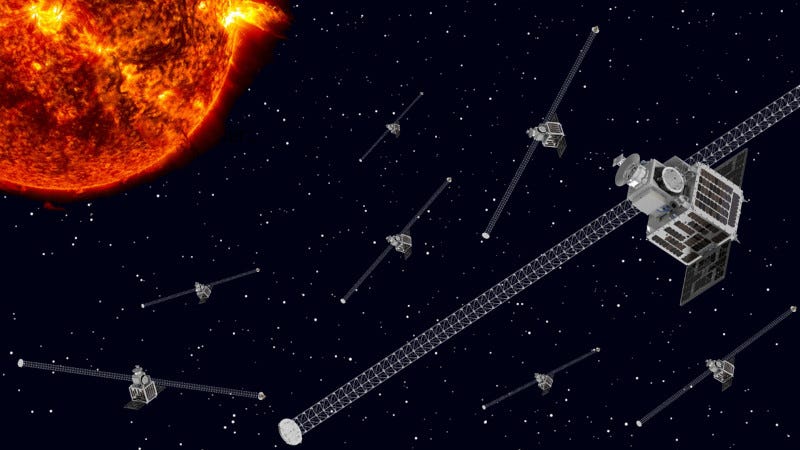
NASA has chosen the contractor to develop eight small satellites for its HelioSwarm mission. SFL Missions will develop “Node” spacecraft that will be carried into a high-Earth orbit aboard a larger “Hub” satellite following separation from a commercial launch vehicle.
“HelioSwarm is an important science mission that will provide critical insights into the dynamic interactions between the Sun’s atmosphere and the Earth.”
Dr. Robert E. Zee, STL Missions
The HelioSwarm mission is tasked with capturing the first multiscale in situ measurements of fluctuations in the magnetic field and motions of plasma turbulence in the solar wind and Earth’s magnetosphere.
The 330-pound Node satellites will be built on the company’s DAUNTLESS platform. This high-performance satellite platform provides high power generation and significant propulsion capabilities which are crucial for this mission. SFL Missions will integrate the HelioSwarm instrument suite developed by the University of New Hampshire (in collaboration with partners at the Centre National d’Études Spatiales, the United Kingdom Space Agency, and the Smithsonian Astrophysical Observatory). SFL will then test the completed spacecraft and then support integration of the completed Node spacecraft onto the Hub satellite.
Once in high-Earth orbit, the nine-satellite constellation will fly in a series of complex formations to capture simultaneous multipoint, multiscale measurements of energy flow and spatial and temporal structure in solar wind plasma. All the spacecraft will be operated through NASA’s Deep Space Network, to allow telemetry, tracking and command, along with payload data downlink.
“HelioSwarm is an important science mission that will provide critical insights into the dynamic interactions between the Sun’s atmosphere and the Earth, including how turbulent energy moves through our protective magnetic bubble and impacts technological assets out to the Moon,” said SFL Missions Director and CEO Dr. Robert E. Zee. “This will be accomplished by leveraging our highly capable spacecraft platforms to achieve the demanding performance of the mission.”
Design of the Node spacecraft will include state-of-the-art onboard propulsion systems to achieve the dynamic geometric configurations set forth in mission specifications. The Nodes will also utilize onboard ranging transponders instead of GPS to determine their positions given the near lunar apogee and above geostationary perigee of the orbits. All eight Nodes will be developed, integrated, and tested at SFL Missions facilities.