

NASA Reorganizes Mission Directorates to Speed National Space Policy Goals
Agency Merges Four Directorates Into Three, Elevates Focus on Moon Base and Nuclear Propulsion

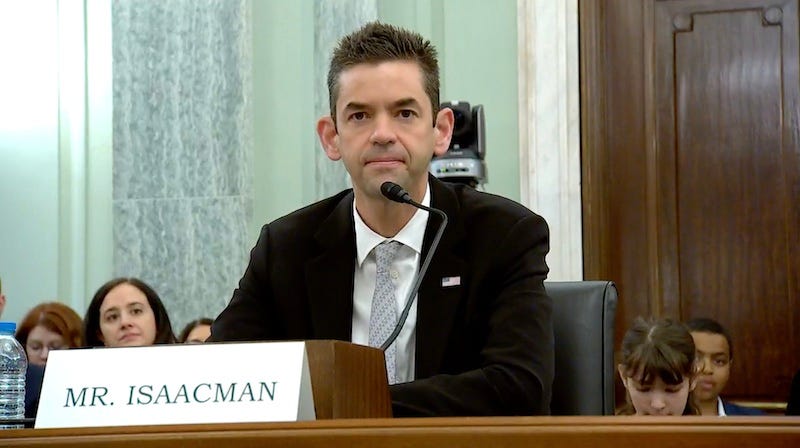
NASA recently announced a sweeping agencywide realignment designed to streamline leadership, eliminate bureaucratic obstacles, and sharpen focus on the highest-priority goals set forth in President Trump’s National Space Policy.
“We are focusing resources on the most pressing objectives only NASA is capable of undertaking and liberating the workforce from unnecessary bureaucracy and obstacles that impede progress.”
Jared Isaacman, NASA
The restructuring consolidates four existing mission directorates into three and shifts their reporting structure so that mission directorate heads now report directly to NASA Administrator Jared Isaacman. Previously, directorates were filtered through the associate administrator layer. The change is intended to give directorates faster access to resources across NASA centers, industry partners, and international allies.
“This initiative reflects NASA’s extreme focus on executing the mission in direct support of the National Space Policy,” Isaacman said. “We are focusing resources on the most pressing objectives only NASA is capable of undertaking and liberating the workforce from unnecessary bureaucracy and obstacles that impede progress.”
Isaacman was explicit that the shake-up will not result in job cuts or program cancellations. “There will be no reduction in force, no program cancellations, no closures, but we will achieve cost savings through more efficient execution and taking an active role in delivering the outcomes the world has been waiting for from NASA,” he said.
The realignment follows the agency’s Ignition event in late March 2026, at which Isaacman and other NASA leaders outlined the agency’s core priorities under President Trump’s executive order on American space superiority. Those priorities include accelerating the Artemis lunar program, establishing a permanent Moon Base, developing a nuclear space reactor, growing the orbital economy, and expanding science and discovery missions.
The new directorate structure is as follows:
Human Spaceflight Mission Directorate (HSMD): The Exploration Systems Development Mission Directorate and the Space Operations Mission Directorate will merge into a single HSMD, reflecting the agency’s current operational status supporting both low Earth orbit and lunar missions.
Research and Technology Mission Directorate (RTMD): The Aeronautics Research Mission Directorate and the Space Technology Mission Directorate will combine into the new RTMD, which will also take charge of nuclear power and propulsion development — a key component of the National Space Policy.
Science Mission Directorate (SMD): Remains unchanged, continuing to lead NASA’s scientific discovery work.
Associate Administrator Amit Kshatriya retains oversight of NASA’s center directors and takes on the additional role of NASA chief engineer, a move the agency says will reinforce its technical decision-making and ensure continuity in critical engineering work.
Several other key leadership appointments accompany the restructuring. Jeremy Parsons has been named program manager for Artemis under HSMD, while Carlos García-Galán will serve as program manager for Moon Base. Steve Sinacore will serve as acting director of the Space Reactor Office and program manager for the SR-1 and LR-1 nuclear reactor programs within RTMD. Dr. Lori Glaze becomes associate administrator for HSMD, and Dr. James Kenyon takes the same role at RTMD.
At the center level, Jamie Dunn will lead NASA’s Goddard Space Flight Center, Brian Hughes will direct Kennedy Space Center, and Dawn Schaible will head Glenn Research Center. Bob Pearce is set to retire after a 36-year career at NASA, having served most recently as head of the Aeronautics Research Mission Directorate.
The agency also said it will continue efforts to rebuild core competencies by converting contractor positions to civil servant roles where appropriate, strengthening its intern pipeline, and expanding its joint recruitment program with the U.S. Office of Personnel Management — an initiative called NASA Force.