

NASA Orders Second Small-Spacecraft Mission To Practice Lunar Rendezvous
Two Identical Spacecraft Will Trade “Chaser” and “Target” Roles Ahead of Crewed Moon Landings

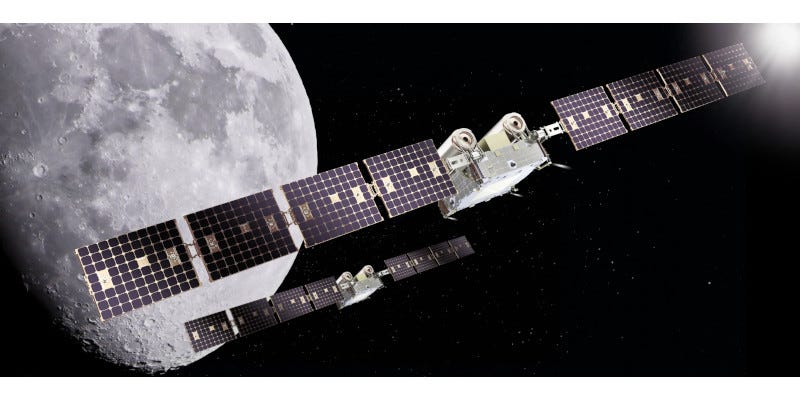
NASA has awarded a contract to Advanced Space for a second CAPSTONE mission that will send two small spacecraft into lunar orbit to practice the rendezvous and docking maneuvers astronauts will need for future Moon landings.
“This mission represents an important step in the maturation of cislunar capabilities.”
Sean Fuller, NASA
The mission, called CAPSTONE 02, is targeted for launch in 2027, according to the agency. It builds on the original CAPSTONE mission, which NASA says became the first U.S. commercial mission to the Moon and the first spacecraft to fly in a near rectilinear halo orbit — a stable path shaped by the combined gravity of Earth and the Moon.
Where the first mission validated navigation and communications systems, CAPSTONE 02 moves into active demonstrations. The two spacecraft, each weighing about 882 pounds (400 kilograms) and built by Terran Orbital Systems Inc., will conduct rendezvous, proximity operations and formation-flying exercises to study how spacecraft trajectories behave under the simultaneous pull of Earth and Moon gravity, known as three-body orbits.
“Achieving our most ambitious space exploration goals requires iterative, risk-tolerant demonstrations in partnership with industry,” said Christopher Baker, who leads the In-Space Infrastructure portfolio within NASA’s Research and Technology Mission Directorate in Washington. “Technology development through flight testing is how we convert hard problems into the lasting capabilities needed for a permanent presence at the Moon.”
Each spacecraft will be able to switch between “chaser” and “target” roles during the mission, according to NASA, testing a range of scenarios that the agency says cannot be fully replicated on Earth. The techniques mirror the navigation approach planned for Orion’s rendezvous with a lunar lander, and are intended to build confidence in systems that will guide astronauts transferring between lunar orbit and the surface.
CAPSTONE 02 will also serve as a testbed for three NASA-developed navigation software suites, collecting data during a low-energy transfer trajectory that carries the spacecraft past the Moon before settling into lunar orbit. One spacecraft will carry an optical imaging payload from Lawrence Livermore National Laboratory to support the navigation work and photograph the Moon. The mission will further develop the Cislunar Autonomous Positioning System software first tested on the original CAPSTONE, which determines a spacecraft’s position without relying on tracking from Earth.
“This mission represents an important step in the maturation of cislunar capabilities,” said Sean Fuller, Moon Base CAPSTONE manager. “By expanding on the lessons learned from CAPSTONE to demonstrate increasingly sophisticated operational concepts, CAPSTONE 02 lays the foundation for lunar infrastructure and commercial services that support Artemis, Moon Base, and future missions to deep space.”
The mission is funded by NASA’s Human Spaceflight Mission Directorate, with support from the Research and Technology Mission Directorate, and is managed by the Small Spacecraft & Distributed Systems office at NASA’s Ames Research Center in California. NASA said it used a Small Business Innovation Research Phase III contract to fund the work.