

NASA-Backed In-Space Transport Mission Passes Design Review
Fully Manifested Vigoride 8 to Launch in 2027

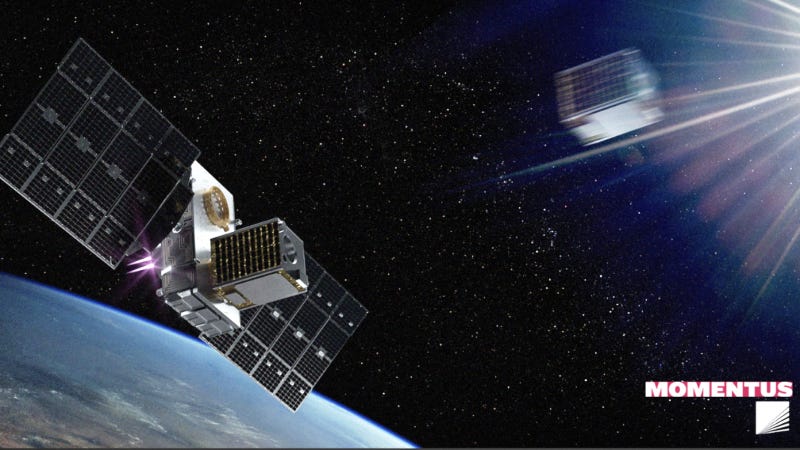
A fully booked orbital transport mission carrying two NASA-contracted payloads has cleared a key engineering milestone, with a preliminary design review now complete and an early 2027 launch target on track.
“Vigoride 8 is a complex, fully booked mission, and this milestone confirms that our design is sound and ready to advance into detailed development.”
Tom Malko, Momentus
The mission, designated Vigoride 8, is operated by San Jose, California-based Momentus Inc. under two contracts with NASA. It will carry the Spaceworks COSMIC payload alongside NASA’s Juno Rotating Detonation Rocket Engine — known as RDRE — a propulsion technology that NASA is evaluating for potential future spaceflight applications.
“The successful completion of the Preliminary Design Review reflects the strength of our engineering team and the close collaboration with our customers,” said Tom Malko, SVP of Engineering and Operations at Momentus. “Vigoride 8 is a complex, fully booked mission, and this milestone confirms that our design is sound and ready to advance into detailed development. We’re proud of the progress and excited to keep driving toward launch.”
A Preliminary Design Review, or PDR, is a formal engineering checkpoint that verifies a mission’s proposed design meets all technical requirements and is sufficiently mature to proceed into detailed development. Completing the PDR is a standard milestone in the aerospace development process, typically required by government customers to confirm schedule readiness before authorizing further investment.
The Vigoride 8 mission is the latest flight in Momentus’ ongoing series of commercial orbital service vehicle operations. Vigoride vehicles are designed to provide hosted payload support, last-mile delivery, and in-orbit servicing capabilities for a range of customers. With the PDR complete, the program is now advancing toward a Critical Design Review scheduled for late May 2026.
A Critical Design Review, or CDR, is the next major engineering gate, at which a fully finalized design is examined in detail before hardware fabrication and assembly begin in earnest. A successful CDR would further solidify the mission’s path toward its 2027 launch window, providing customers and stakeholders with increased visibility into program progress and schedule discipline.
The mission’s fully manifested status — meaning all available payload capacity has been sold — reflects commercial demand for in-space transportation services ahead of flight. The PDR was conducted using expanded infrastructure, including a new facility that Momentus said is intended to support higher mission throughput as the company pursues additional flights.
The Juno RDRE payload is among the more technically notable elements of the manifest. Rotating detonation rocket engines are an emerging propulsion concept that could offer higher thermodynamic efficiency than conventional combustion-based engines. Rather than burning propellant in a steady deflagration, RDREs sustain a series of supersonic detonation waves that cycle continuously inside a combustion chamber. NASA and several defense research organizations have been studying the technology as a candidate for future propulsion systems in both crewed and uncrewed spaceflight.
The Spaceworks COSMIC payload adds a second customer to the manifest. Spaceworks Enterprises is an aerospace research and engineering company focused on advanced space systems concepts, including orbital transfer vehicles and small satellite platforms.
The combination of two distinct government-affiliated payloads on a single commercial orbital transport vehicle reflects the expanding role of commercial in-space transportation as an infrastructure layer for government science and technology demonstration missions — a market segment that has grown steadily as NASA and other agencies pursue public-private partnerships to reduce mission costs.
Momentus conducts Vigoride missions as secondary payloads, with the orbital service vehicle performing independent maneuvering in orbit to deploy or host payloads after reaching orbit. The completion of the PDR, combined with the approaching CDR in May 2026, gives the program a defined engineering path toward launch, with each milestone deepening confidence in the mission timeline and customer commitments.