

Muon Space’s Inorganic Growth Playbook
What the Starlight Engines Acquisition Reveals About Supply Chain Consolidation in Smallsat Propulsion

Signal Summary
Muon Space’s acquisition of Starlight Engines removes an independent propulsion supplier from the open market at the same moment that constellation-scale production demand is reaching program-of-record levels. The smallsat propulsion supplier base was already thin; it is now thinner by design. C-suite executives, supply-chain leaders, and investors with exposure to the 50–500 kg spacecraft segment should map their propulsion dependencies against this consolidation pattern now — the window for open-market optionality is narrowing, and the next acquisition may not come with advance notice.
The smallsat propulsion market was already thin. Now it is getting thinner by design — and the companies that treat Muon Space’s acquisition of Starlight Engines as a news item rather than a supply chain signal are the ones most likely to find themselves without a qualified propulsion source when a program depends on it.
This is not an article about Muon Space’s business strategy. It is an article about what happens to your supply chain when an operator-tier company decides the open market for propulsion is a problem it would rather own than manage.
The Signal Behind the Acquisition
In February 2026, Muon Space closed a $44.5 million Series B extension, bringing its total equity raise to $135 million. Embedded in that announcement was a disclosure that stopped short of headlines but deserves a second read: Muon had acquired Starlight Engines, a propulsion startup targeting the smallsat and microsatellite market. Simultaneously, Muon doubled its workforce and announced production capacity for 500 spacecraft per year.
Taken individually, each element reads as a growth story. Taken together, they outline a deliberate vertical integration thesis: Muon is building toward a closed-loop production system in which propulsion — historically a third-party component purchase — is internalized. That is a make-vs.-buy decision resolved through mergers and acquisitions (M&A), and it removes one supplier from the market that other programs were also counting on.
The question worth asking is not whether Muon’s strategy is sound. It probably is. The question is what it signals about where the rest of the propulsion sub-tier is heading, and how quickly.
Mapping the Smallsat Propulsion Market
The propulsion supplier base for the 50–500 kg spacecraft class has never been deep. The technology categories — electric/ion (including Hall-effect and gridded ion), chemical monopropellant and bipropellant, cold gas, and electrospray — each have a small number of qualified, flight-heritage suppliers operating at commercial scale.
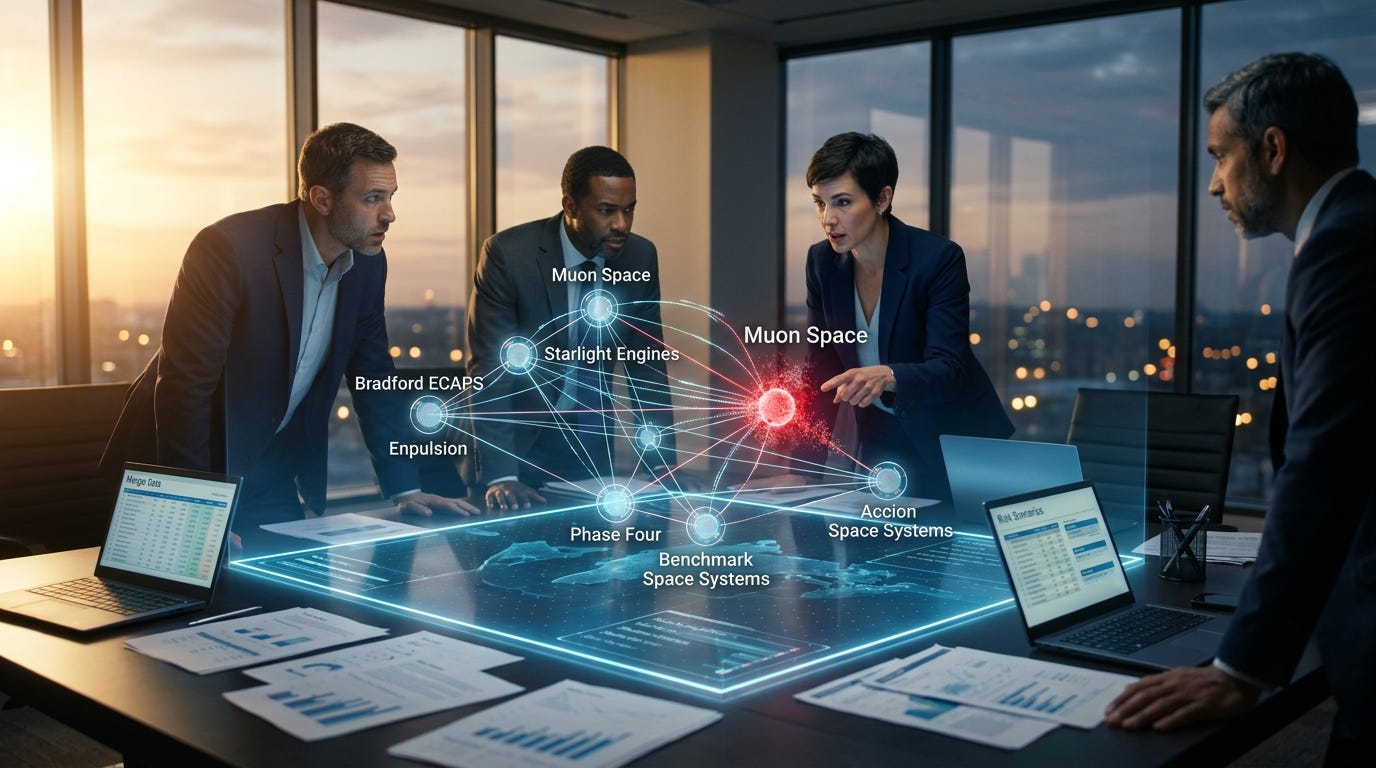
The names most commonly appearing on smallsat approved vendor lists include ECAPS (Swedish-owned, ammonium dinitramide “green” monopropellant), Enpulsion (Austrian, field emission electric propulsion), Phase Four (U.S., radio frequency ion), Benchmark Space Systems (U.S., green monopropellant and electric hybrid), and Revolution Space Systems (U.S., electrospray). Starlight Engines, prior to acquisition, occupied a position in this landscape as an independent propulsion developer targeting the same spacecraft class.
That landscape is now one supplier shorter for any program that needs an open-market source. The precise customer list Starlight Engines held is not publicly disclosed. Based on the company’s stated product focus on smallsat and microsatellite propulsion in the 50–200 kg spacecraft class, the programs most likely affected are commercial Earth observation operators, dual-use constellation developers, and research-affiliated mission developers who do not have direct relationships with larger propulsion primes.
The more important map, however, is not who Starlight was serving. It is how many fully independent, adequately capitalized propulsion suppliers remain in the open market after this transaction — and how many of those are likely acquisition targets themselves.
