

Multiple Factors Influence Polar Region Satellite Communications Market
Report Indicates the Market is Set to Experience Remarkable Growth in the Coming Years

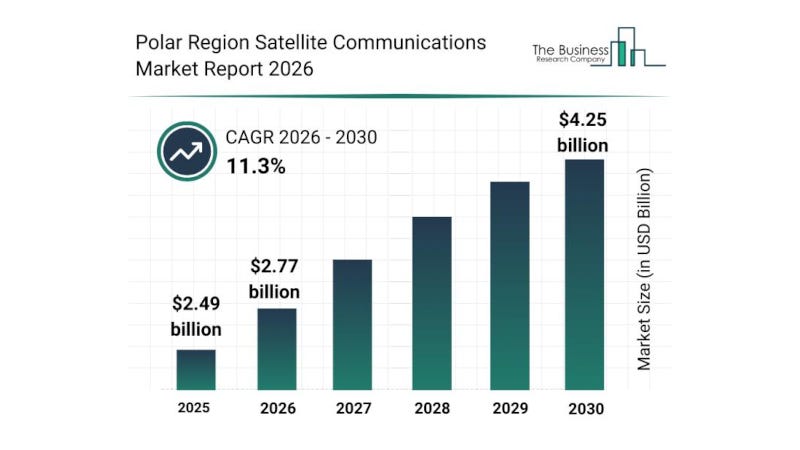
The polar region satellite communications industry is on the verge of significant expansion, driven by increasing technological advancements and growing needs for connectivity in extreme environments. According to new analysis from The Business Research Company, as demand intensifies for robust communication systems in the Arctic and Antarctic, the market is set to experience remarkable growth in the coming years. Let’s explore the market’s size projections, leading players, driving forces, key trends, and the various segments shaping this specialized sector.
The polar region satellite communications market is anticipated to reach a value of $4.25 billion by 2030, showcasing a strong compound annual growth rate (CAGR) of 11.3%. This surge is largely fueled by the deployment of low-earth orbit (LEO) satellite constellations specifically focused on polar coverage, integration with Arctic navigation and surveillance systems, and the increasing use of AI-powered communication optimization technologies. Additionally, expanding activities in polar resource exploration and a growing reliance on emergency and disaster communication services further contribute to this robust growth. Key trends expected to shape the market include the expansion of LEO constellations to enhance polar communication, rising demand for resilient systems to support Arctic shipping, increasing scientific research requiring high-bandwidth data transmission, widespread adoption of portable satellite terminals for fieldwork, and advancements in high-frequency Ka- and Ku-band solutions designed to withstand harsh weather conditions.
One critical driver of market expansion is the rollout of low-earth orbit satellite constellations tailored for polar regions. These constellations improve connectivity and coverage in remote areas, supporting a variety of applications from scientific missions to commercial operations.
Another important factor is the integration of satellite communications with Arctic navigation and surveillance technologies. This integration enhances situational awareness and safety for maritime traffic and resource exploration activities in these challenging environments.
Leading companies are increasingly adopting cutting-edge technologies such as AI-powered microsatellite surveillance to improve connectivity and monitoring in remote, high-latitude locations. These compact satellites automatically gather, analyze, and interpret data in real time, providing invaluable support to governments, defense agencies, and research institutions.
Fascinating. This is such a clear look at a market I barely considered. The details on LEOs and especially AI-powered optimization truely highlight the technical leap. I'm always curious to see how these algorithms handle such extreme environments – probably a lot better than I would in the Arctic, even with my best Pilates form!