


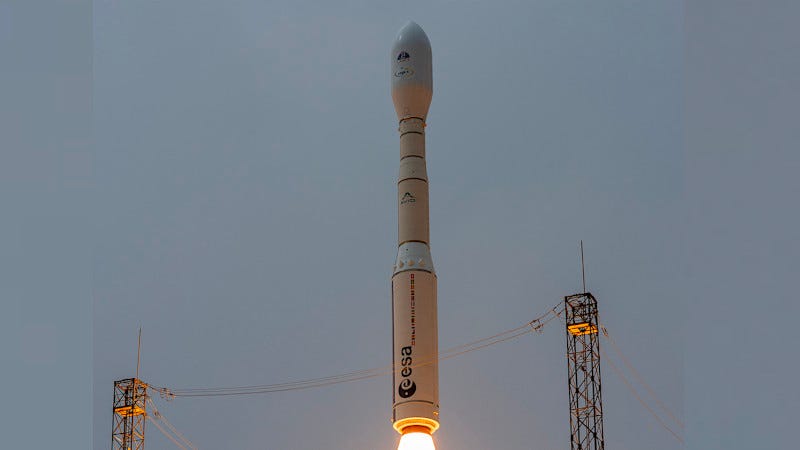
A scientific mission designed to capture the most comprehensive view ever of how the solar wind interacts with Earth’s magnetic field is nearing launch, carried aloft by a launch vehicle whose critical systems were assembled across two countries and multiple specialized facilities spanning nearly 1,000 miles of European supply chain.
“We are proud that our technologies are part of a mission that will significantly deepen our understanding of the fundamental processes between the sun and Earth.”
Stefan Hofmann, Beyond Gravity
The Solar Wind Magnetosphere Ionosphere Link Explorer, or SMILE, a joint mission of the European Space Agency (ESA) and the Chinese Academy of Sciences (CAS), is scheduled to lift off aboard a Vega-C rocket from the Guiana Space Centre in French Guiana in May. Four essential launch systems, the payload adapter, payload fairing, acoustic protection system, and on-board computer, were developed and manufactured by Beyond Gravity at separate facilities in Linköping, Sweden, and Emmen, Switzerland, then integrated into the Italian-built Vega-C launch vehicle produced by Avio.
The multi-site production model reflects a broader pattern in European launch infrastructure, where mission-critical hardware is routinely sourced from specialized suppliers across national borders, then assembled into a functioning rocket by a prime integrator. For the SMILE mission, that supply chain runs from a landlocked Swiss facility producing structural fairings, to a Swedish engineering center developing precision separation hardware and flight computers, before everything converges on a launch pad in South America.
“We are proud that our technologies are part of a mission that will significantly deepen our understanding of the fundamental processes between the sun and Earth,” said Stefan Hofmann, Managing Director of Beyond Gravity Switzerland. “With our systems for Vega-C, we are contributing significantly to European space exploration and to ensuring the security of modern infrastructure that can be affected by space weather events.”
The payload fairing, manufactured in Emmen, is a nine-meter-long, two-piece structure built from carbon-fiber-reinforced composite material. It shields the SMILE satellite from the extreme thermal, acoustic and mechanical stresses of ascent, then jettisons via an automatic pyrotechnic separation system once the rocket clears the upper atmosphere. Integrated within the fairing is Beyond Gravity’s Fairing Acoustic Protection system, which uses sound-absorbing elements to reduce the intense noise of launch to levels safe for SMILE’s sensitive instruments.
The Payload Adapter System, developed in Linköping, provides the structural and mechanical interface connecting the Vega-C to the SMILE satellite. Its modular design incorporates integrated separation and damping mechanisms that enable low-vibration satellite release, a precision requirement for missions where orbital insertion accuracy is critical.
Also produced in Gothenburg, Sweden, is the Vega-C on-board computer, the flight system that coordinates the rocket’s avionics, manages automated sequences, and controls trajectory throughout all phases of flight. The computer effectively serves as the decision-making hub that ensures each stage of the mission, from liftoff through satellite deployment, executes on schedule.
The collaboration between Beyond Gravity and Avio, which develops Vega-C on behalf of ESA, predates the SMILE mission. Beyond Gravity has supplied key systems for the Vega-C program across multiple launches, establishing a supplier relationship that Hofmann described as built on technological strength and mutual trust.
“This mission continues our long-standing and successful partnership with Avio,” Hofmann said. “Several of our core systems play a crucial role in safely and reliably placing the payload into orbit.”
Vega-C is an advanced version of the original Vega rocket, capable of carrying payloads of up to 5,070 pounds to polar orbit. It is a centerpiece of Europe’s strategy for independent access to space and has been used for scientific, institutional and commercial missions.
The SMILE mission itself represents a collaboration between European and Chinese space agencies to study a phenomenon with direct implications for Earth-based technology. Solar wind interactions with the magnetosphere drive space weather events that can disrupt satellites, power grids and communications infrastructure. The data SMILE gathers is expected to provide new foundational insights for space weather forecasting and the protection of orbital and terrestrial systems.