

Moon Base Deliveries Step Up As NASA Adds Four Late-2028 Missions
Suborbital Science Payloads Aim To Build Out Long-Term Lunar Operations

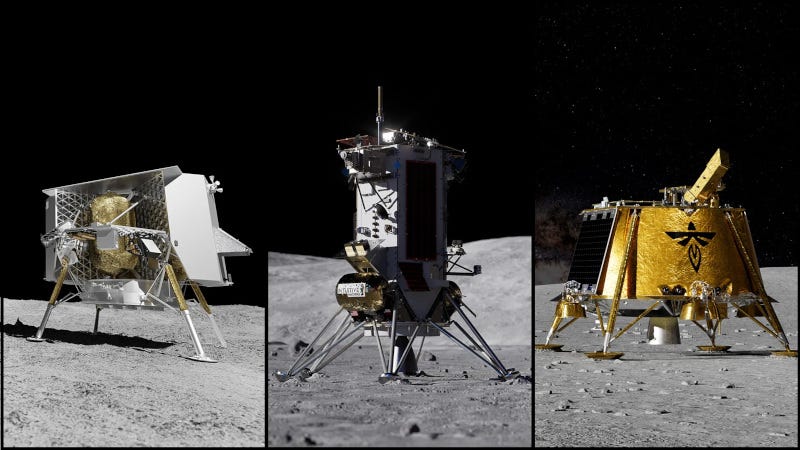
NASA has expanded its Moon Base mission manifest with four additional science deliveries to the lunar surface scheduled for late 2028. Astrobotic, Firefly Aerospace and Intuitive Machines will each use upgraded commercial landers to carry standardized NASA payloads that support the agency’s plan for a sustained human and robotic presence on the Moon.
“We’re building a proving ground for Moon Base operations.”
Ryan Stephan, NASA
The agency said the new missions, part of its Commercial Lunar Payload Services initiative, are valued at nearly $600 million combined. Awards announced June 30 include $297.9 million for two Astrobotic flights and single missions valued at $144.2 million for Firefly Aerospace and $148.3 million for Intuitive Machines. All three companies will fly updated versions of landers that have already been fielded under CLPS, a cornerstone of the Moon Base logistics plan.
“We’re building a proving ground for Moon Base operations,” said Ryan Stephan, NASA’s acting director of cargo landers. “Accelerating our Moon mission ordering cadence and launch opportunities enable us to move quickly to learn, iterate, and improve.”
Each of the four late-2028 missions will deliver a common set of three science instruments designed to characterize landing hazards, radiation exposure and local environment. The payload suite includes the Stereo Camera for Lunar Plume Surface Studies, or SCALPSS, a four-camera array that uses stereo photogrammetry techniques to capture three-dimensional views of engine exhaust plumes interacting with lunar dust during descent. NASA said the data, gathered across different landing sites, propellant types and engine classes, will feed erosion and ejecta models intended to support larger, heavier vehicles operating in proximity on the Moon.
The Laser Retroreflector Array, or LRA, will serve as a passive navigation aid. The cookie-sized device, built around eight quartz corner-cube prisms mounted in a dome-shaped aluminum frame, reflects laser beams from lunar orbiters and other spacecraft to improve orbit determination and final approach navigation. NASA has already flown LRA units on multiple CLPS and international landers and is building toward a global network of permanent location markers on the Moon.
A third payload, the Linear Energy Transfer Spectrometer, or LETS, will monitor the radiation environment across transit profiles and surface locations. Derived from heritage hardware, LETS uses a compact silicon detector to measure incoming particle energy and identify radiation types. NASA expects those data to support mission design and crew protection planning for longer-duration human operations.
“By flying the same science instruments on multiple landers, we will better understand potential hazards during landing and build out a global network of environmental data and location markers on the Moon,” said Joel Kearns, deputy associate administrator for exploration in NASA’s Science Mission Directorate. “It’s akin to having weather stations in different locations on Earth.”
Beyond the four new missions, NASA is preparing additional solicitations tied to Moon Base infrastructure and science. Agency officials said they plan to seek proposals for lander-based power and avionics technology demonstrations, another science payload manifest and a South Pole optical imager. NASA also intends to issue an open call for Moon Base technology demonstrations and to study a dedicated lunar communication and navigation relay constellation linking Moon Base assets and Earth-based operators.
The agency is also considering a path for PROMISE, the Polar Rover for Observation, Mapping, and In-Situ Exploration, to join future Moon Base missions. The proposed rover is described as a hybrid engineering development version that draws on Mars Perseverance and Curiosity heritage designs to survey the lunar surface and subsurface and prospect for resources.
Under the June 30 awards, the three providers will oversee procurement and mission execution, provide assessments of similar previous landers and document lessons learned to improve reliability. The agency said it is reviewing options to add further payloads to the new flights.
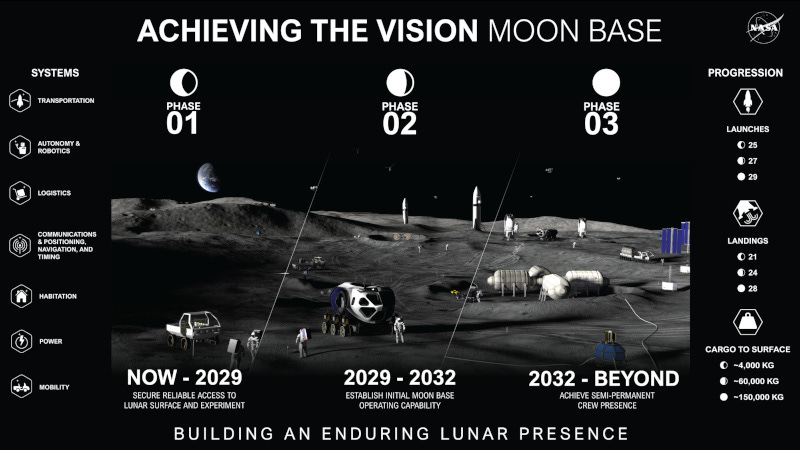
NASA describes Moon Base as a long-term exploration and infrastructure effort aimed at enabling sustained human presence and expanded scientific and commercial activity on the lunar surface. As part of its broader exploration roadmap, the agency plans to send astronauts on progressively more complex missions to extend science, support economic activity and lay groundwork for the first crewed missions to Mars.