

meoSphere MEO Satellite Network to Boost SES Network Capacity
Operational Status Anticipated in 2030

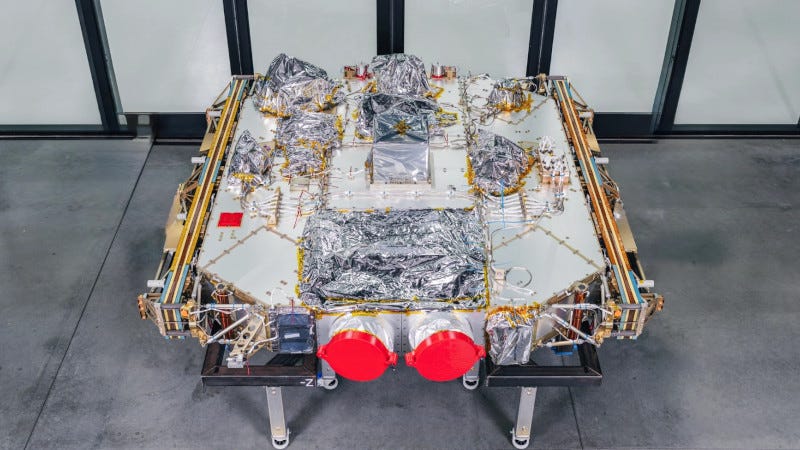
meoSphere, a next-generation medium Earth orbit (MEO) satellite network under development by SES, is being targeted for operation by 2030, according to a company news release. The program launches with a close collaboration designed for efficient satellite production. SES will pair its own software-defined payloads, being developed and manufactured in Luxembourg, with an initial 28 high-power satellite platforms developed by K2 Space, representing the first phase of the broader meoSphere rollout.
“Space is the invisible backbone of the global data economy and national security.”
Adel Al-Saleh, SES
The collaboration gives SES tighter control over key supply-chain elements, compresses the build timeline, and allows the company to manage schedules and costs with precision, laying the foundation for future scalability.
meoSphere is SES’s next generation MEO network, significantly boosting global broadband capacity, increasing user data speeds while reducing terminal sizes and costs. These step-change improvements come from advances in payload and terminal technologies, software-defined networking, 5G non-terrestrial network (5G NTN) standards and MEO’s inherent strengths: efficient geographic coverage, ability to steer capacity to the high-demand areas, optimizing ground-station deployment, and low latency. The network is designed to meet growing demand for secure, stable, reliable, and resilient connectivity across government, mobility, and fixed telecommunications markets. The meoSphere network will be compatible with Europe’s IRIS2 program.
Orbiting at about 8,000 kilometers (≈5,000 miles) above Earth, SES is designing meoSphere for adaptability across new missions, new use cases, and new customer segments. Beyond its core broadband mission, the network’s flexible architecture will support multiple missions simultaneously, including integration with sovereign networks, serving governments and other customers that require sovereign solutions. meoSphere will also support the growing space economy, functioning as a space-based host for customer payloads and as a “backbone network in space” that enables interconnections between constellations in all orbits to relay data to each other and to the ground in real time.
“Space is the invisible backbone of the global data economy and national security,” said Adel Al-Saleh, CEO of SES. “Together with K2 Space and other space partners, we’re building meoSphere as essential infrastructure—constructed faster, designed to handle massive data demands globally, and built to support the secure, resilient sovereign networks that our global government allies depend on.”
“The meoSphere partnership with SES is a clear validation of K2’s mission to build the highest power satellites on orbit to realize our partners’ and customers’ ambitions in space,” said Karan Kunjur, Co-Founder and CEO of K2 Space. “We’re incredibly proud to partner in this effort with SES, a longstanding and forward-leaning space industry leader who shares our commitment to building new, efficient space architectures at speed and scale.”
Over the next three years, SES plans to launch a series of MEO “pathfinder” missions with K2 Space to test and validate the satellite bus and SES payload components in orbit, refine operational concepts, and reduce risk ahead of full-scale deployment. Each mission will carry progressively greater payload complexity, incorporating lessons learned from earlier flights into the development cycle.
This announcement builds on SES’s collaboration with K2 to develop a next generation MEO network. This initiative is included in the company’s previously announced capital expenditure guidance for full-year 2026 and is expected to conform to SES’s financial policy of disciplined capital deployment. The company is committed to using a disciplined mix of commercial and public-private approaches to mitigate financial risk. In addition, SES intends to maintain a dual supply chain across the Atlantic to strengthen resilience against potential constraints in parts availability, permitting, and logistics.