

Mars Mission Tests Firefly’s Composite Capabilities
SkyFall Aeroshell Contract Advances Helicopter-Based Exploration

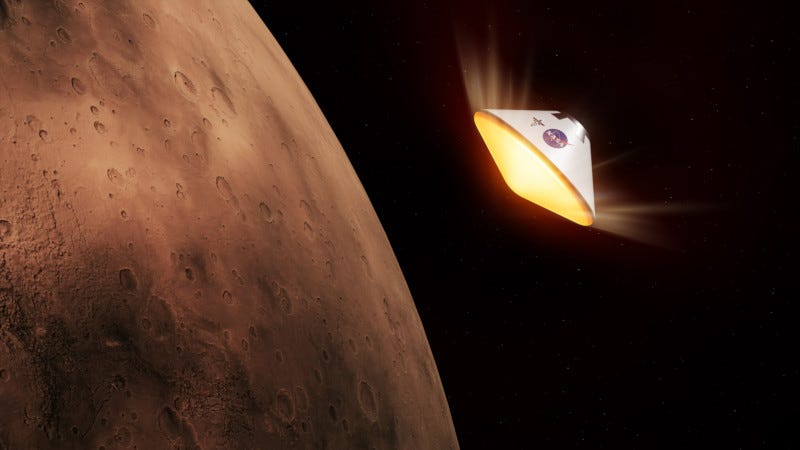
NASA’s Jet Propulsion Laboratory has awarded Firefly Aerospace a $13 million subcontract to build the aeroshell that will deliver three reconnaissance helicopters to the surface of Mars on the agency’s SkyFall mission, targeted for launch in late 2028.
“Our deep expertise in building large composite structures for both spacecraft and rockets gives us a unique advantage to enable critical planetary missions like SkyFall.”
Shea Ferring, Firefly
Under the agreement, Firefly will manufacture, test and deliver both the backshell and heat shield for the entry capsule that will house the rotorcraft, drawing on composite manufacturing techniques proven on the company’s Blue Ghost lunar landers, Elytra orbiters and Alpha and Eclipse launch vehicles. The work will be led out of Firefly’s new Gloworks innovation lab and executed at its Rocket Ranch campus in Briggs, Texas.
Shea Ferring, Firefly’s chief technology officer, said the SkyFall aeroshell deal is the first award to emerge from Glowworks, which the company established to incubate new technologies without disrupting its existing spacecraft and launch vehicle production lines. “Our deep expertise in building large composite structures for both spacecraft and rockets gives us a unique advantage to enable critical planetary missions like SkyFall,” Ferring said. “We’re further innovating these core technologies through Glowworks to push the boundaries of what’s possible and open new frontiers across our solar system.”
The aeroshell will undergo structural qualification and flight acceptance testing at Rocket Ranch before delivery to JPL, where it will be subjected to additional environmental testing prior to integration with the SkyFall helicopters and their deployment system. Firefly said the hardware is being designed to withstand the mechanical loads and thermal stresses associated with launch, interplanetary cruise and Mars atmospheric entry, descent and landing.
SkyFall builds on the Ingenuity Mars Helicopter technology demonstration flown with NASA’s Perseverance rover, extending that concept to a three-aircraft mission focused on science and resource prospecting. JPL plans to deploy the rotorcraft using a mid-air release technique dubbed the “SkyFall Maneuver,” in which the entry capsule will release all three helicopters during atmospheric descent rather than lowering them from a landed platform.
Once deployed, the helicopters are expected to fly to designated surface locations, capture high-resolution imagery and collect subsurface radar data intended to improve understanding of the landing site’s terrain and geologic history. Mission planners also intend to use the radar returns to scout for water ice and other resources that could support eventual American crewed expeditions to Mars.
Ray Allensworth, Firefly’s vice president of spacecraft, framed SkyFall as part of a broader off-Earth mission portfolio that includes multiple flights under NASA’s Commercial Lunar Payload Services program. “We’ve proved our ability to execute off-Earth missions at a fraction of the cost and timeline through our successful Blue Ghost lunar mission,” Allensworth said. “Now we’re applying these lessons learned and utilizing our proven technologies to continue accelerating and lowering costs for future missions to the Moon, Mars, and beyond.”
Firefly said it is making “significant progress” across four upcoming CLPS lunar missions and noted a separate JPL subcontract to deliver four drones above the Moon’s south pole with its Elytra spacecraft for the MoonFall mission. The company earlier doubled the size of its central Texas facilities and expanded its spacecraft cleanroom to support assembly-line production of lunar landers and orbital vehicles, with the goal of fielding multiple missions per year.