


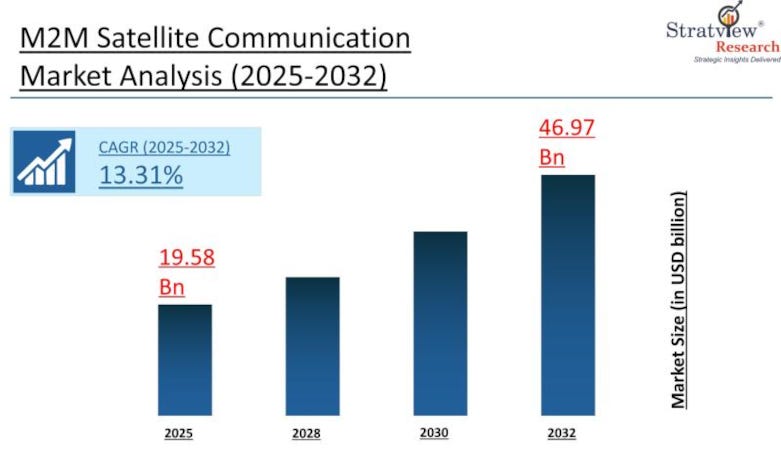
The M2M Satellite Communication market - which enables automatic data exchange between satellite-equipped machines without human intervention - is projected to reach $46.97 billion by 2032, growing at a CAGR of 13.31% during the 2025-2032 forecast period, according to Stratview Research. The market was valued at $17.22 billion in 2024, with strong expansion driven by the rapid adoption of IoT technologies in remote and hard-to-reach locations where terrestrial networks are unavailable or unreliable. This structural demand for assured, seamless connectivity emphasizes the strategic role of satellite M2M communication in diversified industrial applications.
The company’s new report on the global market which provides a comprehensive outlook of the global and regional industry forecast, current & emerging market trends, segment analysis, competitive landscape, & more.
The report covers global and regional forecasts from 2025 to 2032, with detailed segmentation by offering type, technology type, end-use type, and geography. It offers strategic insights into growth drivers, challenges, and high-opportunity segments for manufacturers, suppliers, OEMs, and investors.
In the technology category, the very small aperture terminal (VSAT) segment is projected to be dominant because its flexible, scalable two-way satellite communication capabilities meet diverse industrial connectivity needs in areas lacking terrestrial infrastructure, providing reliable, high-speed communication for monitoring and control applications across sectors such as energy, maritime, and transportation. Such structural reliability enhances operational continuity in remote deployments, influencing strategic investments in VSAT systems.
For end-use, the automotive & transportation segment is expected to account for the largest market share as real-time data exchange becomes critical for fleet management, vehicle tracking, navigation efficiency, safety monitoring, cargo status tracking, and predictive maintenance. This ensures operational efficiency and cost optimization across logistics and transportation services, reinforcing satellite M2M adoption in the sector.
North America is both the dominant and fastest-growing region due to strategic government investments, advanced technological adoption including 5G, AI, and cloud-based satellite systems, and high IoT penetration across industries. The structural innovation ecosystem and strong industry presence boost demand for real-time connectivity solutions in remote, mobile, and mission-critical applications.
According to the report, market drivers include:
Expansion of IoT technologies driving need for uninterrupted remote connectivity.
Rising requirement for communication services in rural and remote areas where terrestrial networks fail.
Strategic government investment in satellite infrastructure supporting advanced technologies.
Integration of 5G, AI, and cloud systems enhancing real-time data capabilities.
Growth in automotive, transportation, and logistics sectors demanding robust data exchange.