

Lunar Rover Contract Advances NASA’s Moon Base Vision for 2028
Astrolab, Lunar Outpost Selected to Deliver Crewed Rovers to the Lunar South Pole

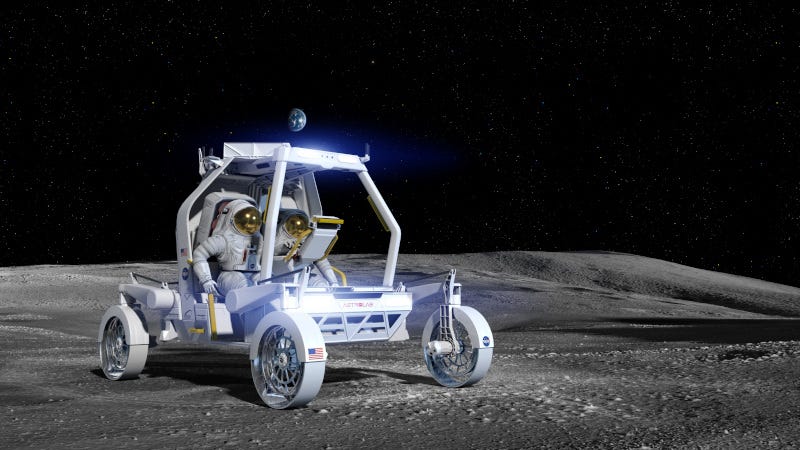
NASA has awarded contracts to two companies to build and deliver crewed lunar rovers to the Moon’s south pole by 2028, a foundational step in the agency’s Moon Base initiative aimed at establishing a sustained human presence on another world.
“CLV-1 reflects the adaptability of our FLEX architecture and the years of testing our team has already completed.”
Jaret Matthews, Astrolab
Venturi Astrolab received a $219 million task order and Lunar Outpost received $220 million to develop their respective rovers under Phase 1 High Achievability Mission task orders of the Lunar Terrain Vehicle Services (LTV) contract. Both rovers will be delivered to the lunar surface through NASA’s Commercial Lunar Payload Services (CLPS) initiative.
Astrolab’s entry, the Crewed Lunar Vehicle-1 (CLV-1), is adapted from the company’s FLEX rover architecture. When stowed on a CLPS lander for delivery, CLV-1 measures approximately 6.6 feet long, 7.5 feet wide, and 7.2 feet tall. Once deployed on the surface, it extends to roughly 13 feet long and 8.5 feet wide, with an antenna height of about 8.5 feet. The rover weighs a maximum of about 2,094 pounds and can reach speeds of more than 6 mph on level ground. CLV-1 is designed to transport astronauts and supplies and can also conduct surface operations remotely.
Astrolab and its teammates — Axiom Space, Interlune and Odyssey Space Research — will deliver CLV-1 and related services supporting both crewed and robotic surface missions. The rover uses tires, batteries, and a battery management system developed with Astrolab’s strategic partner, Venturi Space.
“We’re honored that NASA has selected Astrolab to help provide the surface mobility astronauts will need as the Artemis program returns humanity to the Moon,” said Jaret Matthews, founder and CEO of Astrolab. “CLV-1 reflects the adaptability of our FLEX architecture and the years of testing our team has already completed.”
The second selected provider, Lunar Outpost, will deliver the Pegasus rover — a lighter, mission-ready evolution of its Eagle rover built specifically to meet NASA’s updated LTV requirements. Pegasus is designed to operate for up to a year and can be driven manually, autonomously, or via teleoperations at speeds of more than 9 mph. It incorporates Apollo-heritage technologies and draws on prior prototype and flight experience.
Both contracts were awarded under the Lunar Terrain Vehicle Services indefinite-delivery/indefinite-quantity (IDIQ) contract that NASA issued in 2024 with a potential maximum value of up to $4.6 billion over 13 years. The task orders announced represent Phase 1 of that broader program, with NASA anticipating the first LTVs will reach the Moon by 2028.
To deliver the rovers to the lunar south pole, NASA separately awarded Blue Origin $188 million — with an option period valued at $280.4 million — for lunar lander services under the CLPS framework.
The rover selections were announced during a Moon Base event at NASA Headquarters in Washington on May 26, 2026, where the agency also revealed the first three robotic precursor missions designed to reduce risk before crewed Artemis astronaut landings.
Moon Base I, targeted for launch no earlier than fall 2026, will use Blue Origin’s Blue Moon Mark 1 Endurance lander to deliver NASA scientific instruments to the Shackleton Connecting Ridge. Moon Base II, also planned for 2026, will deliver more than 1,100 pounds of cargo on Astrobotic’s Griffin lander, including Astrolab’s FLIP rover, to advance mobility systems ahead of full LTV operations. Moon Base III, targeted for launch this year as well, will fly on Intuitive Machines’ Nova-C Trinity lander and includes a Lunar Vertex investigation studying lunar swirls, with payloads from ESA and the Korea Astronomy and Space Science Institute.
These three missions are the first of more than a dozen planned for announcement this year, each generating operational data to reduce risk ahead of crewed Artemis surface activities.
“The Moon Base will be America’s and humanity’s first outpost on another celestial world,” said NASA Administrator Jared Isaacman. “Every mission, crewed and uncrewed, will be a learning opportunity as we return to the lunar surface, build the infrastructure to stay, and master the skills required to live and operate in one of the most demanding and dangerous environments imaginable.”
Since unveiling a full-scale working prototype of the FLEX rover in 2022, Astrolab has conducted thousands of hours of lab and field testing covering crewed and telerobotic operations, payload deployment, and mobility in challenging terrain. CLV-1 builds on that experience while meeting NASA’s revised requirements for the next phase of Artemis surface mobility.
NASA also announced updates to MoonFall, a mission targeting 2028 that will send four drones to make short hops across the lunar surface to survey potential Artemis landing sites. Firefly Aerospace has been selected to build the spacecraft that will transport the drones from Earth orbit to the Moon.
Over the next 18 months, Astrolab and Lunar Outpost will finalize rover designs, conduct crewed evaluations, and qualify flight units for operational readiness. NASA said it will also expand opportunities for additional vendors through on-ramp competitions as the Moon Base program matures.