

Lunar Payload Contract Ceiling Set to Rise 62% to Back Expanded Moon Landing Cadence
NASA Seeks to Add $1.6 Billion in Ordering Authority Across 13 Commercial Providers

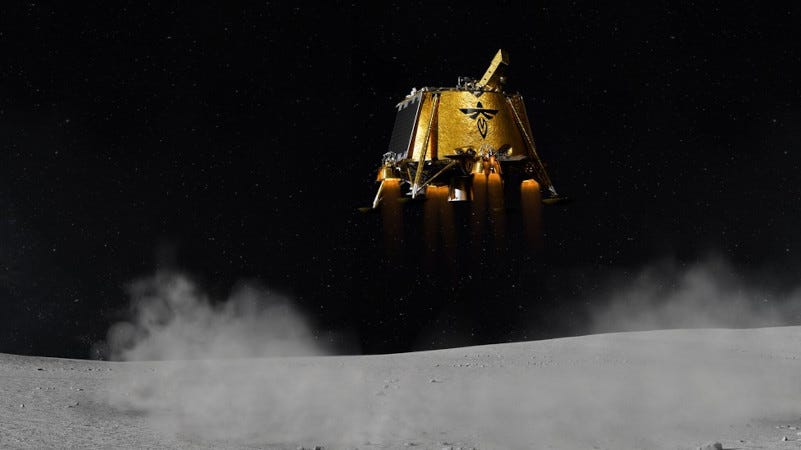
A 62 percent increase in the maximum spending authority for NASA’s Commercial Lunar Payload Services program — lifting the ceiling from $2.6 billion to $4.2 billion — is under consideration by the space agency as it expands a commercial delivery network that has already awarded 11 lunar missions to five contractors.
“Through CLPS, NASA is embracing a new era of lunar exploration, with commercial companies leading the way.”
Joel Kearns, NASA
The proposed modification, disclosed in a special notice posted April 27 by NASA’s Johnson Space Center in Houston to SAM.gov, the federal government’s centralized contract opportunity database, would apply across all 13 companies currently holding CLPS contracts. NASA is contemplating a sole-source contract modification, and organizations that believe they have the capability to perform the work may submit qualifications electronically to tasha.beasley@nasa.gov no later than 4 p.m. CDT on Wednesday, May 6, 2026.
The CLPS program was established to allow rapid acquisition of lunar delivery services from commercial vendors to carry NASA science and technology payloads to the Moon’s surface and orbit. Contracts are structured as firm-fixed-price, indefinite delivery/indefinite quantity agreements under FAR Part 12 commercial services provisions. Under the program, contractors are responsible for all activities necessary to safely integrate, accommodate, transport and operate NASA payloads, using contractor-owned assets that include launch vehicles, lunar landers, lunar surface systems and Earth re-entry vehicles.
The 13 companies currently under CLPS contract are: Astrobotic Technology, Inc.; Blue Origin, LLC; Ceres Robotics, Inc.; The Charles Stark Draper Laboratory, Inc.; Firefly Aerospace, Inc.; Intuitive Machines, LLC; Lockheed Martin Space; Moon Express, Inc.; Orbit Beyond, Inc.; Redwire Space Sensors, Inc.; Sierra Space; Space Exploration Technologies Corp.; and Tyvak Nano-Satellite Systems, Inc. The existing contracts run through November 2028 with a combined maximum ordering value of $2.6 billion.
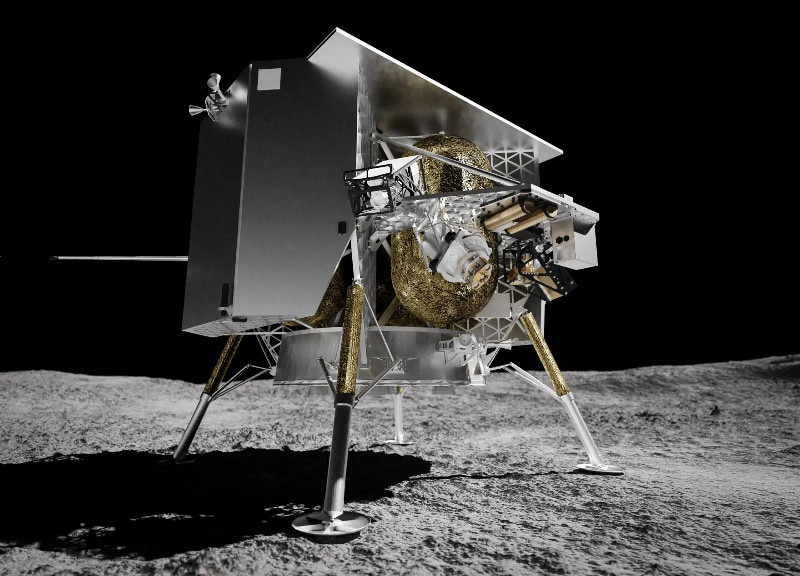
To date, NASA has awarded 11 lunar delivery task orders to five of the 13 CLPS vendors, covering more than 60 NASA instruments and other payloads. The agency currently plans 15 commercial lunar deliveries through 2028. Recent task orders illustrate the pace of the program’s expansion. In March 2026, Intuitive Machines of Houston received a $180.4 million task order to deliver NASA-funded science and technology to the lunar surface. Separately, Firefly Aerospace of Cedar Park, Texas, was awarded $176.7 million to deliver two rovers and three scientific instruments, including a Canadian Space Agency rover, to the Moon’s South Pole region — the company’s fifth CLPS task order and fourth lunar mission.
“Through CLPS, NASA is embracing a new era of lunar exploration, with commercial companies leading the way,” said Joel Kearns, deputy associate administrator for exploration at NASA’s Science Mission Directorate. “These investigations will produce critical knowledge required for long-term sustainability and contribute to a deeper understanding of the lunar surface.”
Adam Schlesinger, manager of the CLPS initiative at Johnson Space Center, has noted that the cadence of commercial deliveries is directly tied to the agency’s longer-term human exploration goals. “As NASA sends both humans and robots to further explore the Moon, CLPS deliveries to the lunar South Pole region will provide a better understanding of the exploration environment, accelerating progress toward establishing a long-term human presence on the Moon, as well as eventual human missions to Mars,” Schlesinger said.
The proposed $1.6 billion ceiling increase would expand ordering authority under the existing CLPS 1.0 structure as the program scales. NASA has stated that commercial deliveries to the lunar surface support science experiments, technology tests and capability demonstrations intended to lay the foundation for sustained human presence on the Moon as part of the Artemis campaign.
The government’s determination of whether to compete the modification on a full and open basis rests solely with the agency and will be informed by capability statements received in response to the April 27 notice. Oral communications are not acceptable in response to the notice.