

Lunar Mapping Study Advances With ESA Moonraker Phase A
Small Satellite Platform To Support Polar LiDAR Survey Of Future Landing Sites

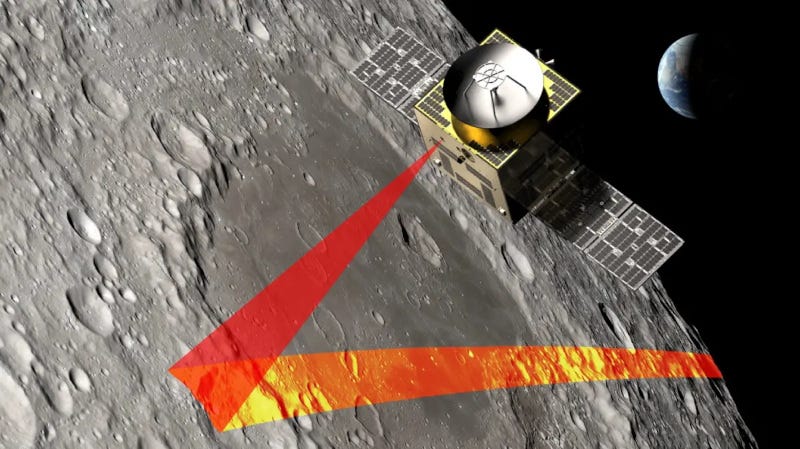
SFL Missions has joined a European Space Agency study that aims to generate detailed three-dimensional maps of the Moon’s polar regions to support future landing site selection and surface operations planning.
“As part of the Pre-Phase A work, the Moonraker team developed a robust mission concept for lunar LiDAR mapping.”
Dr. Robert E. Zee, SFL Missions
The company is part of a team led by prime contractor NUVIEW GmbH, which ESA selected to conduct the Moonraker Phase A study following a completed pre‑Phase A assessment in 2025. Moonraker is intended to deliver wide‑area 3D mapping and high‑resolution terrain models, particularly in the lunar south polar region where accurate topography is critical for landing and mobility.
SFL Missions is responsible for developing the small satellite platform that will host Moonraker’s laser scanning LiDAR payload, and for mission analysis and planning related to launch and operations. The company said its preliminary spacecraft concept is based on its DAUNTLESS‑L platform, a high‑performance small satellite design that emphasizes power generation, data handling, and precise attitude control.
The mission calls for a single orbiter operating in a low‑altitude polar orbit around the Moon, providing significant onboard power and storage to support the LiDAR system. The spacecraft will be designed for precision navigation and payload pointing to enable high‑resolution mapping, and for high‑data‑rate downlink to return lunar terrain data to Earth.
Phase A work will address several technical challenges, including providing sufficient delta‑V for lunar orbit insertion and maintenance, meeting tight navigation requirements, managing large payload data volumes, and operating in a demanding thermal environment.
“As part of the Pre-Phase A work, the Moonraker team developed a robust mission concept for lunar LiDAR mapping,” said SFL Missions’ Director Dr. Robert E. Zee. “This work included development of a preliminary spacecraft concept based on SFL’s DAUNTLESS-L platform. We see tremendous potential for Moonraker to contribute to lunar science, exploration, and future surface operations.”
If Moonraker proceeds beyond Phase A, SFL Missions is positioned to complete detailed spacecraft design, manufacturing, payload integration, environmental testing, launch coordination, and on‑orbit commissioning.
NUVIEW GmbH, a Berlin‑based space technology company, is leading development of Moonraker’s lunar LiDAR capability, drawing on technology and operational concepts from its commercial Earth observation program. The company expects the mission to support landing site assessment, hazard identification, surface operations planning, and scientific investigation for future European lunar exploration activities.