


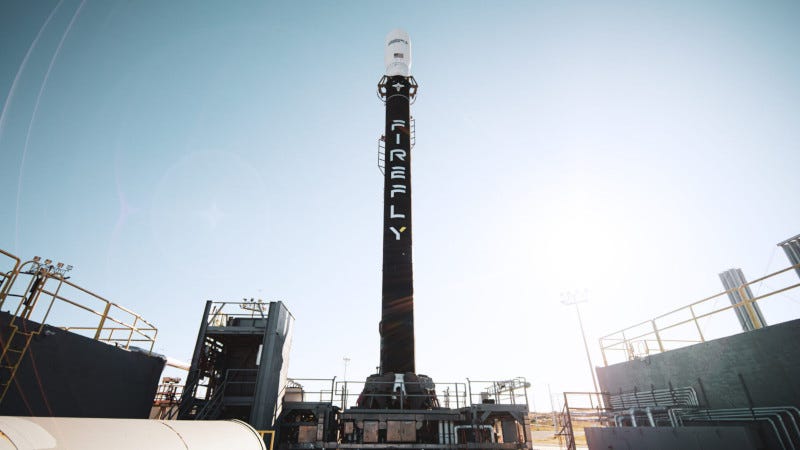
Firefly Aerospace and Lockheed Martin have extended their multi-launch agreement by two years, adding up to 25 dedicated flights on Firefly’s upgraded Alpha rocket through 2031.
“As we upgrade to Alpha Block II, we’re increasing the manufacturability, reliability, and responsiveness of our rockets to support a higher flight rate and provide assured access to space when our customers need it most.”
Jason Kim, Firefly Aerospace
The Cedar Park, Texas-based company, which trades on the Nasdaq under the ticker FLY, announced the extension Aug. 11. The deal shifts Lockheed Martin’s missions onto Firefly’s Alpha Block II configuration, an upgrade the company says increases manufacturing rate and reliability over the current Alpha design.
The extension comes as demand for dedicated launches in the 2,200-pound (1,000-kilogram) payload class outpaces supply, according to the release, with government and commercial customers pushing for more control over launch schedules and direct delivery to preferred orbits.
“As we upgrade to Alpha Block II, we’re increasing the manufacturability, reliability, and responsiveness of our rockets to support a higher flight rate and provide assured access to space when our customers need it most,” said Jason Kim, CEO of Firefly Aerospace. “This upgraded configuration allows us to increase Alpha’s production rate and fills a void at a time when launch options are in high demand, but payload capacity is scarce and launch site diversity is limited.”
Block II is also designed to expand Alpha’s capabilities for tactically responsive space missions, hypersonic testing and commercial satellite launches for domestic and international customers, per the release.
Firefly and Lockheed Martin are separately working with Seagate Space on sea-based launch concepts, using Seagate’s Gateway offshore launch platform. The three companies are developing mission-application concepts and flight-demonstration projects aimed at national security use cases, according to the release, which described the goal as providing “rapid, flexible access to space from diverse locations to support the warfighter’s evolving operational requirements.”