

Live Satellite Jamming Executed From Exhibit Floor at Space Symposium
SBMS Singularity Platform Demonstrates Real-Time Electromagnetic Effects Coordination in Public Setting

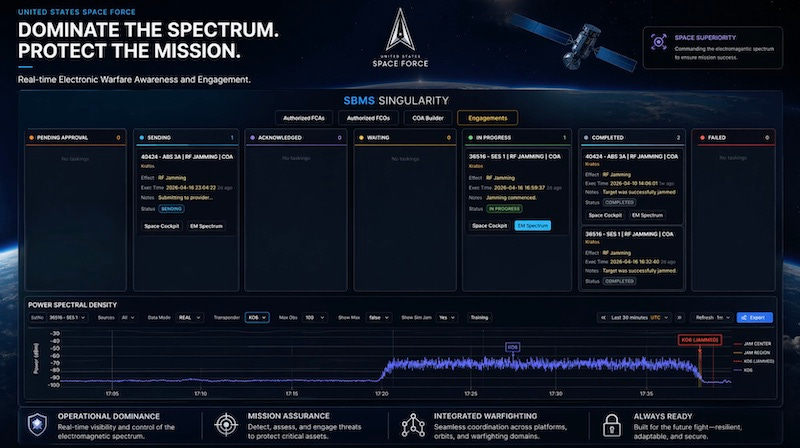
A live satellite jamming operation was executed from an exhibit booth at the recently-completed 41st Space Symposium, marking one of the first times a commercial software platform has publicly coordinated electromagnetic effects against a satellite link in an operationally relevant setting.
“This is a game changer. We’ve shown that effects don’t have to be tied to long acquisition cycles.”
Nathan Parrott, Saber Astronautics
The operation was conducted using the Space Battle Management System (SBMS) Singularity platform developed by Saber Astronautics. Performed at the Colorado Springs event, the demonstration targeted an authorized satellite service in a controlled environment, showcasing the ability to execute live electromagnetic effects against a satellite link in real time.
SBMS is a software platform already fielded in classified environments and operationally accepted across multiple U.S. Space Force Combat Forces Command and STARCOM units. The system supports thousands of users across the United States, NATO, and allied partners. Singularity extends the existing SBMS platform to allow operators to coordinate multiple mission effects simultaneously and in real time from a single unified interface.
“This is a game changer,” said Nathan Parrott, U.S. Director of Saber Astronautics. “We’ve shown that effects don’t have to be tied to long acquisition cycles. They can be orchestrated through software and deployed when they’re needed.”
Singularity supports a range of effects categories, including kinetic operations, rendezvous and proximity operations (RPO), optical effects, and other mission requirements. The platform brings those capabilities into a unified operational environment, enabling operators to plan and execute across distributed systems without the development timelines traditionally associated with new military capability programs.
The demonstration drew strong interest from senior military and space operations personnel attending the symposium. The response reinforced demand for space operations tools that can be deployed rapidly, function within secure environments, and adapt to evolving mission needs.
“We had a genuine ‘wait… what just happened’ moment when it worked live on a conference floor,” said Dr. Jason Held, CEO of Saber Astronautics. “And then we realized what it actually meant: we’re no longer limited to one system at a time. We can orchestrate multiple effects together, on multiple systems, in real time.”
The event also represented one of the first public integrations of commercial effects providers into an operationally relevant space mission scenario. Traditional acquisition programs for space effects systems have historically required years of development before fielding. The SBMS approach, by contrast, is built on software already operationally accepted across multiple command environments — which means Singularity can be integrated into existing mission architectures without the certification overhead associated with entirely new platforms.
SBMS holds a continuous authority to operate and is currently deployed across classified U.S. Space Force networks. Because Singularity extends the existing SBMS architecture rather than introducing a new system, integration into those environments can proceed on an accelerated timeline.
The demonstration comes at a moment of increasing attention to space domain awareness and electromagnetic spectrum operations. As activity in orbit continues to expand across government, allied, and commercial sectors, the ability to coordinate diverse capabilities — kinetic, electronic, optical — within a unified operational framework has become a stated priority across U.S. Space Force commands.
The Singularity demonstration signals an emerging model in which commercially developed, software-based platforms can be applied directly to operational mission environments, compressing the cycle between capability development and deployment. The live execution at one of the space industry’s most widely attended annual forums offered a concrete, public proof of concept.