

Life-Extension “Jetpack” Mission Robotic Vehicle Launch Marks New Phase For On-Orbit Satellite Service
Autonomous Space Robot And “Jetpack” Pods Target Satellite Life Extension, Inspection And Future Refueling

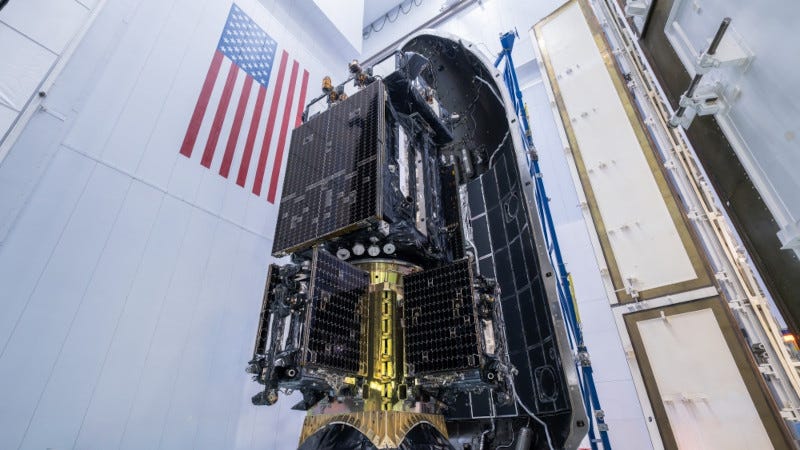
Northrop Grumman’s Mission Robotic Vehicle has reached orbit along with three Mission Extension Pods in a mission the company says ushers in a new phase of commercial satellite servicing and life extension.
“These are not demonstrations. Our world-leading investments in these capabilities are finally providing options in space that are only limited by our imagination.”
Ryan Tintner, NGC
According to SpaceX, the Mission Robotic Vehicle, or MRV, launched July 21 at 5:15 pm EDT aboard a Falcon 9 rocket from Cape Canaveral Space Force Station in Florida. The payload was a combined U.S. government robotics technology and Northrop Grumman’s commercial servicing hardware. According to the NGC, the spacecraft’s mission is to enhance the resilience, mobility and sustainability of U.S. assets in geosynchronous orbit.
Built by Northrop Grumman’s SpaceLogistics subsidiary in partnership with the Defense Advanced Research Projects Agency, MRV carries a Robotic Servicing of Geosynchronous Satellites payload developed by the U.S. Naval Research Laboratory. The payload includes two fully articulated robotic arms and specialized tools designed to enable a range of in-space operations including satellite inspection, relocation, repair, debris removal, payload upgrades, experimentation and in-space assembly.
The launch also placed three Mission Extension Pods, or MEPs, into orbit. Northrop Grumman describes the pods as propulsion “jetpacks” that can be attached to existing satellites to provide additional thrust and extend operational life. The company said the pods build on the capabilities of its Mission Extension Vehicles by offering a smaller-form-factor life extension option that can be deployed to a wider range of satellites.
MRV flew with what Northrop Grumman called the first on-orbit Passive Refueling Module, a Space Force-approved docking and refueling interface intended to allow the spacecraft to be refueled in space. The interface is part of a broader concept of sustained space maneuver missions in which servicing vehicles can be replenished and reused rather than deorbited at the end of a single mission.
The company also highlighted the vehicle’s onboard computing, saying MRV launched with advanced processing hardware sized for future artificial intelligence applications. Northrop Grumman said it plans to use AI to increase reliability, reduce operating costs and enhance mission assurance, and to support advanced in-space servicing concepts on future MRV operations.
Ryan Tintner, Northrop Grumman vice president and general manager for space superiority, said in a prepared statement that MRV represents “a whole new class of advanced autonomous space robotics” intended to support novel missions for national customers. “These are not demonstrations,” Tintner said. “Our world-leading investments in these capabilities are finally providing options in space that are only limited by our imagination.”
The new spacecraft builds on the company’s earlier Mission Extension Vehicle program, which Northrop Grumman said has delivered more than ten years of combined mission extension service to three commercial communications satellites in geosynchronous orbit. The company said MEVs, MEPs and the new MRV draw on its heritage in rendezvous and proximity operations, docking and space-qualified thermal and electronic systems.
Northrop Grumman said the mission-enabling thermal control products and electronics used on MRV protect and control the vehicle’s robotic arms, while space electronics on the electric propulsion thruster units provide the maneuvering necessary for the servicer to reach and dock with client satellites.
The company did not release details about specific client satellites or a schedule for initial servicing operations. Northrop Grumman said only that MRV will safely dock with and service customer spacecraft using its existing rendezvous and proximity operations expertise and that the vehicle is designed to evolve with future missions.