

LambdaVision Books Commercial Space in Low-Earth Orbit
Will Conduct Experiments Aboard the Starlab Space Station

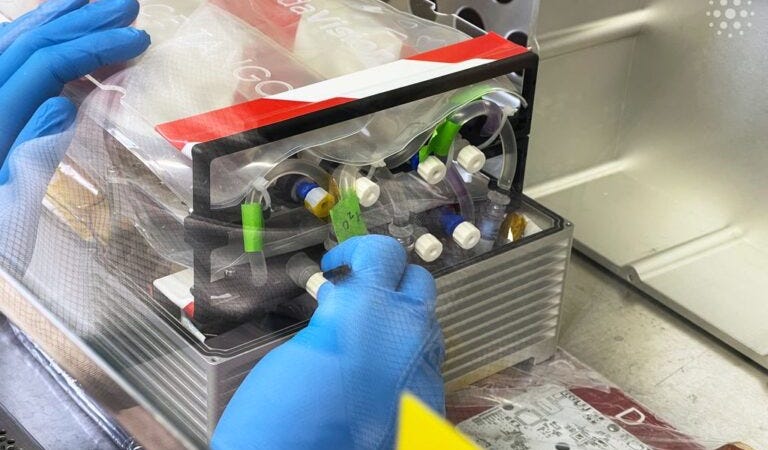
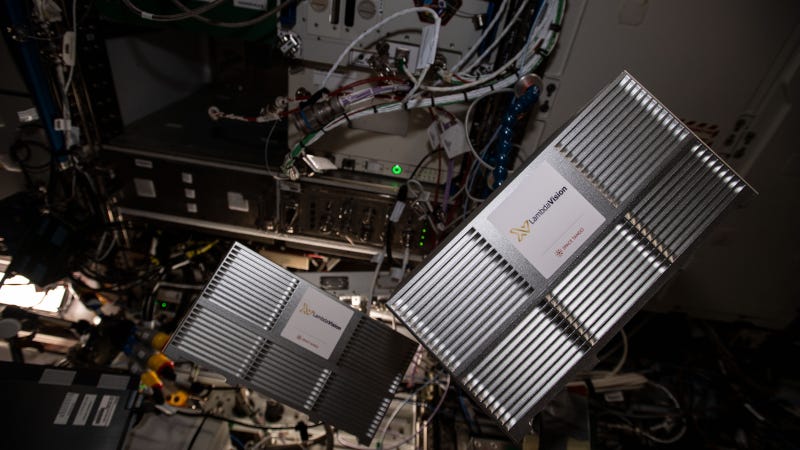
Biotech company LambdaVision has pre-booked commercial space in low-Earth orbit (LEO) through partnerships with Starlab Space LLC, a joint venture led by Voyager Technologies. This strategic agreement supports the company’s plan to scale manufacturing of its protein-based artificial retina in space to benefit people with retinal degenerative diseases here on Earth and prepares the company for the scheduled 2030 retirement of the International Space Station (ISS).
“LambdaVision has demonstrated the maturity of the science, engineering, and in-space manufacturing processes required to produce retinal implants in microgravity.”
Luis Zea, Ph.D., Starlab
Through this agreement, LambdaVision has reserved payload slots and commercial space on Starlab’s next-generation commercial space station.
“This partnership with StarLab will allow us to continue to build on the significant momentum we have created toward our long- and short-term goals of leveraging LEO for both advancing our protein-based artificial retina toward commercialization and laying the groundwork for other potential commercial efforts in LEO,” said Nicole Wagner, Ph.D., CEO of LambdaVision. “Our hope is that our layer-by-layer technology, and this partnership for commercial space in LEO, will help build a thriving LEO economy even as the ISS readies for retirement.”
“LambdaVision has demonstrated the maturity of the science, engineering, and in-space manufacturing processes required to produce retinal implants in microgravity,” said Luis Zea, Ph.D., chief scientist at Starlab. “Their reservation with Starlab enables the transition from demonstration to scalable, sustainable manufacturing, unlocking exponential growth while delivering meaningful benefits to patients on Earth. We are proud to work with LambdaVision to harness the unique advantages of microgravity to do good in the world.”
LambdaVision leverages microgravity to improve the layer-by-layer production process of their artificial retina through alternating layers of the protein bacteriorhodopsin and a polymer, supported by a membrane of a synthetic fiber that has long been used by the medical community. Reduced gravity in an LEO environment improves homogeneity, stability, and performance of thin films like the protein-based artificial retina. By using proteins similar to the visual pigment rhodopsin naturally found in our eyes, LambdaVision’s protein-based artificial retina mimics the light-absorbing properties of human photoreceptors replacing the function of these damaged cells in the retinas of blind patients.
“LambdaVision is a perfect case study to show the transformative potential of Starlab’s orbital platform for the biotech industry,” said Ariel Ekblaw, CEO of Aurelia Institute and founder of MIT Space Exploration Initiative. “Purpose-built infrastructure in space will empower a new generation of biotech companies – starting with LambdaVision – to pursue truly breakthrough advances. We are proud to support LambdaVision in their mission to leverage the space domain for the benefit of life on Earth and enthusiastically support their partnership with Starlab.”
While LambdaVision’s first application is focused on restoring vision, its layer-by-layer protein manufacturing platform has broader potential that could enable highly uniform, stable protein films for sensitive biosensors, optical systems, tissue engineering, and drug delivery applications. Moreover, the pioneering hardware, systems, and processes associated with manufacturing a drug product in microgravity will demonstrate feasibility and inspire new research and commercial therapeutic development in LEO.
“LambdaVision’s work represents an exciting step forward for life sciences in space. As investors in both LambdaVision and Voyager, we’re excited to see LambdaVision’s innovative artificial retina technology combined with Voyager’s Starlab platform,” said Rob Desborough, partner at Seraphim Space. “Together, they are demonstrating how orbital research can accelerate new therapies and expand the possibilities for commercial science in low-Earth orbit. It’s inspiring to see companies working together to harness microgravity to benefit patients here on Earth.”
LambdaVision has recently closed a $7M seed funding round co-led by Seven Seven Six and Aurelia Foundry Fund, with additional support from Seraphim Space, providing runway into 2027. With this funding, the company continues to validate its innovative space-based manufacturing to benefit those on Earth.
“LambdaVision has demonstrated the maturity of the science, engineering, and in-space manufacturing processes required to produce retinal implants in microgravity,” said Luis Zea, Ph.D., chief scientist at Starlab. “Their reservation with Starlab enables the transition from demonstration to scalable, sustainable manufacturing, unlocking exponential growth while delivering meaningful benefits to patients on Earth. We are proud to work with LambdaVision to harness the unique advantages of microgravity to do good in the world.”
The announcement builds on Starlab’s growing capabilities in biopharmaceutical and life sciences research in orbit. Microgravity offers conditions that cannot be replicated on Earth, allowing for reduced sedimentation and improved material uniformity, which support higher consistency in protein-based structures and directly impact therapeutic quality, reproducibility and regulatory readiness.
To date, LambdaVision has secured $22.0 million in funding and launched 9 missions to the ISS.
Genuinely compelling case for why the LEO bioeconomy is starting to look more than aspirational. The point about reduced sedimentation improving layer-by-layer protein film homogeneity is underrated -- this isn't just about convenience, its actually about batch-to-batch reproducability that matters for FDA clearance. I've followed microgravity manufacturing research for a few years and the jump from ISS demonstration missions to pre-booked commercial slots on Starlab is a meaningfull signal that the unit economics are getting real.