

JAXA Selects Contractor for Next-Gen Earth Observation Constellation
Consortium Led by Axelspace to Build the Spacecraft

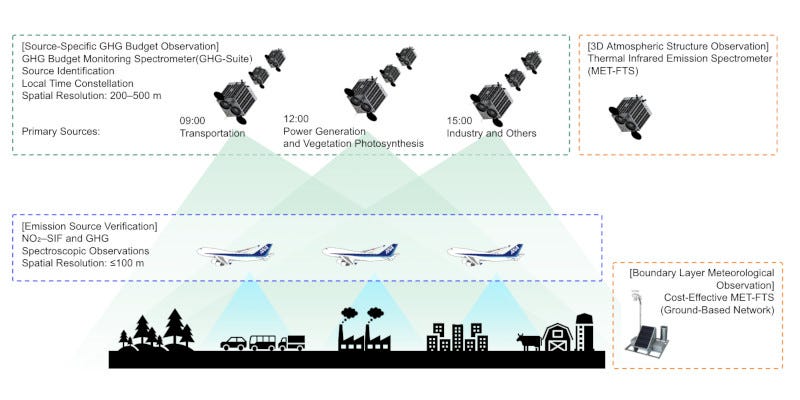
The Japan Aerospace Exploration Agency (JAXA)’s Space Strategy Fund has selected a consortium led by Axelspace for to develop technology that enhances capability of next generation Earth observation satellites.
“To drive effective action by governments and businesses alike, objective and transparent monitoring of greenhouse gas emissions —by specific sources— is essential.”
Yuya Nakamura, Axelspace
The overarching goal of this technology development program is a new satellite constellation working in coordination with aircraft and ground-based sensors. This integrated system aims simultaneous, multi-point observations at different times of day — morning, noon, and afternoon — particularly in regions that house major urban areas. Leveraging these data, CO2 emission and uptake information would be analyzed by source sector, time, and location.
Axelspace and the consortium believe that such objective and transparent information should provide a basis for an international benchmark for GHG reductions and contribute to the development of globally harmonized evaluation frameworks that incorporate economic incentives for emissions mitigation.
A key enabler for achieving time- and source-specific CO2 monitoring through a coordinated satellite constellation, aircraft, and ground-based observations is the miniaturization and cost reduction of spectrometers.
“Japan was the first country in the world to launch a satellite dedicated to observing greenhouse gases from space — Ibuki (GOSAT). Under this Space Strategy Fund initiative, the project will be led by Akihiro Kuze, who has been engaged in greenhouse gas observation at JAXA for many years and previously served as Project Manager of the Ibuki-2 (GOSAT-2) mission,” said Yuya Nakamura, president and CEO of Axelspace Corporation. “Climate change represents one of the most urgent challenges facing humanity. To drive effective action by governments and businesses alike, objective and transparent monitoring of greenhouse gas emissions —by specific sources— is essential. By bringing together Japan’s technological capabilities and expertise, we aim to help shape international rulemaking grounded in scientific evidence, while advancing the realization of a sustainable society and the creation of new market opportunities.”
Spectrometers measure gas concentrations by leveraging the property that atmospheric constituents absorb light at specific wavelengths, quantifying concentrations based on the degree of absorption. Under this Space Strategy Fund initiative, we will develop a new compact sensor that can be commonly deployed across satellites, aircraft, and ground-based observations. Unlike conventional high-precision spectrometers designed for government-operated satellites — which are typically large and costly — the new sensor will incorporate advanced domestically developed detector technologies to achieve both compactness and affordability.
Following a series of aircraft-based validation tests, we plan to launch a demonstration satellite equipped with the newly developed compact sensor between FY2030 and FY2032, with the aim of acquiring in-orbit observation data.
The results of this project will advance commercialization efforts beyond estimating CO2 emissions and uptake at the individual operator level. To strengthen data credibility, CO2 emission and uptake estimates will be accompanied with the underlying datasets used for their derivation and validation. These datasets include nitrogen dioxide (NO2) from fossil fuel combustion, solar-induced chlorophyll fluorescence (SIF) from vegetation, meteorological parameters such as wind direction and speed, and measurements from aircraft and ground-based meteorological networks. This comprehensive data integration will be intended to contribute to the establishment of internationally recognized benchmarks and standards for CO2 monitoring.
By harnessing the innovative satellite technologies developed through this initiative, the four companies will work in close partnership with stakeholders across industry, government, and academia to tackle pressing climate challenges, drive new market creation, and enhance Japan’s competitiveness on the global stage.