

Japan’s Space Strategy Fund Enlists ispace
Development for Planned ‘High Precision Landing’ Mission in 2029 Underway

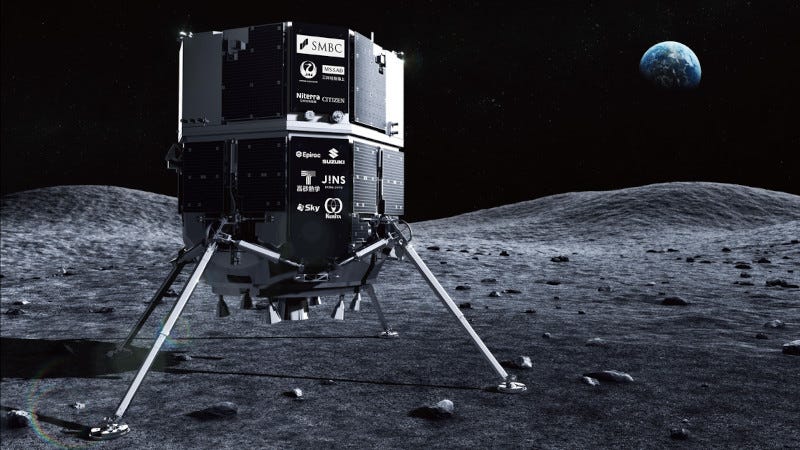
ispace has announced that the company was selected to implement its proposal for “High Precision Landing Technology in the Lunar Polar Regions” project under the second phase of Japan’s Space Strategy Fund. The technology will be implemented in ispace’s Mission 6, with development now underway.
“ispace’s goal is to create a single system encompassing both Earth and the Moon, where an economy centered on space infrastructure supports the lives of people living on Earth and realizes a sustainable world.”
Takeshi Hakamada, ispace
Through this selection, ispace will receive funding for up to 5 years, with a maximum ceiling of ¥20 billion (≈$126.4 million), to advance the technological development of the project entitled: “High-Precision Landing Near the Lunar South Pole and Support for Payload Activities in Polar Regions Using Communication Relay Satellites.”
It is estimated that the lunar surface contains significant water resources in the form of ice. These resources are expected to be utilized in the future as a fuel supply source for deep space exploration missions as well as returning to Earth. In particular, the permanently shadowed regions near the lunar south pole are now commonly considered to contain water ice.
High-precision landing at these locations is an essential technology from the perspectives of resource exploration and infrastructure construction. ispace has been developing the Series 3 Lunar Lander, scheduled for launch on Mission 4, funded through a Small Business Innovation Research (SBIR) grant from Japan’s Ministry of Economy, Trade, and Industry (METI). The company has also proactively conducted studies on high-precision landing technology for polar regions.
With this selection, ispace will develop a lunar lander developed from the Series 3 lunar lander with the aim to achieve stable, high-precision landing technology for the scientifically and economically valuable high-latitude regions near the lunar south pole, with Mission 6 scheduled for 2029.
This technical trial involves demonstrating high-precision landing technology in the most challenging region of the lunar surface near the South Pole and can also be applied to achieve landings on diverse lunar terrains and locations. For example, underground cavities called “Lunar Pits” found in mid-latitude regions may have the potential for future habitation and underground resource extraction. Achieving high-precision landings near these pits could lead to new development opportunities. Furthermore, the long-term operational capability and experience gained with the lander through this development will be a crucial step directly linked to developing lunar night survival technology. This will contribute to establishing the foundation for future long-term missions across the entire lunar surface, not just polar regions, and for human activities.
Additionally, the communication relay satellite ispace plans to deploy into lunar orbit during Mission 6 through this proposal will remain operational after the mission concludes. They may be utilized for future lunar exploration and human activities, not only in the polar regions but also on the far side of the Moon. This enables the development of networked systems using multiple satellites and data relay services, laying the foundation for communication infrastructure supporting lunar activities.
“We are deeply honored to have been selected as the implementing organization for the ‘High-Precision Landing Technology in Lunar Polar Regions’ under the second phase of the Space Strategy Fund. We are also grateful to announce the commencement of development for the 2029 Mission 6 launch following this selection,” said Takeshi Hakamada, Founder & CEO of ispace. “ispace’s goal is to create a single system encompassing both Earth and the Moon, where an economy centered on space infrastructure supports the lives of people living on Earth and realizes a sustainable world. Water resource exploration on the Moon is the starting point for achieving this. ispace sincerely recognizes the importance of this project. We will pool Japan’s technological capabilities, boldly tackle difficult technical challenges, and strive to deliver solid results through our development efforts.”
This is a significant development in the commercial lunar economy! The dual focus on high-precision landing technology and deploying communication relay satellites shows ispace thinking comprehensively about lunar infrastructure, not just single missions. The emphasis on water ice resources near the south pole as a fuel supply for deep space exploration highlights how lunar development is becoming integral to broader space exploration strategy - Mission 6 in 2029 could be a pivotal moment for commercial lunar operations.