

ISS Tests Validate Orbital “Tow Truck” for Debris Capture and Satellite Servicing
Gecko-Inspired Adhesive Arms Could Enable Safe Maneuvering of Unprepared Objects in Low Earth Orbit

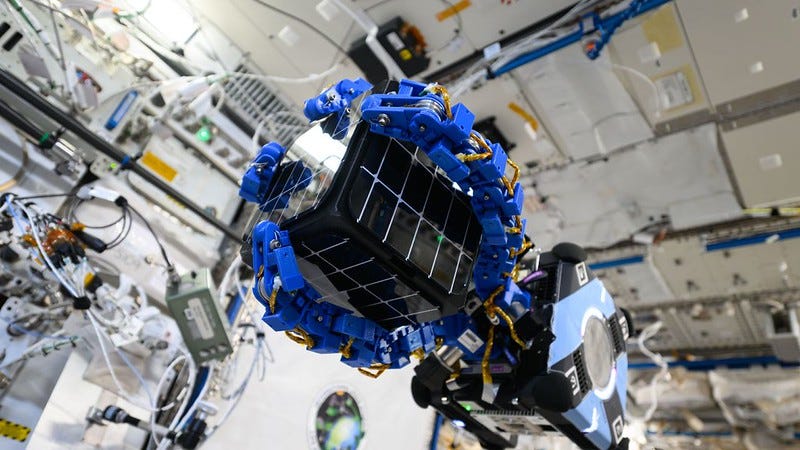
A debris-capture system using tentacle-like arms with gecko-inspired adhesive pads has completed an extensive test campaign aboard the International Space Station, with results that its developer says could not have been obtained any other way.
“On the ISS, we got multiple repetitions, the astronauts giving us ideas, making adjustments, changing materials. It’s hard to express the value because without it, we wouldn’t have been able to do this.”
Adam Kall, KMI.
Kall Morris Inc., known as KMI, used the ISS National Laboratory to test its REACCH system — Responsive Engaging Arms for Captive Care and Handling — across more than 170 capture trials. Astronauts conducted the experiments, varying surface materials and object motion scenarios throughout the test series.
The system does not wrap around a target object. It attaches to a surface and pushes, which allows REACCH to move objects considerably larger than itself. Once attached, the system can steer an object away from a collision path, reposition a satellite to a different orbit, or guide debris toward a controlled deorbit.
“On the ISS, we got multiple repetitions, the astronauts giving us ideas, making adjustments, changing materials,” said Adam Kall, co-founder and chief strategy officer of KMI. “It’s hard to express the value because without it, we wouldn’t have been able to do this.”
The ISS test campaign gave KMI engineers performance data across different surface types and motion conditions — data Kall said would have been prohibitively expensive to gather through single-run small satellite tests.
The technology is designed to work on unprepared objects, meaning targets that were not built with capture interfaces. That distinction separates REACCH from servicing systems that require a cooperative or specially equipped spacecraft.
KMI is preparing for additional tests beyond the space station. Long-term plans call for deploying REACCH on operational life-extension and debris-removal missions. The company also expects the system to support satellite relocation and end-of-life management in low Earth orbit.
The full account of the ISS test campaign appears in Upward, the official magazine of the ISS National Laboratory.