

ION Satellite Carrier Marks Significant Milestone with Recent Launch
Surpasses 200 Payloads Delivered to Orbit

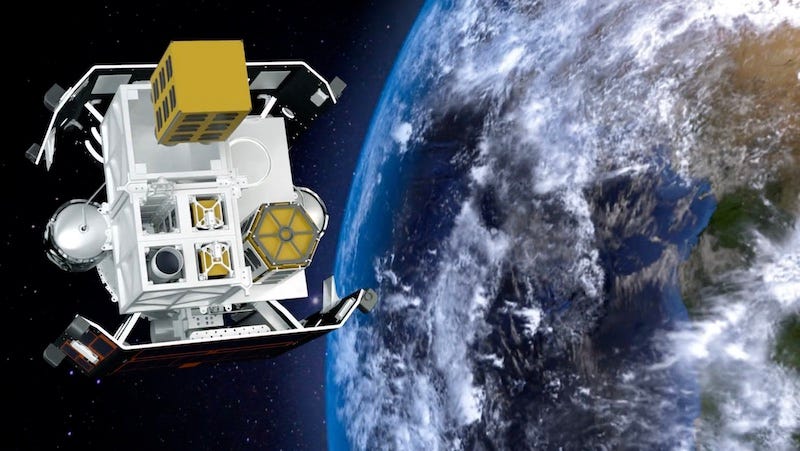
Among the payloads launched aboard the SpaceX Transporter-15 mission were two D-Orbit ION spacecraft that surpassed the 200 mission milestone for the company.
“With these two missions we cross the 200-payload milestone, carrying technologies that reflect the diversity and dynamism of today’s space sector.”
Matteo Andreas Lorenzoni, D-Orbit
‘We Need More Space’ and ‘Ride With Me’ were the 20th and 21st commercial missions of its ION Satellite Carrier orbital transfer vehicle (OTV). Following liftoff, the OTVs, ION SCV Stellar Stephanus and ION SCV Galactic Georgius, were released into a Sun-synchronous Orbit at an altitude of approximately 510 km (≈317 miles).
“With these two missions we cross the 200-payload milestone, carrying technologies that reflect the diversity and dynamism of today’s space sector,” said Matteo Andreas Lorenzoni, VP Commercial Strategy at D-Orbit. “From AI and blockchain applications to sustainable propulsion and optical communications, each payload contributes to advancing the capabilities that will define the next generation of space operations.”
ION Satellite Carrier is a versatile space vehicle capable of transporting and releasing satellites into distinct orbital slots. It can also accommodate third-party payloads, including innovative technologies, research experiments, and instruments requiring in-orbit testing. Additionally, ION can support edge computing and space cloud services, providing satellite operators with advanced storage and computational capabilities in orbit. D-Orbit’s mission control team is now conducting the Launch and Early Orbit Phase (LEOP), setting the stage for the upcoming operational phase.
Collaborating with New and Recurring Passengers The two ION vehicles carry payloads from a diverse range of commercial, institutional, and research entities, supporting applications from Earth observation and IoT connectivity to in-orbit technology demonstrations. These include:
AI-eXpress 1 Plus (Planetek, D-Orbit, AIKO) AI-eXpress 1 Plus (AIX-1+) is the third satellite of AI-eXpress, a project led by Planetek in collaboration with D-Orbit and AIKO, and co-funded by ESA InCubed, an Earth Observation programme managed by ESA Φ-lab. The mission leverages advanced technologies such as Artificial Intelligence (AI) and Blockchain in Space to enhance satellite reactivity, responsiveness, and low-latency information delivery. AIX-1+ implements the final building blocks of fundamental software services, data processing and execution, directly in space, forming the backbone of the “satellite-as-a-service” model. AIX-1+ represents the next step toward creating a space “App Store,” offering a simpler and more innovative way to access space resources.
Foresail-1 prime (Aalto University) Foresail-1 prime is a 3U CubeSat developed by Aalto University in the Finnish Centre of Excellence in Research of Sustainable Space, led by University of Helsinki, to study Earth’s radiation environment and demonstrate sustainable deorbiting technologies. It carries two main payloads: the Particle Telescope by the University of Turku, which measures precipitating electrons and solar energetic neutral atoms with high precision, and the Plasma Brake by the Finnish Meteorological Institute, designed to test a propellant-free deorbiting method using Coulomb drag. Built entirely in-house, the satellite features radiation-tolerant avionics and improved communications, supporting a five-year polar orbit mission that advances Finland’s space science and sustainability goals.
LASERCUBE Compact ISL 1000 (Stellar Project, D-Orbit, ESA) The LaserCube Compact mission is the first Italian Optical Inter Satellite Link (OISL) mission taking place within the IRIDE Constellation program, one of Europe’s largest space programs for Earth observation, managed by the European Space Agency on behalf of the Italian Government, with the support of Agenzia Spaziale Italiana. Two LaserCube Compact terminals, the smallest of the Stellar Project’s lasercom production, integrated on the two ION satellites, will establish an optical connection to demonstrate this low-power, high-performance laser communication technology applicable to Earth imagery, weather forecasting, global telecommunications, and internet services.
Lacuna-3, -4, -5, -6 (Lacuna Space, Spire Global) These four satellites combine a Spire Global-built platform with Lacuna Space’s latest-generation IoT payloads, expanding Lacuna Space’s constellation designed to deliver low-cost, reliable global connections to sensors and mobile equipment in remote locations. The constellation supports IoT services across agriculture, logistics, energy, environmental monitoring, and the blue economy, enabling applications from improving crop yields to tracking critical assets worldwide.
LEMUR-2-HOTSPUR-TOM, LEMUR-2-TARTIFLETTE, LEMUR -2-STARLIGHT (Spire Global) The satellites are part of Spire Global’s replenishment program, sustaining and enhancing the company’s fully deployed multipurpose constellation. They carry advanced Radio Occultation (RO) and Automatic Identification System (AIS) payloads to deliver high-quality atmospheric and radio frequency data supporting global weather monitoring and commercial intelligence, providing critical insights to better understand and respond to changes in Earth’s environment
MS-1 / Mission Nicoló (Spaceium) MS-1 is Spaceium’s first in-orbit demonstration mission, developed to test a high-precision robotic actuator for in-orbit fuel transfer, a key technology for future space refueling stations. The payload includes two robotic actuators, flight computers, motor drivers, and a thermal control system. On Earth, the actuator would be powerful and precise enough to lift the weight of an average human, while in orbit, it achieves an exceptional pointing accuracy of 0.0013 degrees, validating its potential for complex, autonomous refueling operations in space.
PBI (Pale Blue) PBI is a water ion thruster by Pale Blue. Already flight-proven in orbit, PBI is a compact gridded ion engine offering best-in-class total impulse with instant operation and rapid startup time. Its fully-integrated, propellant-preloaded design eliminates the need for fueling at the launch site. By using water as a propellant, the thruster streamlines the supply chain and significantly reduces overall costs from development to operation.
StardustMe SD-3 (StardustMe) A memorial payload by StardustMe, composed of several machined aluminum capsules, known as “tokens”, each containing 1 gram of human cremated ashes. The capsules are secured within an additively manufactured frame and enclosure mounted to the main structure of the host ION vehicle. No deployment or release will occur at any stage of the mission. The payload remains permanently attached to the ION vehicle, which will eventually deorbit and re-enter Earth’s atmosphere.