

Investment will Advance Reusable Rockets
Awards Will Accelerate Development of the Astrobotic Xodiac and Xogdor Platforms

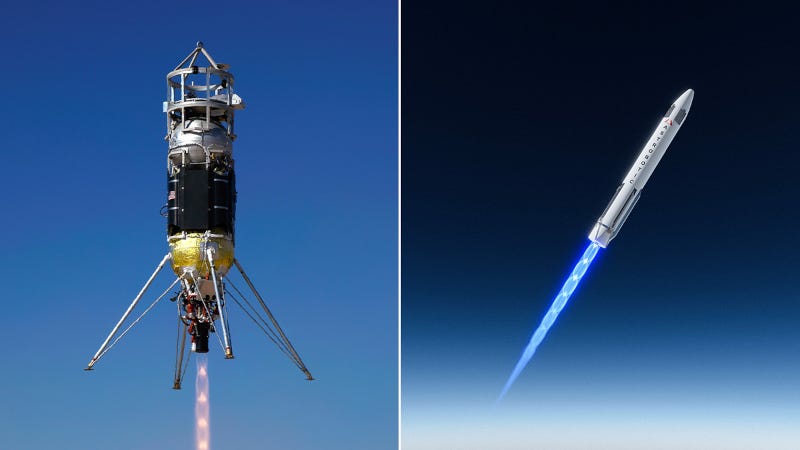
Three contracts totaling $17.5 million will advance the next generation of reusable rocket systems under development by Astrobotic. The awards will accelerate development of both its Xodiac and Xogdor platforms, with three distinct vehicles in development. Together, these vehicles will strengthen suborbital flight test capabilities and expand access to high-frequency, low-cost, reusable rocket testing.
“Each of these awards reinforces Astrobotic’s position as a trusted partner in reusable rockets.”
John Thornton, Astrobotic.
The three projects support Astrobotic’s mission to make spaceflight sustainable and repeatable through reusable rocket technology. By providing reliable and rapidly reusable flight testbeds for propulsion systems, sensors, and advanced avionics, the company is empowering NASA, the national security sector, and commercial partners to shorten development timelines and lower the cost of access to space.
“Each of these awards reinforces Astrobotic’s position as a trusted partner in reusable rockets,” said John Thornton, CEO of Astrobotic. “We are building a family of vehicles that can test technologies quickly, safely, and at a fraction of the cost of traditional programs. This work can accelerate innovation across the space industry.”
Xodiac-B: Enabling Advanced Propulsion Flight Testing
Selected by the U.S. Space Force and the Air Force Research Laboratory (AFRL) for a Small Business Innovation Research (SBIR) award worth approximately $1.9 million, Astrobotic will design and build Xodiac-B, a fully reusable suborbital hover rocket developed to flight test rotating detonation rocket engines (RDREs) and other small rocket engines. RDREs have the potential to revolutionize in-space and hypersonic vehicle propulsion by leveraging a supersonic detonation wave to produce more efficient combustion. This technology offers exciting benefits, including superior packaging, an improved thrust-to-weight ratio, and a 10-15% improvement in specific impulse over conventional rocket engines. Xodiac-B is based on Astrobotic’s proven Xodiac platform, which has completed more than 170 successful flights since 2015.
The new vehicle will serve as a first-of-its-kind reusable testbed for kerosene-fueled RDREs in the 1,000-pound thrust class. It will reach altitudes of up to 500 meters with downrange translation of 300 meters and support deep throttling for complex flight profiles. Xodiac-B will give engine developers a reliable, affordable way to validate next-generation engine designs in-flight, and advance propulsion technologies from the laboratory to operational readiness.
Xodiac-C: Enhancing Precision Flight Testing
A NASA Phase III SBIR award valued at $1.6 million will fund development, integration, and flight qualification of an upgraded variant of Astrobotic’s Xodiac rocket for entry, descent, and landing (EDL) testing. This enhanced vehicle, dubbed Xodiac-C, will expand Astrobotic’s capabilities for flight testing sensors, algorithms, and hardware in relevant environments. Upgrades will enable longer flights, improved maneuvering, enhanced electromagnetic interference (EMI) shielding, and a lighter and modular payload bay.
Like its Xodiac-A predecessor, Xodiac-C will provide rapid, low-cost access to dynamic flight conditions that cannot be replicated through ground testing. The vehicle incorporates Astrobotic’s Sensei™ hypervisor, which enables third-party guidance, navigation, and control (GN&C) systems to command the rocket in flight while Astrobotic’s safety system ensures operational boundaries are maintained. These improvements will assist industry partners in validating technologies critical to future lunar and planetary lander missions. When paired with Astrobotic’s Lunar Surface Proving Ground (LSPG) analog test field, Xodiac-C will provide state of the art, high-fidelity EDL simulation for lunar and planetary lander missions.
Xogdor Block 1B: Achieving Suborbital Spaceflight
Astrobotic’s largest award, totaling $14 million under a NASA SBIR Phase III contract, will fund upgrades to the Xogdor reusable rocket, advancing it to the Block 1B suborbital variant. This new configuration will expand flight profiles to include suborbital space access above 100 kilometers, microgravity testing, and supersonic flight.
The upgraded Xogdor Block 1B vehicle will carry payloads up to 200 kilograms in a 270-liter bay and will be capable of multiple flights per week with minimal refurbishment and little to no ground infrastructure. The upgraded system will include an improved main engine with a spin-start relight capability, active aerodynamic controls, thermal protection, and upgraded radio frequency communications for long-range operations.
Building the Future of Reusable Flight Testing
Astrobotic has conducted more than 625 reusable rocket flights across 5 vehicles, demonstrating one of the most extensive reusable rocket test records in the industry. Operations at the Mojave Air and Space Port provide flight opportunities for NASA, universities, and commercial developers seeking to mature technologies from early prototypes to flight-ready systems.
“Each flight we conduct is a leap toward making space routine and accessible. Xodiac and Xogdor give engineers the tools to innovate faster, bringing the next era of sustainable spaceflight within reach,” said Sean Bedford, Senior Director of Business Development at Astrobotic. “Our Xodiac and Xogdor programs will give a wide range of researchers and engineers the ability to test, learn, and iterate faster than ever before.”