

Industry Leaders Unveil Expanded Orbital Safety Standards at Critical Moment for Space Sustainability
Updated AIAA Best Practices Document Sets New Bar for Collision Avoidance, Debris Management in Crowded Orbits


The release of a landmark orbital safety document this week could not be better timed. As the global space community converges on Washington, D.C., for ASCEND 2026 — the American Institute of Aeronautics and Astronautics’ flagship event running May 19–21 at the Washington Hilton — AIAA has published Version 3.0 of “Orbital Safety Best Practices for Satellite Operators,” signed by Amazon, Eutelsat, Iridium Communications, and SpaceX.
The document arrives as ASCEND itself reflects the industry’s accelerating complexity, bringing together more than 200 leaders from the civil, commercial, and national security space sectors to address what organizers describe as “the most important opportunities and mission-critical challenges at this pivotal time for the space community.” Space sustainability and orbital traffic management rank prominently among those challenges, making the new best practices release a timely complement to the week’s programming.
A Living Document for a Changing Domain
Version 3.0 builds on an original 2022 publication, incorporating lessons learned from additional years of operational experience and expanding the signatory base. Its authors are candid about the broader context: the private sector has joined a growing number of governments launching satellites, accelerating the growth of the global space economy, and the resulting congestion demands more rigorous cooperation.
The document covers four mission phases — satellite design, pre-launch and early orbit, on-orbit operations, and end-of-life disposal — and is explicitly designed for global applicability. Unlike agency-specific handbooks, it is intended to provide strategic guidance for any operator anywhere in the world, regardless of which conjunction warning services they rely on.
The authors also acknowledge the limits of formal regulation. “Guidelines and best practices that establish goals for the design and operation for new and emerging systems are generally more effective than unbending and static regulations,” the document states, noting that technology evolves faster than the rulemaking process.

Design Phase: Building Safety In
The standards place heavy emphasis on addressing collision risk before a satellite ever leaves the ground. Operators are directed to analyze potential orbital conflicts at design time, including identifying so-called systematic conjunctions — recurring close approaches between two objects — and either eliminating them through minor orbital adjustments or establishing coordination protocols with affected operators before launch.
Hardware requirements are detailed and stringent. Satellites must be designed with reliable maneuvering capability, a radar cross-section sufficient for cataloging authority tracking, and cybersecurity protections against hostile commandeering. The document calls for surviving reentry fragments to carry no more than 15 joules of kinetic energy, and recommends designing to an even more conservative 10-joule threshold, noting the “lack of sophistication of prediction tools.” Operators are also expected to plan for greater than a 90% per-satellite probability of successfully completing planned disposal.
Pre-Launch: Transparency as a Safety Tool
One of the document’s more assertive positions concerns pre-launch disclosure. Operators are directed to publicly share planned insertion orbits, final operational orbits, and transit strategies — including, for constellation operators, launch cadences and satellite counts. The governing principle is explicit: “Proprietary restrictions should be construed very narrowly; the general guideline should be if a feature or approach is discoverable after launch, then it should be shared explicitly before launch.”
Launch collision avoidance (LCOLA) screening against all resident space objects is required, with heightened protections for crewed vehicles. The document specifies use of NASA’s standard safety screening volume of 31 miles radially by 124 miles in-track by 31 miles cross-track (50 km x 200 km x 50 km) around crewed assets, and mandates closing any launch window whose predicted trajectory penetrates that buffer.
Operators must also register satellites with national registries including operational contact information, and coordinate pre-launch with cataloging agencies to minimize the “COLA Gap” — the window of reduced safety screening between deployment and the establishment of reliable catalog tracks.
On-Orbit Operations: A Precision Regime
During operations, the standards call for satellite operators to submit predicted orbital ephemerides — descriptions of future position, velocity, and associated uncertainties — to conjunction assessment screening authorities at least three times daily for low Earth orbit satellites, with additional updates required whenever a trajectory change is planned or executed.
The document codifies the probability of collision (Pc) threshold of 1-in-10,000 as the level requiring a mitigation maneuver, describing it as “an industry-accepted metric that achieves an acceptable balance between the need to perform risk mitigation actions and tolerable false alarm rates.” When a potential collision could generate more than 50 debris fragments, a more conservative 1-in-100,000 threshold is recommended.
The standards also set precise requirements for post-maneuver verification: the primary conjunction risk must be reduced by at least 1.5 orders of magnitude below the threshold, and operators must confirm no new, unmitigatable high-risk conjunctions are created within a 48-hour window.
Satellite Disposal: The Five-Year Rule
End-of-life management receives direct treatment. LEO satellites that cannot naturally decay within five years must be actively deorbited, with operators expected to maintain collision avoidance maneuvers throughout the deorbit process. Satellites should be passivated — drained of residual stored energy sources — to minimize fragmentation risk. Operators are also directed to coordinate reentry timing with cataloging agencies to avoid overwhelming tracking systems with simultaneous events.
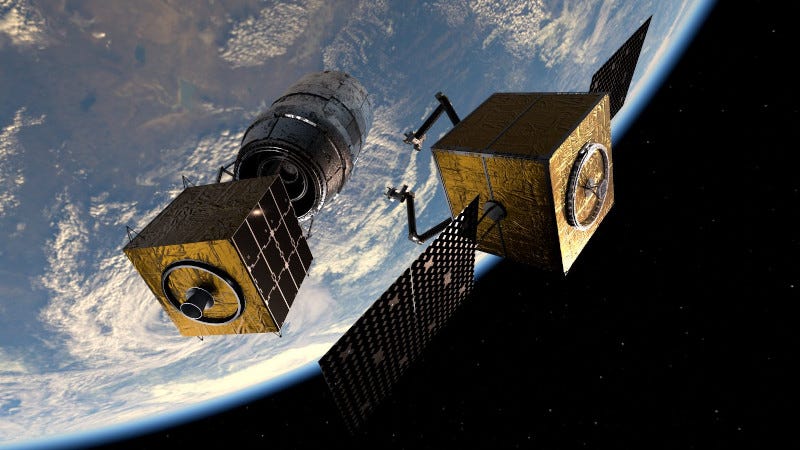
Looking ahead, the document calls for satellites occupying high-altitude orbits to include interfaces for active debris removal, acknowledging that the technology is still maturing. It is one of several areas the authors describe as “aspirational” — recommended practices for which the global infrastructure is still under development.
Satellite operators, both new entrants and established constellation managers, are encouraged to review the full document. “This set of best practices can guide and improve cooperative operations in space,” the document states, “helping to ensure that future generations maximize the benefits of space.”