


What This Means
The 28-to-32-week lead time now quoted for Inconel 718 bar and sheet stock is not a temporary logistics hiccup. It is a structural condition created by a supplier base that serves aerospace, defense, energy, and medical markets simultaneously from the same melting and rolling capacity, with no short-term path to meaningful expansion. Three producers dominate the space-grade superalloy supply chain: ATI (Allegheny Technologies Incorporated), which has documented nickel superalloy production for aerospace applications; Special Metals Corporation, a subsidiary of Precision Castparts Corp (PCC); and VSMPO-AVISMA, now under active sanctions management. Executives and supply-chain leaders at space primes and Tier-1 contractors who have not already adjusted procurement schedules, qualified alternate alloy forms, or pre-positioned inventory face a compounding schedule risk that will surface in 2026 and 2027 production cycles. The window to act without premium cost or program delay is narrowing.
A Lead Time Number That Rewrites Production Math
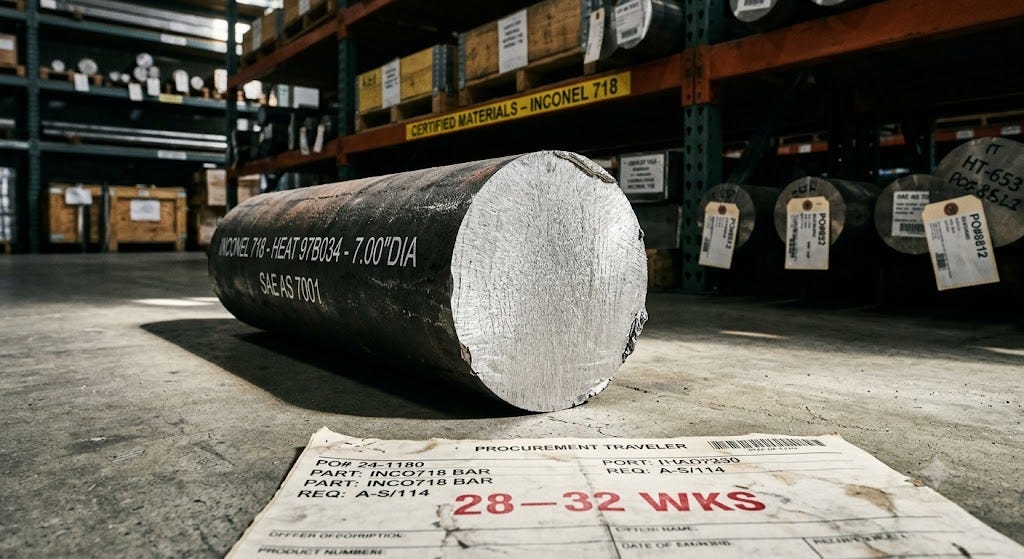
Procurement planners at space primes who built their 2024 and early 2025 manufacturing schedules around 12-to-16-week superalloy delivery assumptions are now operating against a benchmark that has roughly doubled. Inconel 718, the nickel-chromium superalloy that appears in rocket combustion chambers, turbopump housings, thrust structures, fastener systems, and cryogenic fluid management hardware, is quoting at 28 to 32 weeks across the major qualified distributors serving the aerospace segment, a figure based on synthesized distributor sourcing data current as of late June 2026, rather than a single named primary source, and should be confirmed against current supplier quotes before procurement commitments are made.
That number matters because it is not abstract. A program targeting a 2027 launch manifest that needs Inconel 718 forgings in the supply chain for machining, heat treatment, and qualification testing must place purchase orders by late 2026 at the latest, and in many cases significantly earlier if non-standard alloy chemistries, aerospace-grade certifications, or customer-source-control drawings are involved. Programs that have not yet entered formal procurement action are already at risk of schedule slip, independent of any other technical or regulatory factor.
The lead time problem is concentrated in three observable constraints: raw material production capacity, qualified melting process availability, and the competition for that capacity from sectors with comparable or greater purchasing power than space.
The Supply Chain Map: Three Producers, No Quick Alternates
ATI (Allegheny Technologies Incorporated)
ATI is among the leading Western producers of nickel-based superalloys, including Inconel 718, for aerospace and defense applications. Its specialty alloys segment serves aerospace primes through vacuum induction melting and electroslag remelting processes that produce the billet and bar stock from which forged aerospace components are machined. ATI’s aerospace-grade output competes for furnace time and rolling capacity with its defense and industrial customer base. When demand from any one segment accelerates, the others absorb the constraint through extended lead times rather than through price alone.
ATI’s public filings through Securities and Exchange Commission (SEC) Electronic Data Gathering, Analysis, and Retrieval (EDGAR) confirm its position as a significant aerospace nickel superalloy supplier, with the specialty alloys segment identified as a primary revenue driver serving jet engine and aerospace structure applications. [Class 1 Gap: production volume by end-market segment at the alloy-product level is not separately disclosed in public filings; the Inconel 718-specific characterization is based on Class 2 trade reporting and should be treated as a directional inference rather than an audited figure.]
VSMPO-AVISMA
Before sanctions and export controls took full effect following Russia’s February 2022 invasion of Ukraine, VSMPO-AVISMA supplied an estimated 25 to 30 percent of global aerospace-grade titanium, a figure consistent with pre-2022 U.S. Geological Survey mineral commodity summaries and aerospace industry reporting, and held a meaningful position in nickel superalloy intermediates. The sanctions picture has evolved substantially since 2022. U.S. and European aerospace primes have publicly disclosed active programs to qualify alternative titanium and superalloy sources, and several have confirmed they have largely exited VSMPO-AVISMA dependency for new production programs.
The residual VSMPO-AVISMA risk is subtler than a simple import prohibition. Two exposures remain material. First, Tier-2 and Tier-3 suppliers in the space and defense base who did not have the procurement scale or compliance infrastructure to re-source rapidly may still carry indirect VSMPO-AVISMA exposure through distributors or intermediate processors. Second, and more consequential for production schedules, the removal of VSMPO-AVISMA from the available supply pool has not been offset by equivalent new capacity elsewhere. The global aerospace-grade nickel superalloy melting base did not expand in proportion to the supply that was effectively removed. That gap is a direct contributor to the current 28-to-32-week lead time condition.
Program managers and supply-chain leaders whose Tier-2 and Tier-3 suppliers were not audited for VSMPO-AVISMA exposure in 2022 and 2023 should treat that audit as overdue. The question is not whether direct imports continue (they are substantially constrained) but whether certified alloy stock processed through third-country intermediaries before final distribution retains traceability to sanctioned origins.
Special Metals Corporation (Precision Castparts Corp)
Special Metals, operating as a subsidiary of Precision Castparts Corp following PCC’s acquisition and PCC’s subsequent acquisition by Berkshire Hathaway, is the closest thing the Western aerospace supply chain has to a purpose-built Inconel 718 specialist. Special Metals’ Huntington, West Virginia facility and its European operations have supplied Inconel 718 and related nickel superalloys to aerospace primes for decades, and its material certifications appear on source-control documents across a substantial portion of U.S. space launch and spacecraft programs.
The consolidation of Special Metals into the PCC structure has implications for space-sector buyers. PCC is a major Tier-1 supplier to commercial aviation, and aviation demand for nickel superalloys tracks aircraft build rates at Boeing and Airbus. When commercial aviation production accelerates, as it has been attempting to do through 2025 and 2026 following post-pandemic recovery, the shared melting and primary processing capacity at Special Metals’ facilities competes across aerospace customers. Space programs, which typically require smaller absolute volumes than commercial aviation but impose more demanding certification and traceability requirements, are structurally disadvantaged in queue priority when aviation demand is high.
PCC’s acquisition by Berkshire Hathaway means that investment capital for capacity expansion flows through a corporate structure that evaluates returns against a broad industrial portfolio. Capital expenditure decisions for new vacuum induction melting or electroslag remelting capacity at Special Metals facilities are not made in isolation from PCC’s overall capital allocation priorities. This is not a criticism of the ownership structure; it is a supply-chain fact that program managers should incorporate into lead-time planning assumptions.
Why Space Is Structurally Disadvantaged in the Queue
The three-supplier concentration matters most when you understand what those suppliers are managing simultaneously. Inconel 718 is not a space-specific alloy. It is the workhorse high-temperature material for jet engine turbine discs, oil and gas downhole tooling, medical implant components, and land-based power generation turbines. The space sector’s annual consumption of Inconel 718 is meaningful but represents a fraction of total production volume.
When a petrochemical operator or a jet engine manufacturer places a large-volume, long-term purchase agreement with Special Metals or ATI, it does not displace existing aerospace orders in a simple queue sense. What it does is consume furnace time, rolling mill capacity, and certified processing hours that have a fixed ceiling in the near term. The result is that all customers, including space primes and their Tier-1 contractors, see the same extended lead time signal.
The space sector compounds its own disadvantage through procurement behavior. Unlike commercial aviation, where Boeing and Airbus use decades of production data to drive fairly predictable alloy purchasing at scale, space production programs are episodic. A new launch vehicle development program generates a surge demand for certified superalloy forgings during its development and qualification phase, followed by a production rate that may be measured in tens of units annually rather than hundreds. Suppliers cannot justify dedicated capacity for episodic low-volume demand. The result is that space primes are perpetual spot buyers in a market dominated by volume customers, and spot buyers absorb lead time risk that volume customers offset through advance commitment.
The next section explains why supplier diversification cannot solve a lead time problem that already exists, what the expediting premium data shows, how the neon gas supply disruption compounds the same program schedules, and which specific programs and primes are carrying the highest documented exposure right now. It also includes five structured decision actions for supply-chain leaders and program managers, and a commercial opportunity map for organizations positioned to serve the constraint. Subscribers get full access to the complete supply chain map, risk exposure analysis, and decision framework.
