


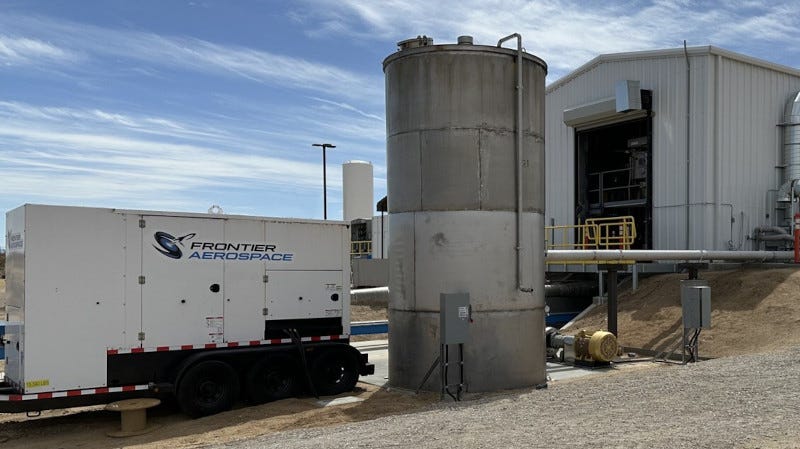
The first hot fire test has been successfully completed at the new Frontier Aerospace hypergolic vacuum test stand, marking a major expansion of the company's in-house testing capability. The inaugural campaign validated Frontier's latest MON/MMH satellite engine and underscores the company's commitment to provide customers with the fastest path from concept to flight-qualified hardware.
"There is a clear need for faster, more flexible propulsion testing."
Jim McKinnon, Frontier Aerospace
Demand for hypergolic propulsion is growing – from "Golden Dome" missile-intercept initiatives and maneuver-on-demand military satellites, to NASA's lunar exploration and increased commercial space missions – yet US testing capacity remains bottlenecked by a handful of fully booked, aging facilities, forcing new programs to wait months and sometimes years for a testing window. Frontier's new test facility fills that gap, offering customers a readily accessible, high-thrust hypergolic stand capable of moving programs from bench-top concept to flight qualification. This expansion not only strengthens Frontier's offerings but also opens a critical avenue for accelerated propulsion development across the industry.
"There is a clear need for faster, more flexible propulsion testing," said Jim McKinnon, president and CEO of Frontier Aerospace. "After testing at several different facilities with varying limitations, we decided to build a facility that delivers superior data, greater schedule certainty and rapid turnaround time. Our customers can now qualify cutting-edge engines on an accelerated cadence."
Engineered to meet the demanding requirements of commercial and defense programs, the stand supports steady-state and pulse-mode engine firings up to 1000 lbf under vacuum conditions. Extensive instrumentation, high-speed data acquisition, and propellant-temperature conditioning deliver high-fidelity performance data across a broad range of hypergolic propellants – including MON-25/MMH and emerging advanced formulations – enabling precise, repeatable results that accelerate engine development and drive down mission risk.