

Hybrid Satellite Communications Selected for NOAA Hurricane Hunter Upgrade
Lockheed Martin Taps Viasat for C-130J SATCOM in First Factory-Integrated Line-Fit Installation

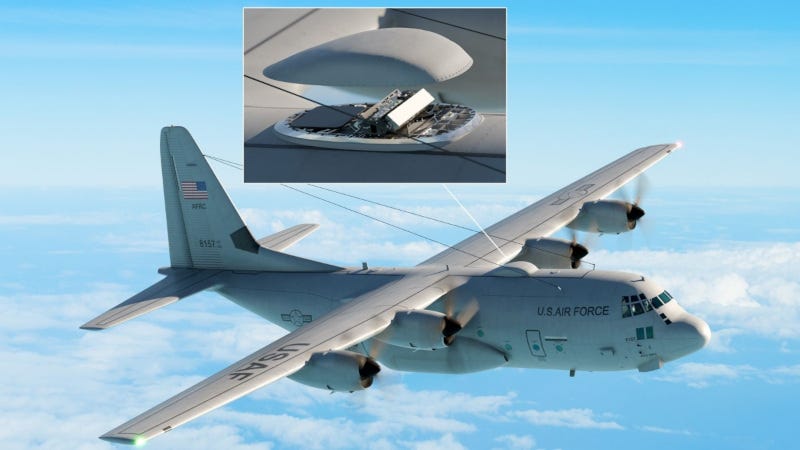
A hybrid satellite communications platform developed by Viasat has been selected by Lockheed Martin to equip two next-generation C-130J Hercules aircraft being built for the National Oceanic and Atmospheric Administration’s Hurricane Hunter program — the first time the technology will be factory-integrated into the C-130J airframe at the point of production.
“By enabling a standardized, ARINC compliant integration, this program not only supports NOAA’s lifesaving weather research mission today but also helps futureproof the aircraft for evolving connectivity and aircraft mission communications requirements.”
Victor Farah, Viasat
Viasat Inc. was awarded a subcontract under Lockheed Martin’s prime contract to provide engineering support, terminal hardware and structural integration data for the NOAA aircraft. The contract includes prime contract options for additional aircraft beyond the initial two. The announcement was made June 1, 2026.
NOAA’s C-130J Super Hercules aircraft serve as airborne laboratories, flying directly into tropical cyclones and hurricanes to collect atmospheric data. That data feeds into forecast models used by the National Hurricane Center for tracking and intensity prediction. The next-generation platforms are expected to replace legacy aircraft and enter service by 2030.
The NOAA award represents the first formal line-fit integration of Viasat’s Hybrid SATCOM Approach, known as HSA, on the C-130J. Line-fit means the hardware is installed during production at the factory rather than retrofitted after delivery. That distinction matters operationally — post-delivery modifications to military and government aircraft typically require separate certification processes, added cost and extended timelines. A factory-standard baseline can be applied more efficiently across subsequent aircraft in the same production run.
“The selection of Viasat by Lockheed Martin for the NOAA C-130J program is a strong validation of our open-architecture approach to resilient airborne communications,” said Victor Farah, SVP, Government Services and Solutions at Viasat. “By enabling a standardized, ARINC compliant integration, this program not only supports NOAA’s lifesaving weather research mission today but also helps futureproof the aircraft for evolving connectivity and aircraft mission communications requirements.”
The NOAA configuration will integrate HSA’s ARINC 791/792-compliant antenna baseplate with a Viasat Ku/Ka broadband antenna. The platform is designed to support real-time transmission of scientific and operational data gathered during hurricane and tropical cyclone reconnaissance missions. NOAA has reported that access to airborne reconnaissance data substantially improves the accuracy of storm track and intensity forecasts.
The agency has noted that better forecast accuracy directly affects the quality and timing of evacuation decisions and emergency response coordination during active tropical weather events.
The baseplate architecture is modular by design. The initial NOAA installation will use Ku-band connectivity. However, the standard baseplate can accommodate additional frequency bands and satellite constellations without requiring structural rework to the airframe. That approach aligns with growing government demand for communications architectures that can be upgraded as satellite network options evolve — across low Earth orbit, medium Earth orbit and geostationary orbit.
Viasat’s HSA platform is built to accommodate multiple antenna apertures and connect across multiple satellite networks and orbital regimes simultaneously. The company describes the architecture as designed to remain current as the broader satellite communications landscape continues to grow and diversify.
More than 650 C-130Js have been delivered worldwide and certified by 20 airworthiness authorities, supporting a wide range of military, government and humanitarian airlift missions. The establishment of HSA as a line-fit option on the C-130J production baseline positions the integration architecture to serve operators across multiple mission sets, beyond weather reconnaissance.
The contract falls under Viasat’s Communication Services segment. No contract value was disclosed in the announcement. Prime contract options covering aircraft beyond the initial two have not yet been exercised.