

House Subcommittee Examines SAT Streamlining Act to Modernize Satellite Licensing
Bipartisan Legislation Aims to Set FCC Deadlines, Reduce Backlog as China Expands Space Presence

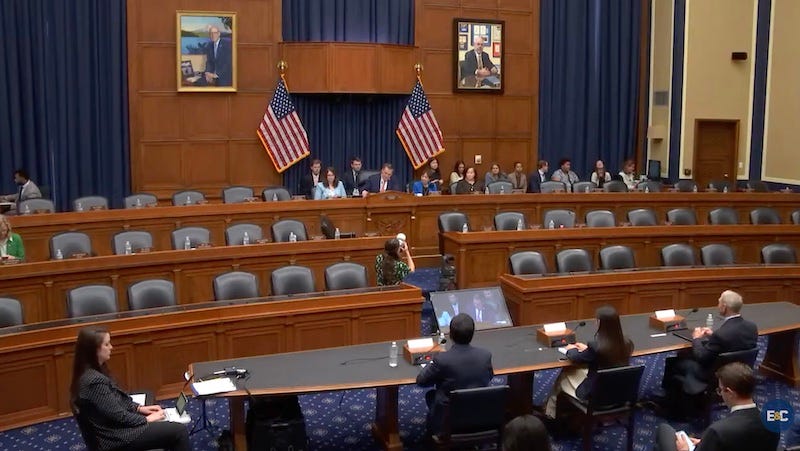
A House subcommittee heard testimony April 22 that the United States risks ceding ground to China in commercial and military space if Congress does not act to speed up the federal satellite licensing process, as members and industry witnesses pressed the case for bipartisan legislation to overhaul how the Federal Communications Commission approves satellite applications.
The current licensing regime was not designed for a world in which thousands of satellites are launched in a single year, and constellations are replenished on multi-year cycles.”
Tom Stroup, Satellite Industry Association
The House Energy and Commerce Committee’s Communications and Technology Subcommittee held a hearing titled “SAT Streamlining Act: Modernizing Satellite Licensing for the Final Frontier,” examining the Satellite and Telecommunications Streamlining Act — S. 3639 in the Senate and H.R. 8255 in the House. The Senate bill advanced out of the Senate Commerce Committee earlier this year.
The legislation would require the FCC to act on satellite license applications within set timeframes — 180 days for standard applications and one year for more complex ones — with provisions allowing the agency to toll, or pause, the clock in cases requiring additional technical review. If the FCC misses a deadline, an application would be deemed granted upon written notice from the applicant.
Three witnesses testified: Tom Stroup, president of the Satellite Industry Association; Kara Azocar, vice president of regulatory and public policy at Iridium Communications; and Shiva Goel, a partner at Wiley Rein and former NTIA spectrum official and FCC advisor.
Stroup told the subcommittee that the pace of satellite deployment has outstripped the regulatory framework designed to govern it. “The current licensing regime was not designed for a world in which thousands of satellites are launched in a single year, and constellations are replenished on multi-year cycles,” he said, noting that the number of satellites in orbit has grown almost tenfold in the last decade and that operators have announced plans to deploy over 40,000 additional satellites in the next four years.
Goel offered the most pointed assessment of the cost of delay, arguing that the harm from slow licensing goes well beyond the direct expense of waiting. “We tend to measure the cost of regulatory delay in terms of extra capital burned, and maybe even a missed launch window,” he said. “As intolerable as those costs may be, they pale in comparison to the losses we never see — the breakthroughs never attempted, the companies never formed, the architectures never designed because the regulatory risks and timelines prevented the economics from penciling in.”
Goel also invoked the competitive threat directly: “China doesn’t make companies wait years for a license. And if we’re serious about maintaining leadership, nor should we.”
The national security dimension ran throughout the hearing. Guthrie called satellite licensing reform “an imperative national security issue that will help us maintain our competitive edge against adversaries like the People’s Republic of China.” Rep. Darren Soto of Florida noted that China’s presence in space has grown more than 600 percent in recent years and that failing to maintain U.S. market leadership “risks our nation falling behind.” Goel described Chinese moves to secure spectrum and orbital resources internationally as a strategic priority, adding that broadband satellites are already being used for battlefield communications and drone operations.
Members on both sides pressed witnesses on how to prevent regulatory shortcuts from undermining the reliability and interference protections that existing operators depend on. Ranking Member Rep. Doris Matsui of California cautioned that the FCC is already strained — noting that the Space Bureau acknowledged limited staff even as earth station applications grew by 72 percent last year — and asked what safeguards would ensure the agency can review applications quickly and thoroughly given proposed budget cuts.
Azocar told the subcommittee that speed must be paired with deliberation. “Shot clocks and deemed-granted provisions are key to speeding up the process, but without a tolling provision that enables additional analysis in complex situations, it could result in a rubber stamp — and when an application is rubber stamped, it results in petitions for reconsideration, which results in uncertainty for licensees.” She said the tolling provision in the bill gives the FCC room to resolve technical questions while still providing applicants with a defined timeline they can rely on.
Goel argued that smaller satellite operators and startups stand to gain the most from the legislation. “Smaller companies in particular have much more to lose and are much more vulnerable from delay. They don’t have war chests. They need to show their investors and customer base that they have a license and that they’re ready to go.” He added that the combination of shot clocks and tolling safeguards should allow most market participants to count on receiving a license within a predictable window.
Stroup noted that if the permitting process remains too burdensome, the risk is not just slower deployment but a loss of the innovation ecosystem itself. “If this is pushed offshore, we lose out on the potential for that innovation, that industrial base, as well as the other things that I mentioned in terms of tax base and employment.”
Witnesses also addressed spectrum coordination with federal agencies, satellite-to-satellite collision risks, orbital debris mitigation, and the role of the FCC’s ongoing Space Modernization for the 21st Century rulemaking proceeding. Goyal called for Congress to update the Communications Act to explicitly address satellite licensing, noting that the word “satellite” scarcely appears in the current statute despite the volume of FCC activity in the sector. “Legislation is enduring,” he said. “Space is hot right now. But it’s also an industry where you make long-lived investments. Legislation tells the industry that five years from now, ten years from now, even if you’re not as popular as you are today, you’re still going to get the same treatment from the FCC and you’re going to get your licenses through.”
No markup date for the legislation has been announced.