

High-Power Electric Thruster Test Marks Milestone for Future Mars Missions
Lithium-Fed Magnetoplasmadynamic Engine Achieves 120 Kilowatts in First U.S. Test of Its Kind

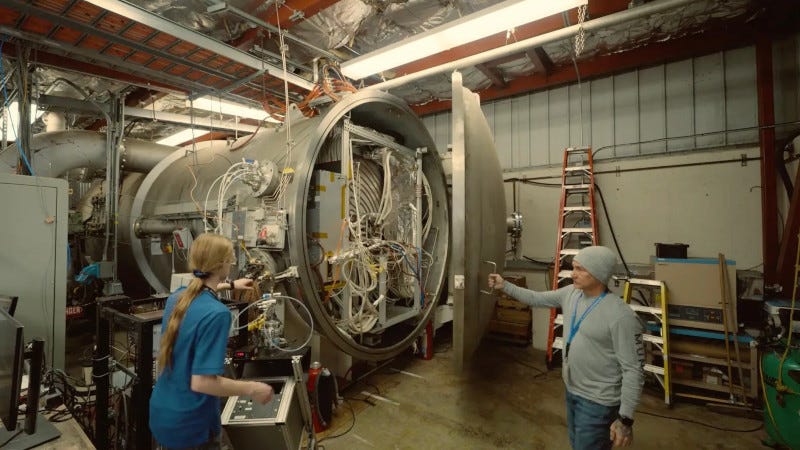
A high-power electric thruster capable of propelling crewed missions to Mars achieved power levels exceeding any previous test of its kind in the United States, completing five successful ignitions at NASA’s Jet Propulsion Laboratory in Southern California.
“This marks the first time in the United States that an electric propulsion system has operated at power levels this high, reaching up to 120 kilowatts.”
Jared Isaacman, NASA
The prototype lithium-fed magnetoplasmadynamic (MPD) thruster reached up to 120 kilowatts during testing — more than 25 times the power output of the electric thrusters currently operating on NASA’s Psyche spacecraft, which represents the agency’s highest-power electric propulsion system currently in service. In space, Psyche’s thrusters gradually accelerate the spacecraft to speeds of 124,000 mph.
“This marks the first time in the United States that an electric propulsion system has operated at power levels this high, reaching up to 120 kilowatts,” said NASA Administrator Jared Isaacman. “We will continue to make strategic investments that will propel that next giant leap.”
The MPD thruster is fundamentally different from conventional electric propulsion systems. Rather than using electric fields to accelerate ions, it uses high electrical currents interacting with a magnetic field to electromagnetically accelerate lithium metal vapor plasma. During the February tests, the tungsten electrode at the thruster’s center reached temperatures exceeding 5,000 degrees Fahrenheit as the nozzle-shaped outer electrode emitted a vibrant red plume.
Testing was conducted inside JPL’s condensable metal propellant (CoMeT) vacuum facility — a 26-foot-long, water-cooled vacuum chamber and a specialized national asset for safely testing electric thrusters that use metal vapor propellants at up to megawatt-class power levels.
“Designing and building these thrusters over the last couple of years has been a long lead-up to this first test,” said James Polk, senior research scientist at JPL, who peered through a small portal in the chamber wall to observe the ignitions. “It’s a huge moment for us because we not only showed the thruster works, but we also hit the power levels we were targeting. And we know we have a good testbed to begin addressing the challenges to scaling up.”
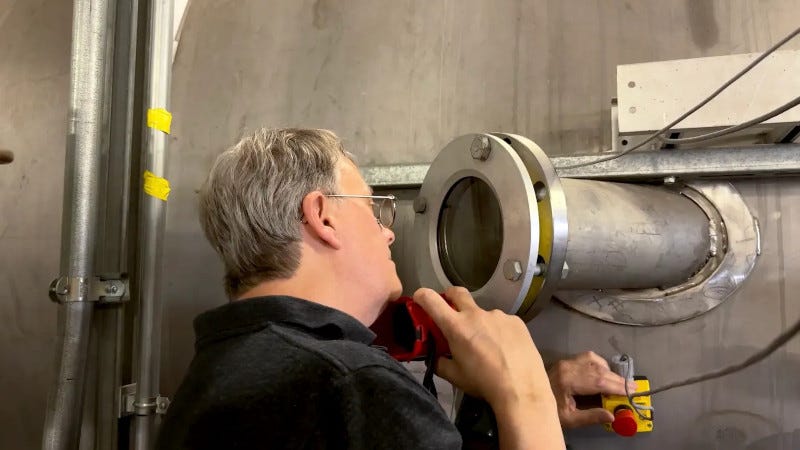
Polk has studied lithium-fed MPD thrusters for decades and previously worked on NASA’s Dawn mission and Deep Space 1, the agency’s first demonstration of electric propulsion beyond Earth orbit.
The appeal of MPD technology for deep-space exploration lies in its efficiency advantage over chemical rockets. Electric propulsion uses up to 90% less propellant than traditional chemical systems, reducing launch mass while achieving high speeds through sustained low-thrust acceleration over time. Fully developed and paired with a nuclear power source, MPD thrusters could dramatically lower the mass requirements for crewed Mars missions.
A human mission to Mars is estimated to require between 2 and 4 megawatts of total propulsion power, necessitating multiple MPD thrusters operating in tandem for more than 23,000 hours. The February test was the first validation step in a roadmap to scale the technology from its current 120-kilowatt output to a target range of 500 kilowatts to 1 megawatt per thruster in the coming years. Managing the extreme heat generated during sustained high-power operation is among the primary engineering challenges ahead.
The MPD thruster program has been in development for approximately two and a half years, led by JPL in collaboration with Princeton University and NASA’s Glenn Research Center in Cleveland. Funding comes from NASA’s Space Nuclear Propulsion project, which was established in 2020 to advance a megawatt-class nuclear electric propulsion program focused on five critical technology elements for human Mars missions. The project is managed out of NASA’s Marshall Space Flight Center in Huntsville, Alabama, under the agency’s Space Technology Mission Directorate.
MPD thruster research dates to the 1960s, but the technology has never been flown operationally. The February test represents the most significant advancement in domestic MPD development in years, and the data gathered will shape a forthcoming series of higher-power tests.
“At NASA, we work on many things at once, and we haven’t lost sight of Mars,” Isaacman said. “The successful performance of our thruster in this test demonstrates real progress toward sending an American astronaut to set foot on the Red Planet.”