

GENA-OT Satellite Launched by OroraTech
Newest Satellite Platform Among Transporter-15 Payloads

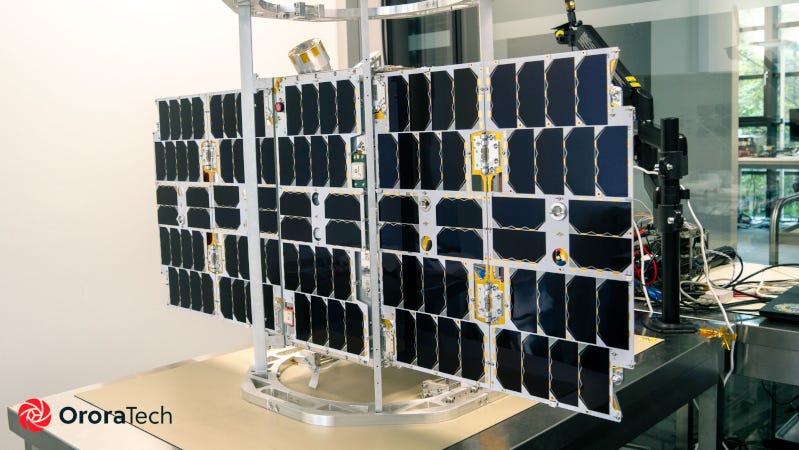
A new satellite platform developed by OroraTech was among the payloads launched on the recent SpaceX Transporter-15 Mission. GENA-OT, the first mission of its GEneric flexible NAnosatellite (GENA) platform, carried scientific projects built by the Universität der Bundeswehr Munich (UniBw) and others into low Earth orbit.
“GENA-OT is the first purely German mission to be funded under the GSTP Element 3 ‘FLY’, and is a great example of how smart public investment and industrial innovation can work together.”
Dr. Shahin Kazeminejad, DLR Space Agency
This 16U CubeSat mission was developed under the European Space Agency’s (ESA) General Support Technology Program (GSTP) and supported by funding from the German Space Agency at DLR. “GENA-OT demonstrates the future of satellite development, one that combines speed, modularity, and innovation,” said Professor Andreas Knopp from the Universität der Bundeswehr Munich. “Within an unprecedented timeframe, we implemented several innovative payloads built by the university and other startups. This project showcases how academia and commercial partners can rapidly meet the needs of the New Space economy.”
GENA-OT carries multiple scientific payloads. This includes the relaunch of the ICARUS satellite-based animal tracking system from the Max Planck Institute, which has been on hold since 2022. Other projects include technology demonstrators from UniBw’s SeRANIS Mission and contributions from the Munich Center for Space Communications. The platform allows these programs to perform scientific experimentation and validation of new technologies on-orbit quickly and easily, without the need to build full satellite platforms.
“This mission shows how commercial platforms can power public benefit,” said Dr Martin Langer, CEO and CTO of OroraTech. “GENA-OT is the result of a public-private partnership that delivered spaceflight-ready hardware in record time. We believe in turning data into action, and this satellite proves that infrastructure can be fast, flexible, and ready for tomorrow’s missions.”
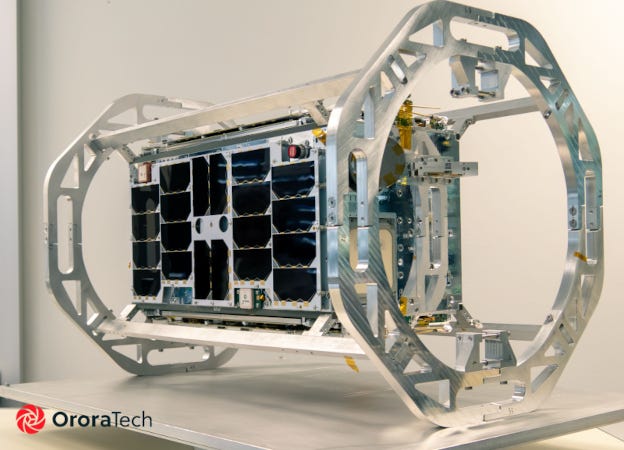
“This mission reflects the German Space Agency’s and ESA’s commitment to supporting scalable platforms for in-orbit demonstration and validation,” said the Head of GSTP at DLR Space Agency, “GENA-OT is the first purely German mission to be funded under the GSTP Element 3 ‘FLY’, and is a great example of how smart public investment and industrial innovation can work together to advance European space capabilities and enable new business opportunities for companies.”
GENA-OT marks a new era of accessibility in orbital testing and experimentation, with a short time to orbit, standardized experimental modules, and easy integration for scientific projects. The mission hosts multiple third-party research payloads, offering universities, startups, and research institutions a shared platform to validate technologies in space more quickly and affordably.
With standardized commercial platforms like GENA-OT, governments and institutions can accelerate mission timelines and lower the cost of access to orbit. This mission supports national and European efforts to develop sovereign, responsive space infrastructure that can empower research, foster innovation, and strengthen the continent’s competitiveness in the New Space economy.
GENA-OT will operate in a sun-synchronous orbit and serve as the foundation for future GENA missions, designed to carry diverse payloads in evolving configurations. With this launch, OroraTech and its partners continue to push the boundaries of what’s possible in responsive space infrastructure.