

Gen-3 General Availability Opened by BlackSky
Fourth Satellite Commissioned in Less Than a Week Following Launch

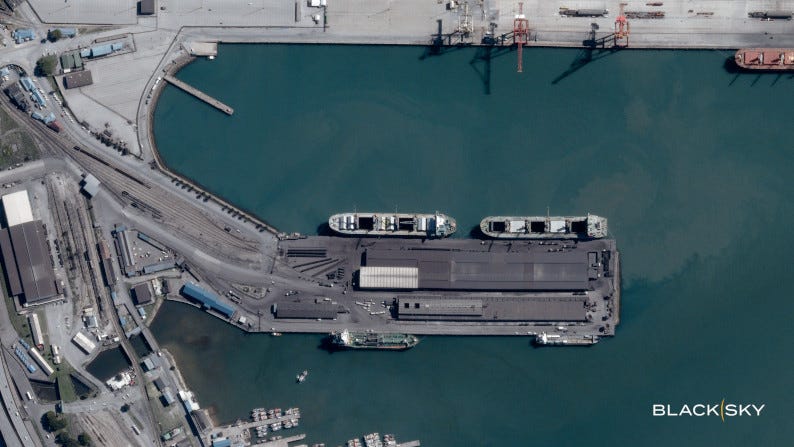
The fourth BlackSky Gen-3 satellite has been commissioned in less than one week following launch, opening general availability for its advanced, next-generation Gen-3 capabilities to all of the company’s customers. This achievement makes daily service for 35-centimeter imagery and AI-enabled analytics available to customers through BlackSky Spectra.
Our ability to rapidly develop, build and deploy Gen-3 at a rapid pace fulfills our commitment to accelerate real-world decision workflows in real time.”
Brian O’Toole, BlackSky
Gen-3 general availability opens opportunities for BlackSky’s global customer base to directly task daytime, twilight, and nighttime collections to support persistent monitoring and rapid response to emerging events. BlackSky’s proprietary AI-enabled analytics give customers the ability to detect and classify vehicles, vessels and aircraft of strategic interest and observe critical pattern-of-life changes over time. The combined value of daily Gen-3 and hourly Gen-2 monitoring capabilities gives customers an immensely powerful high-cadence, time-diverse view of the operational landscape.
“With immediate additional capacity integrated into live operations, customers experience a pivotal qualitative increase in how they see, understand, and anticipate changes at the tactical edge,” said Brian O’Toole, BlackSky CEO. “Commissioning our latest Gen-3 in just days gets critical capability into our customers’ hands quickly, increases each satellite’s operational lifespan and ultimately expands the total ROI of our on-orbit assets.”
“BlackSky is delivering trustworthy on-orbit capability now to the most demanding military and intelligence organizations in the world at disruptive scale and economics. Our ability to rapidly develop, build and deploy Gen-3 at a rapid pace fulfills our commitment to accelerate real-world decision workflows in real time,” said O’Toole.
BlackSky’s rapid commissioning process includes establishing communications and quickly verifying system functionality for propulsion, positioning and power. The process also includes calibrating the imagery sensor payload, onboard processing systems and testing automated operations, a process that traditionally may take many months to accomplish.
The entire Gen-3 constellation has consistently delivered initial images with remarkable clarity and uniform quality, detailing vehicles, maritime vessels, and aircraft of various sizes, as well as individual people and their shadows. Sharper imagery reduces ambiguity and contributes to better analytics development with stronger insights for end users.