

Four Astronauts Named to Artemis III Earth-Orbit Test Mission Ahead of Lunar South Pole Landing
Mission Designed to Validate Docking Hardware and Procedures Before First Crewed Lunar Landing in 2028

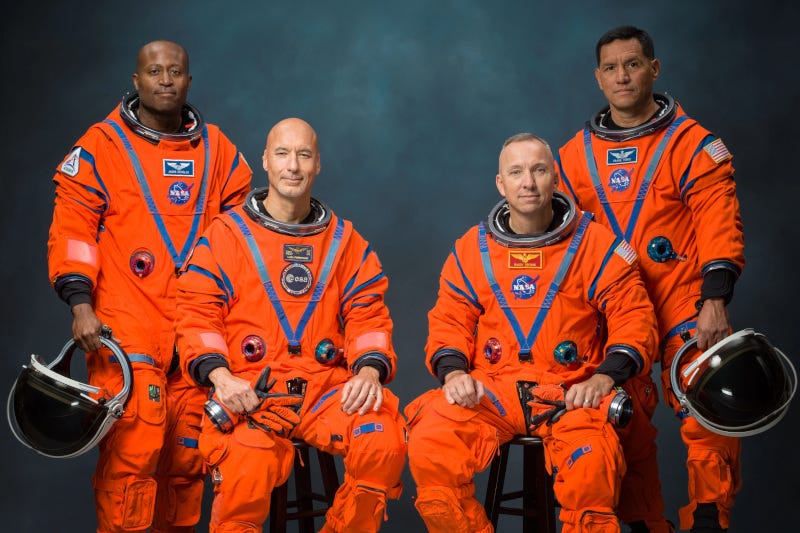
Four astronauts have been assigned to Artemis III, a two-week Earth-orbit test mission scheduled for 2027 that will demonstrate rendezvous and docking operations with commercial lunar landers from Blue Origin and SpaceX.
“Artemis III will demonstrate the power of American innovation and international partnership as we test complex rendezvous and docking operations and advance the technologies that will one day carry us deeper into the solar system.”
Jarad Isaacman, NASA
NASA announced the crew assignments during a Tuesday event, identifying the mission as a critical step toward Artemis IV, the first planned crewed landing at the lunar South Pole, set for 2028. The Artemis III crew will launch aboard the agency’s Space Launch System rocket from Kennedy Space Center in Florida.
The crew is as follows: NASA astronaut Randy Bresnik, commander; ESA astronaut Luca Parmitano, pilot; NASA astronaut Frank Rubio, mission specialist; and NASA astronaut Andre Douglas, mission specialist. NASA astronaut Bob Hines was named backup crew member and will train alongside the prime crew.
Artemis III marks the first time an ESA astronaut has been assigned to an Artemis mission.
“Today we take another bold step in humanity’s return to the Moon, building on the extraordinary foundation laid by the Artemis II astronauts,” said NASA Administrator Jared Isaacman. “Artemis III will demonstrate the power of American innovation and international partnership as we test complex rendezvous and docking operations and advance the technologies that will one day carry us deeper into the solar system.”
The mission profile calls for multiple heavy-lift rocket launches in sequence. Blue Origin’s lander pathfinder, capable of remaining in orbit for multiple weeks, will launch first and await the crew. NASA will then send the astronauts aboard Orion to Earth orbit, where they will rendezvous with Blue Origin’s test article and spend approximately two days docked for tests and technology demonstrations, including entering the lander.
After completing docked operations with Blue Origin, Orion will detach and await SpaceX’s Starship pathfinder. After approximately one day of docked checkout and testing with the Starship article, Orion and its crew will undock and return home, splashing down in the Pacific Ocean for recovery by U.S. Navy and NASA teams. Total mission duration is expected to be approximately two weeks, with the exact length determined based on real-time operational factors.
“Artemis III will push the boundaries of spacecraft operations in orbit,” said ESA Director General Josef Aschbacher. “Luca’s assignment as pilot reflects the depth of European expertise in human spaceflight and draws on his extensive operational experience in high-pressure situations.”
ESA’s European Service Module will once again provide propulsion and power for the Orion spacecraft on Artemis III.
Bresnik, a retired U.S. Marine colonel, will be making his third spaceflight. He flew aboard space shuttle Atlantis in 2009 and later served as flight engineer and commander of ISS Expeditions 52 and 53. He has been assigned to NASA’s Artemis exploration development program since 2018.
Parmitano, also on his third spaceflight, served as commander of ISS Expedition 61 in 2019, becoming the first Italian to command the station. He holds a master’s degree in experimental flight test engineering and has logged more than 2,000 flight hours across 40 aircraft types.
Rubio holds the record for the longest single-duration spaceflight by an American astronaut, 371 days, logged during a Soyuz MS-22 mission that ran from September 2022 to September 2023. He is a U.S. Army physician and aviator.
Douglas is making his first spaceflight. A former U.S. Coast Guard officer, he holds a doctorate in systems engineering from George Washington University and previously served as a backup and closeout crew member for Artemis II.
Hardware processing is underway. Engineers plan to connect the Orion crew module and service module this summer and integrate the spacecraft’s docking system, which will fly for the first time on this mission. SLS core stage assembly is in progress, with RS-25 engine installation scheduled for this summer. All solid rocket booster segments are at Kennedy Space Center, and rocket stacking is set to begin this summer. NASA is also designing and fabricating a spacer that will replace the upper stage used on the Artemis II configuration.
Both Blue Origin and SpaceX are building non-crewed pathfinder versions of their respective lunar landers for Artemis III. The crew will begin training immediately on Orion systems and will assist in development and operations of both lander test articles.