


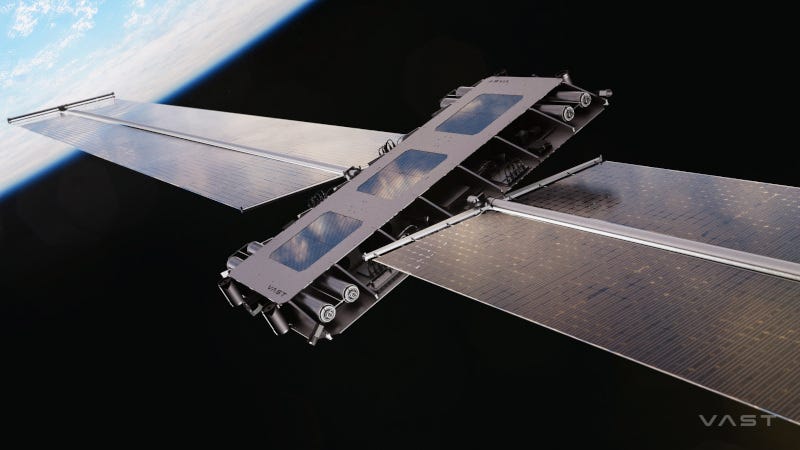
A new line of high-power satellite buses built on technology developed for commercial space stations has been announced by Vast, marking the company’s expansion beyond habitation platforms into high-volume spacecraft production. The inaugural offering is a 15 kW-class bus targeting communications, Earth observation, national security, and orbital data center constellation operators.
“We believe Vast is uniquely positioned to compete in the high-power satellite.”
Max Hoat, Vast
The new product line, branded Vast Satellite, draws directly from subsystems — avionics, power, communications, propulsion, and flight software — developed for Vast’s Haven-1 space station and validated in orbit during the Haven Demo mission in 2025. That spacecraft completed a controlled deorbit on Feb. 4, 2026, after demonstrating the maturity of the core technologies now slated to underpin the satellite bus line.
“We believe Vast is uniquely positioned to compete in the high-power satellite market through the combination of our world-class engineering team, large-scale manufacturing capabilities, and the on-orbit success of Haven Demo, said” Max Haot, CEO of Vast. “Customers can benefit from our experience designing, building, and operating flight-proven large-scale spacecraft while gaining access to highly capable, flexible spacecraft platforms backed by operational expertise.”
Vast has already secured its first sale. A confidential customer has signed an agreement for four satellites with an option to purchase up to 200 additional units.
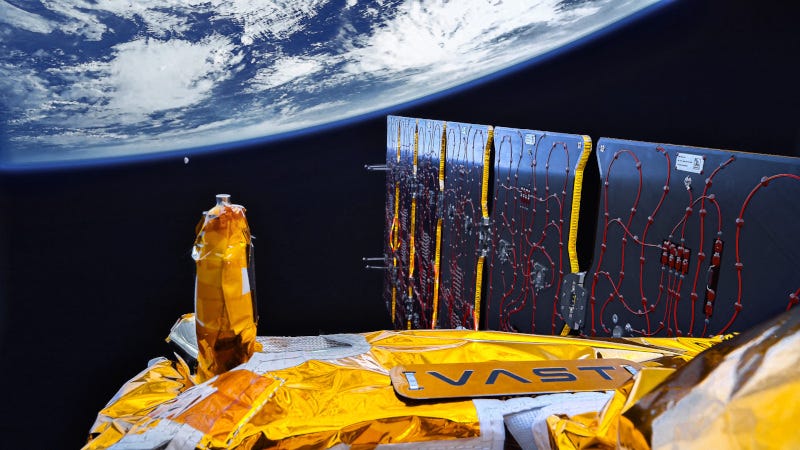
The Haven Demo mission was led by Jim Martz, SVP of Special Projects, who previously led satellite engineering organizations at SpaceX’s Starshield division and Muon Space.
“Haven Demo allowed us to validate key spacecraft systems in the operational environment they were designed for,” Martz said. “The mission provided valuable flight heritage and demonstrated the maturity of the avionics, power, and software systems that are expected to form the foundation of our satellite platforms.”
The 15 kW-class bus is designed for low Earth orbit operations between 230 and 745 miles altitude, with a five-year design life and a total mission delta-v of at least 1,640 feet per second. Vast says future variants will support medium Earth orbit, geostationary orbit, and lunar applications.
Key platform specifications include:
Bus dry mass: approximately 1,543 pounds (700 kg); payload capacity exceeding 772 pounds (350 kg)
Flat panel structure measuring approximately 7.2 by 11.8 feet, optimized for high-density launch and batch deployment
Solar power generation of 15 kW via two deployable rollout arrays with drive actuators; payload peak power exceeding 20 kW
Electric propulsion running on krypton at 10 kW, complemented by control moment gyroscopes and torque rods
Pointing knowledge better than 0.05 degrees (1-sigma), with an enhanced option achieving 0.005 degrees
Avionics include lockstep core flight computers with Gigabit Ethernet switches, an inertial measurement unit, sun sensors, star tracker, magnetometer, and dual-input GNSS receiver. Standard payload interfaces cover Ethernet, RS-422 serial, and discrete I/O, with optional MIL-STD-1553 and SpaceWire interfaces for defense applications.
Communications are handled via S-band telemetry, tracking, and command radios and antennas as standard, with optional X-band radios, third-party laser communication terminals, and a software-defined radio platform with custom RF front ends.
Optional onboard systems include a high-performance GPU, a 4K video camera and recorder, and an NVIDIA Space-1 Vera Rubin Module for orbital data center inferencing, AI edge compute, advanced signal processing, and autonomous space operations.
Vast is targeting a late 2027 launch for an inaugural batch of 10 of its 15 kW-class satellites and is accepting capacity reservations for that mission. The company frames the satellite bus line as complementary to its Haven space station program, which aims to support continuous human presence in low Earth orbit and enable exploration to the Moon and Mars.