

Final GPS III Satellite Launches Opening the Door to Next Generation
Optical Crosslink Payload and Advanced Atomic Clock Among New Capabilities Aboard GPS III SV10

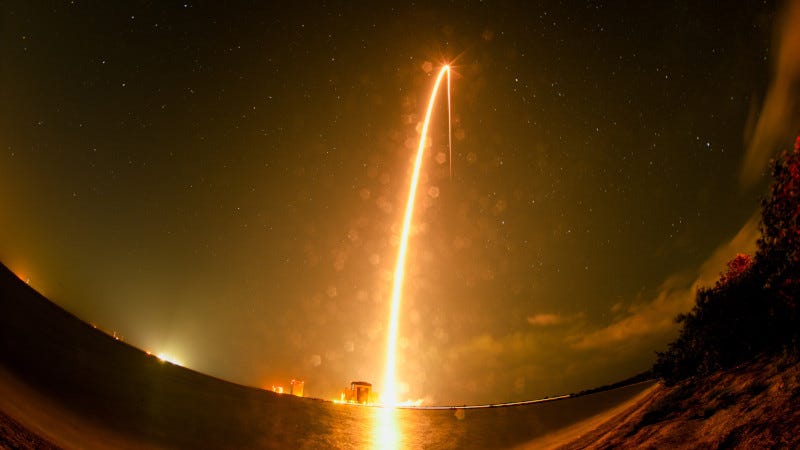
The Global Positioning System constellation reached its highest level of capability ever achieved early Tuesday with the pre-dawn launch of the final satellite in the GPS III series, a milestone that sets the stage for the more advanced GPS IIIF generation now in production. GPS III Space Vehicle 10 (SV10) lifted off from Cape Canaveral Space Force Station with Lockheed Martin and the U.S. Space Force marking the fourth consecutive GPS satellite launch on an accelerated delivery schedule.
“The final GPS III deployment is an important milestone as we continue strengthening the GPS constellation.”
Fang Qian, Lockheed Martin
The spacecraft secured signal acquisition shortly after launch and is currently being managed at Lockheed Martin’s Denver Launch & Checkout Operations Center pending formal acceptance into the GPS operational control network.
“The final GPS III deployment is an important milestone as we continue strengthening the GPS constellation,” said Fang Qian, vice president of GPS at Lockheed Martin. “By launching SV10 into orbit, we’re not only adding to the resiliency of today’s GPS capabilities — we’re opening the door to the next generation of GPS IIIF satellites that will provide greater resiliency and serve as the backbone of the GPS constellation for years to come.”
SV10 carries two notable demonstration payloads that point toward the future of GPS technology.
The satellite features an optical crosslink demonstration payload, enabling GPS satellites to communicate directly with one another in space rather than routing signals through ground stations. That satellite-to-satellite link increases on-orbit resiliency — a capability that will be central to the GPS IIIF generation.
SV10 is also equipped with a demonstration Digital Rubidium Atomic Frequency Standard clock, an advanced timekeeping instrument designed to deliver reliable and precise timing from orbit. Accurate timekeeping is foundational to GPS, underpinning everything from smartphone navigation to financial market transactions and telecommunications networks.
GPS III satellites as a class offer three-times greater accuracy, eight-times stronger anti-jamming capability, and secure M-Code signals compared to legacy GPS spacecraft. Those enhancements benefit both military users operating in contested environments and the approximately six billion civilians who rely on GPS daily.
With the GPS III series now fully deployed, Lockheed Martin has shifted its focus to producing the GPS IIIF block at its facility in Denver, Colorado. The company is currently under contract to build 12 GPS IIIF satellites.
The IIIF generation will introduce Regional Military Protection, delivering more than a 60-fold increase in anti-jamming performance compared to current GPS satellites — a significant leap in electronic warfare resistance for U.S. forces.
To accelerate production, Lockheed Martin is incorporating emerging technologies on the manufacturing floor, including augmented reality tools and digital twins — virtual replicas of physical systems used to streamline assembly and testing.
More than 30 GPS satellites currently operate in orbit, providing positioning, navigation and timing services to military, civilian and commercial users worldwide. GPS remains the world’s most widely used space-based navigation system.