

FCC Unanimously Adopts Proposal to Open Unlicensed Spectrum for Satellite Direct-to-Device Links
Commissioners Moved the NPRM Forward Thursday Morning, Starting the Clock on Formal Public Comment

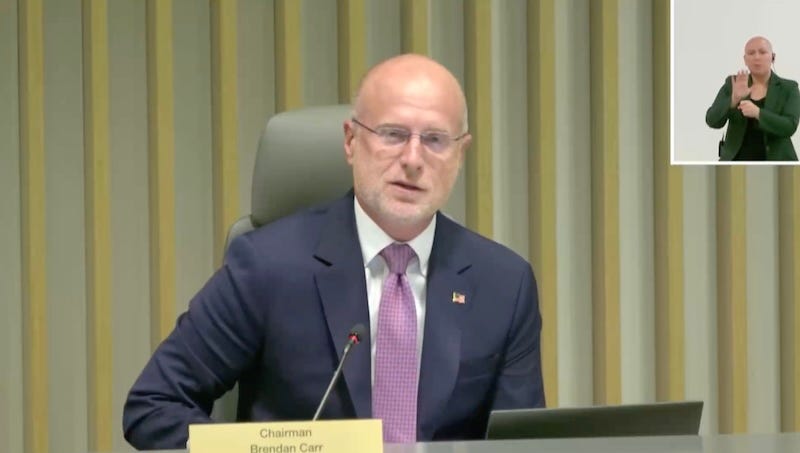
The Federal Communications Commission voted unanimously Thursday to adopt a rule proposal that would let satellites communicate directly with smartphones, laptops and other consumer devices operating in spectrum currently reserved for unlicensed uses such as Wi-Fi and Bluetooth.
“For the first time we are exploring whether D2D services are technically possible in more than 200 megahertz or unlicensed spectrum bands.”
Brendan Carr, FCC
The Notice of Proposed Rulemaking, adopted at the Commission’s August open meeting under ET Docket No. 26-169, targets three frequency bands governed by the agency’s Part 15 unlicensed-device rules: 902-928 MHz, 2400-2483.5 MHz and 5725-5850 MHz. Devices already certified under Part 15 would be permitted to transmit to FCC-authorized satellites at up to 4 watts equivalent isotropically radiated power, the same ceiling that applies to their terrestrial use today. The notice does not propose to raise that power limit.
The measure responds to a wave of investment in direct-to-device satellite service. More than $40 billion has moved through the sector over 18 months, according to the notice, including SpaceX’s $19.6 billion acquisition of spectrum from EchoStar, a $550 million spectrum-access agreement between AST SpaceMobile and Ligado, and separate acquisitions by Amazon and Rocket Lab of Globalstar and Iridium worth close to $20 billion combined.
Part 15 devices operate without individual licenses but must not interfere with licensed services and must accept whatever interference they receive. The Commission has granted case-by-case waivers for satellite links in this territory before — Hubble Network and Spire Global both received licenses to receive signals from Part 15 Bluetooth-type devices in the 2400-2483.5 MHz band — but each required a waiver of the Table of Frequency Allocations. Thursday’s adopted notice proposes writing a standing allocation into the table instead.
The bulk of the notice is devoted to open questions rather than settled rules, and adoption of the NPRM opens those questions to public comment rather than resolving them. The Commission proposes allowing device-to-satellite transmission, known as Earth-to-space, in all three bands, but has not proposed a matching allocation for satellite-to-device transmission. Instead, it is asking whether the 5725-5850 MHz band, sometimes called U-NII-3, could handle satellite downlinks without disrupting the terrestrial devices that already share it. Downlink signals cover more ground than uplink transmissions from handheld devices, a distinction the notice flags as a technical complication requiring separate treatment.
The notice also raises the question of how devices operating with a Part 15 satellite license would be authorized in the first place, floating two options: a “license by rule” approach modeled on the Commission’s 2024 framework for Supplemental Coverage from Space, or a blanket-license system similar to those used for large fleets of identical earth stations.
Radio astronomy interference is one of several concerns embedded in the request for comment. The notice cites peer-reviewed studies documenting unintended electromagnetic radiation detected from satellite constellations at frequencies studied by radio astronomers, and asks whether geofencing or other technical measures would be needed to protect observatories if the 2400-2483.5 MHz band opens further to satellite traffic. Commission staff separately note that expanding satellite use in these bands raises national security questions, including whether new categories of devices communicating with satellites could create fresh openings for espionage, though the notice does not identify any specific incident or threat.
Chairman Brendan Carr said during the meeting that the proposed rule takes D2D communications into uncharted territory.
“For the first time we are exploring whether D2D services are technically possible in more than 200 megahertz or unlicensed spectrum bands,” Carr said. “These frequencies could yield more capacity to compliment D2D services, and encourage experimentation.”
Beyond Earth-to-space and space-to-Earth links, the adopted notice proposes to formally permit the use of Part 15-certified equipment — laptops, smartwatches, tablets — inside spacecraft, a practice NASA currently manages informally aboard the International Space Station through device lists submitted before each mission. It also opens a separate comment period on whether Part 15 frequencies could support communications during spacewalks and between spacecraft, without proposing specific rule changes for those uses yet.
The vote starts, rather than ends, the rulemaking process. Once the notice is published in the Federal Register, the public will have 30 days to file comments and 60 days to file replies. The Commission has asked for input on nearly every element of the proposal, including which frequency bands beyond the three named should be considered and what interference protections satellite operators would need to meet.