

Europe’s Hydrazine Clock Is Running Out
The Regulatory Deadline Reshaping Satellite Propulsion Supply Chains

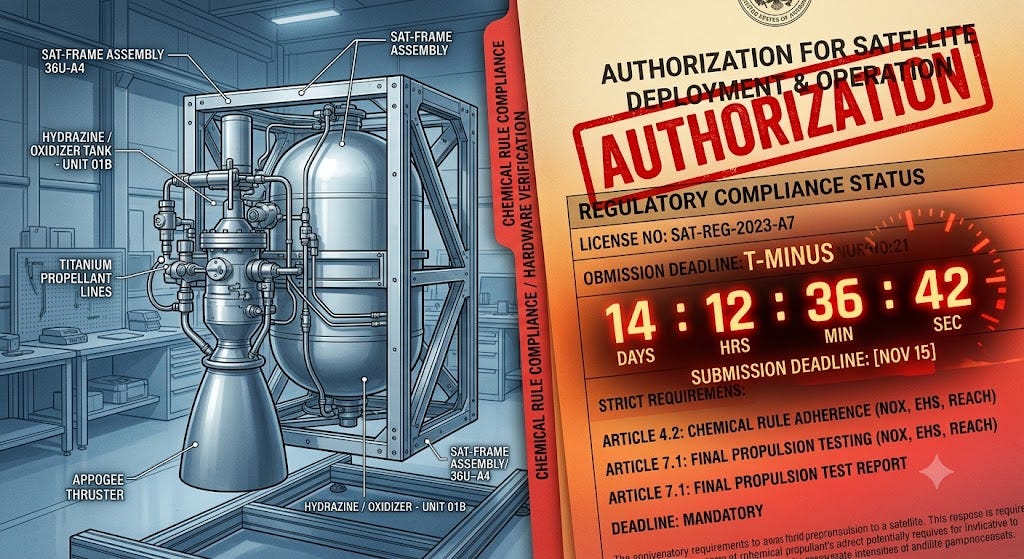
What This Means:
Hydrazine, the propellant that has powered satellite station-keeping and apogee raising for five decades, sits on the European Union (EU)’s REACH (Registration, Evaluation, Authorisation and Restriction of Chemicals) Authorisation List as a Substance of Very High Concern, and every company still using it in Europe operates under a time-limited license, not a permanent right. That license comes up for renewal on a recurring cycle set by the European Chemicals Agency (ECHA). The qualified alternatives, ammonium dinitramide (ADN) and hydroxylammonium nitrate (HAN) monopropellants, are flying on a handful of missions but have not been qualified across the thruster classes most European primes still fly. Executives and propulsion supply chain leaders with hydrazine-fueled programs in production or on the manifest should confirm their supplier’s authorization status now, not when the next renewal decision lands.
A Chemical Rule Just Became a Satellite Supply Chain Problem
Ask a propulsion engineer why hydrazine still dominates satellite station-keeping and the answer has nothing to do with performance. It is the flight heritage. Hydrazine monopropellant thrusters have flown on geostationary communications satellites, low Earth orbit constellations, and deep-space missions since the 1960s, and every qualification database, every anomaly report, and every failure mode is documented down to the catalyst bed. That heritage is exactly what makes the coming decade uncomfortable for the companies that build and fly satellites in Europe.
Hydrazine is not being banned outright. It is being managed out through a regulatory mechanism that most satellite program managers have never had to think about: chemical authorization law. The European Union classified hydrazine as carcinogenic and added it to the REACH Candidate List of Substances of Very High Concern in 2011, then moved it onto REACH’s Annex XIV Authorisation List, the list of substances that cannot be placed on the EU market or used within the EU without an explicit, time-limited authorization from the European Commission based on opinions from ECHA’s Risk Assessment Committee and Socio-Economic Analysis Committee. Companies that want to keep using hydrazine in Europe, meaning propellant producers, propulsion integrators, and satellite primes that load and handle it, have had to apply for authorization and justify continued use against the availability of safer alternatives. Authorizations of this kind are granted with a review period, not indefinitely, which means the industry does not get to solve the hydrazine question once. It has to keep re-solving it on a schedule set by chemical regulators in Brussels, not by satellite program timelines.
This is a Policy/Regulatory risk with a Supply Chain Map underneath it, and the two halves of that risk reinforce each other. The chemical regulation drives up the cost and complexity of staying on hydrazine. The requalification burden of switching to a green alternative, an inference from typical satellite-thruster qualification costs rather than a sourced figure, runs into years and tens of millions of dollars per thruster class. Programs that assumed they had a stable, low-friction propellant supply for the life of a satellite bus are finding that assumption was never true in the EU market, and the review window that determines whether it stays true again falls inside the current planning horizon for most European geostationary and constellation programs now in design.
Who Actually Touches the Hydrazine Supply Chain
Named-entity clarity matters here because “hydrazine supply risk” sounds abstract until you map who actually holds the exposure.
Propellant production. Aerospace-grade hydrazine is a narrow, specialized chemical market, not a commodity one. Olin Corporation remains the dominant U.S. producer of propellant-grade hydrazine and hydrazine derivatives for defense and space applications. In Europe, the number of chemical producers willing to manufacture and register a Substance of Very High Concern has shrunk, an inference from industry structure rather than a published producer count, as REACH compliance costs, liability exposure, and the administrative burden of periodic reauthorization make hydrazine production a shrinking, low-margin business line rather than a strategic one. That producer concentration is itself a supply chain constraint independent of any single company’s authorization status: if one of the remaining qualified producers exits the aerospace-grade hydrazine business, the remaining supply base for European programs narrows further, and it narrows in a market too small to attract a new entrant quickly.
Propellant loading and handling. ArianeGroup is the anchor company in the European hydrazine supply chain that most program managers actually interact with. It supplies apogee and station-keeping thruster hardware, manages propellant loading services for Ariane-launched payloads, and holds much of the institutional and commercial hydrazine handling infrastructure and expertise concentrated in France and Germany. Any authorization decision affecting hydrazine use in France or Germany runs directly through ArianeGroup’s compliance posture, which makes the company both the primary point of exposure and the primary point of leverage for European satellite primes trying to understand their own risk.
Satellite integration. Airbus Defence and Space, Thales Alenia Space, and OHB SE are the three primes most exposed on the integration side, because their production lines for geostationary and constellation buses have historically specified hydrazine monopropellant systems as the default architecture. A change in hydrazine availability or cost does not just affect the propellant line item on a bill of materials. It affects thruster selection, tank design, fueling infrastructure at the launch site, and the qualification testing plan for every satellite bus variant still on the drawing board.
Green alternative suppliers. The supply chain’s other half is thinner but growing. Bradford Space’s Swedish subsidiary ECAPS developed the ADN-based monopropellant LMP-103S and its associated High Performance Green Propulsion (HPGP) thruster line, which has flown on Sweden’s Prisma technology demonstration mission and, per public reporting on ECAPS’ customer base, on Planet Labs’ SkySat Earth-imaging constellation. In the United States, Aerojet Rocketdyne, now part of L3Harris Technologies following the 2023 acquisition, developed the HAN-based AF-M315E propellant, marketed under the Advanced Spacecraft Energetic Non-Toxic (ASCENT) name, which flew on the National Aeronautics and Space Administration’s (NASA) Green Propellant Infusion Mission, launched in June 2019 aboard a SpaceX Falcon Heavy on the Space Test Program-2 mission. Both propellants exist, both have flight heritage, and neither has been qualified across the full range of thruster classes and satellite bus architectures that European primes currently fly at volume.
That is the map. A narrow, aging producer base for the incumbent propellant, a small number of primes with deep operational dependence on it, and a green alternative supply chain that is real but not yet sized or qualified to absorb a fast transition.
