

Europe’s First Geostationary Sounder Satellite Is Launched
MTG-S1 will Improve Weather Forecasting on the Continent

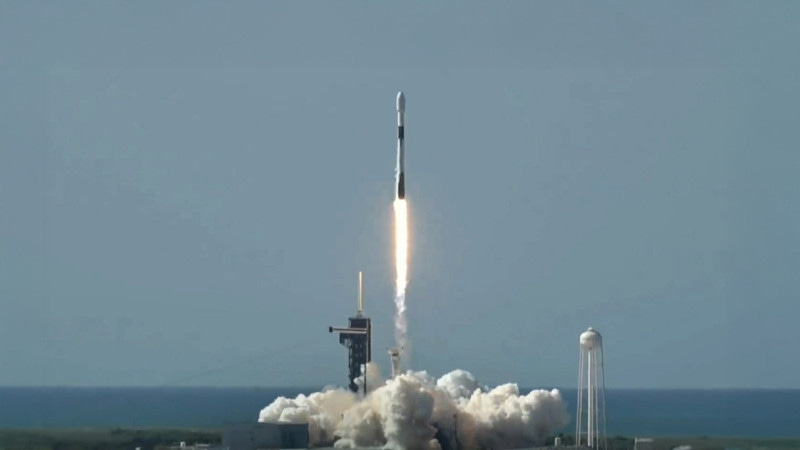
Europe has taken a major step forward in strengthening its resilience to extreme weather events with the successful launch of the Meteosat Third Generation Sounder 1 (MTG-S1) satellite by EUMETSAT. MTG-S1 will deliver new streams of atmospheric data, enabling earlier, more accurate warnings that protect lives, property and infrastructure.
“MTG-S1 will provide entirely new types of data products that will support specialists across EUMETSAT member states in detecting signs of atmospheric instability even before clouds begin to form."
Phil Evans, EUMETSAT
The satellite was launched by SpaceX from Kennedy Space Center in Florida on Tuesday. It was the ninth flight for the Falcon 9 first stage booster supporting this mission, which previously launched Crew-9, RRT-1, Firefly Blue Ghost Mission 1, Fram2, SXM-10, and three Starlink missions.
Extreme weather events like storms, flooding, and heatwaves have caused hundreds of billions of euros in damage and claimed tens of thousands of lives across Europe in the past decades. Launched on 1 July 2025, MTG-S1 will provide Europe’s national meteorological services with high-frequency data on temperature, humidity and trace gases throughout the atmosphere – enabling forecasters to detect the earliest signs of severe weather, extend the lead times of weather warnings, improve forecasting, and help protect lives and property.
“MTG-S1 will provide entirely new types of data products that will support specialists across EUMETSAT member states in detecting signs of atmospheric instability even before clouds begin to form," said Phil Evans, Director-General of EUMETSAT. "Combined with data from the MTG imaging satellites, it will, for the first time, offer a space-based view of the full lifecycle of convective storms. This will provide tremendous support to national meteorological services in carrying out their vital work, helping to save lives, reduce disruption, and strengthen resilience.
“The effects of the climate crisis are not distant threats: they are already being felt across Europe – through more frequent storms, longer heatwaves, and shifting climate patterns. MTG-S1 will support more timely warnings, safer travel decisions, more effective emergency response, and support informed action.
“My sincere thanks go to everyone who made MTG-S1 possible – our teams at EUMETSAT, our member states, the European Union, the European Space Agency, national meteorological services, and all our industrial and academic partners. This successful launch is a testament to the strength of European cooperation. We now look forward to moving to the next phases and preparing the satellite for full operations.”
MTG-S1 is the first geostationary meteorological sounder satellite to fly over Europe and carries two key missions: the Infrared Sounder and the European Union’s Copernicus Sentinel-4 Ultraviolet Visible Near-infrared spectrometer.
Applause broke out at EUMETSAT headquarters in Darmstadt, Germany, as staff, guests, and media watched a live stream of the satellite separating from its launcher and continuing its journey into orbit. Tension turned to celebration as confirmation arrived that the satellite had contacted ground control, deployed its solar panels, and was on course for geostationary orbit – some 36,000 km (≈22,370 miles) above the equator.
With power and communications established, MTG-S1 entered its Launch and Early Operations Phase, during which engineers are activating systems and guiding it to its geostationary orbital position. From this position, aligned with Earth’s rotation, MTG-S1 will maintain an uninterrupted view of Europe, Africa, and surrounding regions.
MTG-S1’s Infrared Sounder will scan nearly 2,000 thermal infrared wavelengths every 30 minutes to build vertical profiles of temperature, humidity, and trace gases. These data will be crucial for detecting fast-developing convective weather by revealing sudden shifts in instability, moisture, or wind – even before clouds begin to form.
Combined with imagery from MTG’s imager satellites, it will offer a continuous view of a storm’s full life cycle, from early instability through to lightning and dissipation. The observations made by MTG-S1 will also enhance very-short-range forecasts called nowcasts, daily forecasts, improve models linking weather, air quality, and climate, and support long-term climate monitoring.
The Copernicus Sentinel-4 mission is expected to provide hourly data on pollutants and aerosols – including from wildfires and volcanic eruptions – that will enable specialists to monitor emissions, enhance air quality forecasts, support public health and environmental policy. Copernicus is the Earth Observation component of the European Union Space Program.
“These two groundbreaking missions are set to change the way we forecast both severe weather and the quality of air over Europe," said Simonetta Cheli, Director of Earth Observation Programs at ESA. "It is thanks to the outstanding work our teams have done with EUMETSAT, the European Commission and dozens of European industry partners, that we are able to now look forward to more accurate and timely ways of predicting storm events and air pollution.”