

Europe’s Copernicus Radar Constellation Reaches Full Strength With Sentinel-1D Activation
Fourth Satellite Completes 12-Year Radar Observation Mission, Setting Stage for Sentinel-1A Retirement

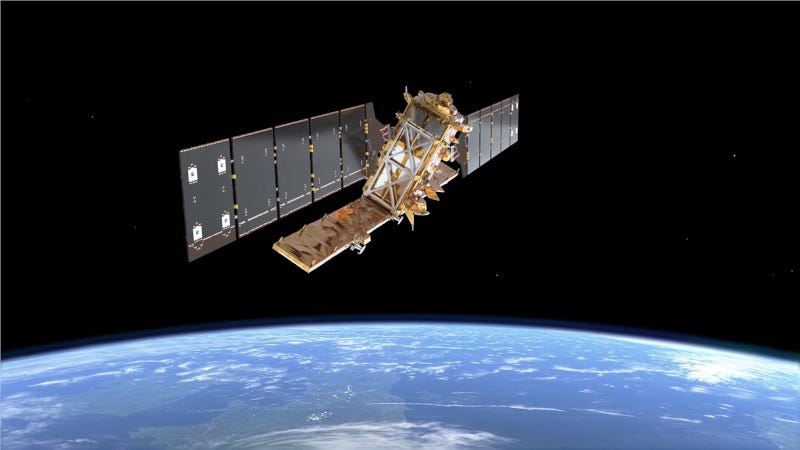
The European Space Agency’s Copernicus Sentinel-1D radar satellite declared fully operational May 1, completing the first-generation Sentinel-1 constellation and capping a 12-year journey that began with the 2014 launch of Sentinel-1A.
“Sentinel-1 began as a trailblazer. With the successful commissioning of Sentinel-1D, it now stands as a cornerstone.”
Nuno Miranda, ESA
The four-satellite constellation delivers high-resolution synthetic aperture radar (SAR) imagery of Earth’s surface around the clock, regardless of weather or lighting conditions. The mission has become an essential tool for tracking natural disasters, sea ice, land deformation, deforestation, and other environmental indicators relied upon by scientists, government policymakers, and emergency responders worldwide.
Sentinel-1D launched Nov. 4, 2025, aboard an Ariane 6 rocket from Europe’s spaceport in French Guiana. The vehicle placed the satellite into its planned orbit within 34 minutes of liftoff, with an injection accuracy of approximately 660 feet — a remarkable precision for a rocket traveling at roughly 18,600 miles per hour. After a roughly six-month in-orbit commissioning phase, ESA formally declared the satellite operational.
“Sentinel-1 began as a trailblazer,” said Nuno Miranda, ESA’s Sentinel-1 Mission Manager. “With the successful commissioning of Sentinel-1D, it now stands as a cornerstone — reflecting Europe’s achievements while serving as a launchpad for what comes next.”
The first-generation constellation was originally designed as a pair of satellites flying 180 degrees apart to optimize Earth coverage. Sentinel-1A launched in 2014, followed by Sentinel-1B in 2016. That pairing came to an abrupt end in August 2022 when Sentinel-1B suffered a technical anomaly that left it unable to acquire data. ESA responded by launching Sentinel-1C in 2024 and Sentinel-1D the following year to fully restore and extend the mission.
With Sentinel-1D now operational, the constellation will temporarily run three active satellites — Sentinel-1A, 1C, and 1D — through the end of June 2026. During this overlap period, open-access Sentinel-1D data, available through the Copernicus Data Space Ecosystem since April 17, is being integrated into operational pipelines. Sentinel-1D is currently flying along the Sentinel-1C ground track with a one-day offset, enabling users to validate data continuity and build denser time series for research and monitoring applications.
In the second half of June, ESA will reposition Sentinel-1C into a new orbital slot to establish the long-term six-day revisit cycle alongside Sentinel-1D. Sentinel-1A operations are expected to wind down by early July 2026, at which point the two newest units will form the operational backbone of the constellation. Priority areas — including Europe, tectonically active regions, and polar ice sheets — will receive observations as frequently as daily, while most global landmasses will be covered on a 12-day cycle.
The mission’s data record is on track to reach two uninterrupted decades of continuous radar observations, providing an unmatched long-term dataset for climate research and environmental monitoring. The Copernicus program, launched in earnest with Sentinel-1A in 2014, is now regarded as the world’s most comprehensive civilian Earth observation system, with Sentinel-1 data freely and openly available globally.
Sentinel-1C and Sentinel-1D carry a new debris-avoidance separation mechanism described by ESA as a world premiere, reinforcing the agency’s and European Commission’s commitment to sustainable space operations.
Miranda noted that ESA and the European Commission are already looking beyond the current generation. “For several years, we have been advancing a follow-on mission: Sentinel-1 Next Generation, designed to ensure continuity of measurements well into the mid-2030s and beyond. These future satellites are expected to deliver enhanced performance and new capabilities, building on the legacy of their predecessors while addressing emerging scientific and societal needs.”