


WHAT THIS MEANS
SatVu’s February 2026 £30M funding round — bringing total equity to £60M — is not simply a constellation financing event. The cap table composition (NATO Innovation Fund, British Business Bank, Space Frontiers Fund II, and Presto Tech Horizons) signals that high-resolution thermal Earth observation has crossed into dual-mandate infrastructure territory: simultaneously serving sovereign defense intelligence and ESG-driven corporate climate risk disclosure. For investors, this convergence creates a structural demand floor not available in single-application EO plays. For supply chain professionals, it surfaces a critical SSTL payload dependency that deserves independent verification before HotSat-2 and HotSat-3 launch timelines are embedded in procurement plans.
──────────────────────────────────────────────────────
When the NATO Innovation Fund writes a check to an Earth observation startup, you do not need to squint to read the signal. When the British Business Bank joins the same cap table, alongside a climate-tech venture fund and a specialist space investor, you are looking at something more interesting than a funding announcement. You are looking at the emergence of a new asset class.
In February 2026, UK-based thermal intelligence company SatVu closed a £30 million funding round, bringing its total equity raised to £60 million. The investors were not random. The NATO Innovation Fund brought sovereign defense alignment. The British Business Bank brought UK economic development mandate. Space Frontiers Fund II, managed by SPARX Asset Management, brought deep sector specialization. And Presto Tech Horizons brought the ESG climate-tech thesis that has been hunting for durable space-enabled plays. Existing shareholders — including Molten Ventures (lead), Adara Ventures, Lockheed Martin, and Seraphim Space Fund — also participated.
Four different investors. Four different investment mandates. One thermal imaging constellation. That is the story worth telling.
The Sensor That Works for Everyone
Before unpacking why the money matters, it helps to understand what the money is actually buying.
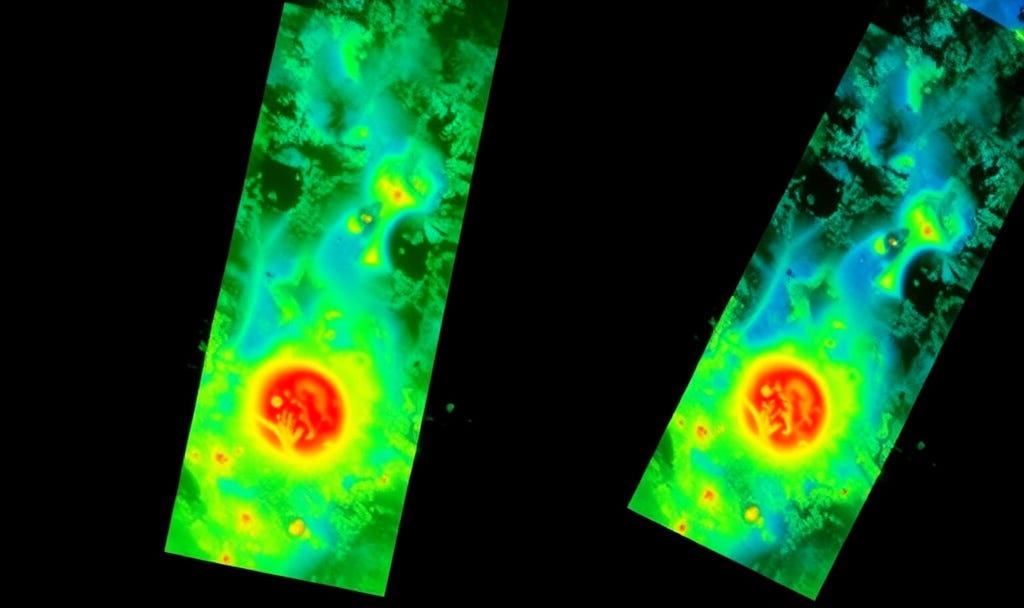
SatVu’s HotSat satellites capture high-resolution thermal infrared imagery from low Earth orbit — day and night, in all weather conditions. The resolution sits at approximately 3.5 meters, meaning the satellites can detect heat signatures at a level of granularity that reveals not just whether a building is operational, but how intensively it is operating. That specificity is what makes thermal EO genuinely dual-use, in a way that most ‘dual-use’ claims in the space industry are not.
For a defense intelligence analyst, that specificity means monitoring whether military vehicles are inside a facility or deployed, whether an industrial plant is running at full capacity, or whether activity around a sensitive installation has changed overnight. HotSat-1 data has already been used, as reported, in the investigation of operational timelines at North Korea’s Yongbyon Nuclear Scientific Research Center. That is not a marketing use case. That is exactly the kind of sovereign, persistent intelligence capability that NATO member states have historically been unable to acquire from commercial providers.
For a corporate sustainability officer, the same sensor resolves a different problem entirely. Building energy audits traditionally require physical access, self-reported data, or coarse satellite proxies. A 3.5m thermal image of a commercial or industrial facility, captured repeatedly over time, can independently verify whether a company’s reported emissions reduction is real, whether an industrial site is genuinely running cleaner, and where urban heat islands are intensifying in ways that city planners have not yet mapped. SatVu CEO Anthony Baker frames the mission explicitly around both poles: ‘climate technology’ in one sentence, ‘national security’ in the next. This is not a company hedging. It is a company that has correctly identified a structural convergence.
